Behavioral Neuroscience Overview

ix
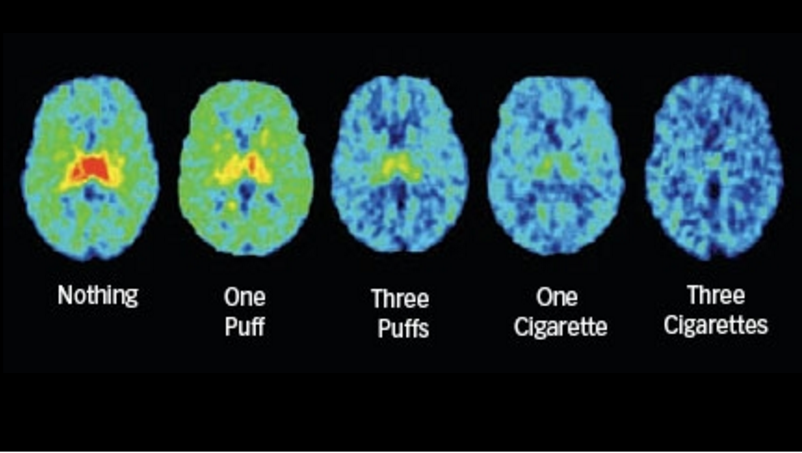
Smoking Saturates Receptors: As nicotine from a cigarette attaches to the α4β2*-nACh nicotinic receptors in the brain, it displaces a radiolabeled tracer (red and yellow indicate high levels of the tracer, green indicates intermediate levels, and blue indicates low levels). The nicotine from three puffs displaced 75 percent of the tracer from study participants' receptors, and the nicotine from three cigarettes, nearly all. Source: NIDA

Summary

Behavioral neuroscience is the application of the principles of biology (in particular neurobiology), to the study of physiological, genetic, and developmental mechanisms of behavior in humans and non-human animals.

It typically investigates at the level of neurons, neurotransmitters, brain circuitry and the basic biological processes that underlie normal and abnormal behavior. Often, experiments in behavioral neuroscience involve non-human animal models (such as rats and mice, and non-human primates) which have implications for better understanding of human pathology.

OnAir Post: Behavioral Neuroscience Overview

Discuss

OnAir membership is required. The lead Moderator for the discussions is Scott Joy. We encourage civil, honest, and safe discourse. For more information on commenting and giving feedback, see our Comment Guidelines.

    Skip to toolbar