Gray Matter Research

Principal Investigator: Baldwin Goodell

Gray Matter Research focuses on Microdrive Systems and Recording Chamber Systems. For the BRAIN Initiative, Goodell and his colleagues aim to develop optrodes, which are implantable columns of lights and wires for simultaneous electrical recording of neurons and delivery of light flashes to multiple brain areas.


Web Information

Website:  graymatter-research.com/ Brain Initiative Grant – “Large-Scale Electrophysiological Recording and Optogenetic Control System”

Contact Information

Emailbaldwin@graymatter-research.com Phone: (406) 672-1915 Address: Gray Matter Research 920 Technology Blvd. Suite 106 Bozeman, MT 59718


OnAir Post: Gray Matter Research
Albert Baldwin Goodell – Gray Matter Research


Principal Investigator: Gray Matter Research

Goodell and his company Gray Matter Research focuses on Microdrive Systems and Recording Chamber Systems. For the BRAIN Initiative, Goodell and his colleagues aim to develop optrodes, which are implantable columns of lights and wires for simultaneous electrical recording of neurons and delivery of light flashes to multiple brain areas.

Web Information

Brain Initiative Grant

Contact Information

Emailbaldwin@graymatter-research.com Phone: (406) 672-1915 Address: Gray Matter Research 920 Technology Blvd. Suite 106 Bozeman, MT 59718

OnAir Post: Albert Baldwin Goodell – Gray Matter Research

Electrophysiological Recording and Control

Principal Investigator: Baldwin Goodell Graymatter Research Title: “Large-Scale Electrophysiological Recording and Optogenetic Control System” BRAIN Category: Large-Scale Recording-Modulation – Optimization (RFA NS-14-008)

Dr. Goodell and his colleagues aim to develop optrodes, which are implantable columns of lights and wires for simultaneous electrical recording of neurons and delivery of light flashes to multiple brain areas.

NIH Webpages

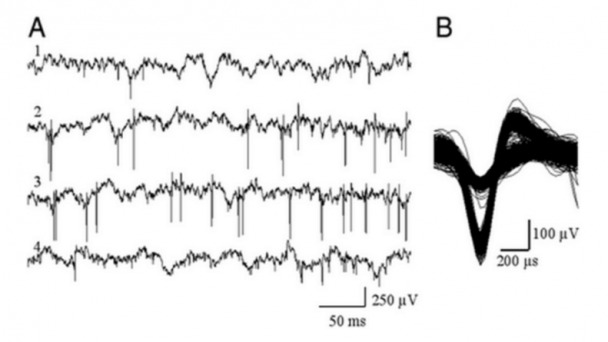
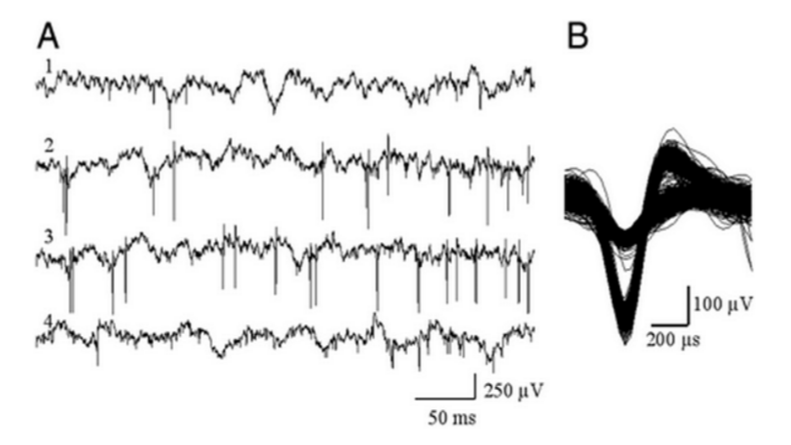
Example data collected from 4 electrodes during a single recording session. A: short epoch of raw data sampled from 4 electrodes in area 7a of the posterior parietal cortex of an alert monkey. The signals are broadband (1 Hz to 10 kHz). Extracellular action potentials are visible as negative going spikes in the signals. B: plot of 1,000 superimposed waveforms extracted from the high-pass filtered signal on channel 3. The high-amplitude waveforms reveal a single unit that is well separated from the lower amplitude multiunit activity.

Project Description

In order to gain a greater understanding of the neural mechanisms that mediate human cognitive function new approaches and technologies are needed to dramatically expand the ability to record and manipulate the activity of large numbers of neurons throughout widespread areas of the primate brain. Over the past 5-10 years, our groups have made two major ...

OnAir Post: Electrophysiological Recording and Control

Skip to toolbar