DARPA and the BRAIN Initiative

The Defense Advanced Research Projects Agency (DARPA) mission is to create breakthrough technologies for US national security and to protect the health of U.S. service members and veterans.

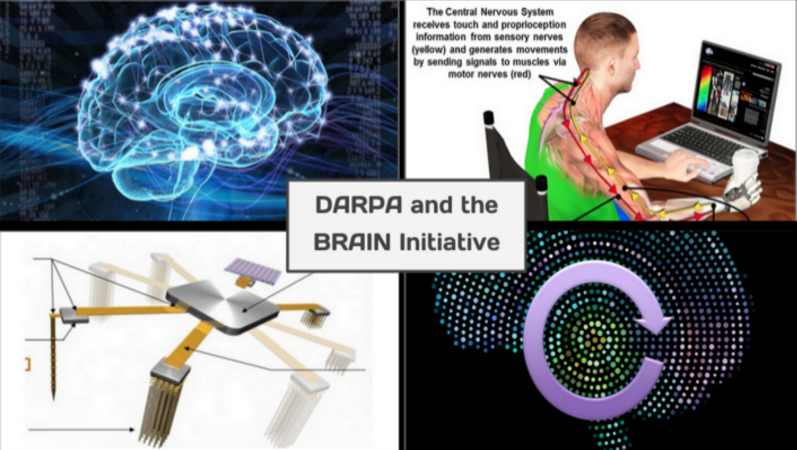
To better address the health needs of service members and veterans, DARPA has launched four programs that support the goals of the BRAIN Initiative: RAM (Restoring Active Memory), RAM Replay, HAPTIX (Hand Proprioception and Touch Interfaces), and SUBNETS (Systems-Based Neurotechnology for Emerging Therapies).

Clockwise from top left: RAM, HAPTIX, RAM Replay, and SUBNETS. Images from DARPA articles.

DARPA and the BRAIN Initiative

DARPA is supporting four current programs and is planning new investments in support of the BRAIN Initiative, with the ultimate goal of relieving and rehabilitating warfighters and civilians suffering from traumatic injury and neuro-psychiatric illness: The Defense Advanced Research Projects Agency (DARPA) has launched a number of major efforts to develop breakthrough neurotechnologies that are deepening scientists’ understanding of brain function and are supporting the development of novel therapeutic strategies. As part of this effort, DARPA is developing and assessing revolutionary electronic interfaces to the brain, as well as to the peripheral nervous system, that have the potential to provide high-resolution insights into neural circuits, lower the need for ...

OnAir Post: DARPA and the BRAIN Initiative

RAM Replay, a DARPA program

The RAM (Restoring Active Memory) Replay DARPA research program aims to investigate the role of neural “replay” in the formation and recall of memory. The goal is to help individuals better remember specific episodic events and learned skills. The military application is to improve rehabilitation and recovery for injured warfighters challenged by impaired memory.

The program is designed to develop “novel, rigorous computational methods to help investigators determine which brain components matter in memory formation and recall, and how much they matter.”

DARPA Article

DARPA Aims to Accelerate Memory Function for Skill Learning

Research may accelerate rehabilitation post trauma or memory impairment, enable warfighter training

OUTREACH@DARPA.MIL 4/27/2015

A new DARPA program aims to investigate the role of neural “replay” in the formation and recall of memory, with the goal of helping individuals better remember specific episodic events and learned skills. The 24-month fundamental research program, Restoring Active Memory Replay or RAM Replay, is designed to develop novel and rigorous computational methods to help investigators determine not only which brain components matter in memory formation and recall but also how much they matter. To ensure real-world relevance, those assessments will be validated through performance on DoD-relevant tasks instead of conventional computer-based behavioral paradigms commonly used ...

OnAir Post: RAM Replay, a DARPA program

HAPTIX, a DARPA program

Despite recent advances in technology for upper-limb prostheses, artificial arms and hands are still unable to provide users with sensory feedback. DARPA has awarded prime contracts for Phase 1 of its Hand Proprioception and Touch Interfaces (HAPTIX) program.

HAPTIX seeks to create a prosthetic hand system that moves and provides sensation like a natural hand. Sensory feedback, especially from the hand, is vitally important for many functions, and HAPTIX seeks to create a sensory experience so rich and vibrant that users would want to wear their prostheses full time.


Video

HAPTIX Virtual Limb Simulator Technologies

Published Feb. 9. 2015 by DARPAtv

DARPA’s Hand Proprioception and Touch Interfaces (HAPTIX) program seeks to develop advanced neural interfaces that would enable prosthetic hand systems to move and provide sensation like natural hands. To help the performers more quickly and cost-effectively conduct their research, DARPA is providing prosthetics simulation software for testing designs.

https://www.youtube.com/watch?v=VXCpVz-EAnEVideo can’t be loaded because JavaScript is disabled: HAPTIX Virtual Limb Simulator Technologies (https://www.youtube.com/watch?v=VXCpVz-EAnE)

DARPA Articles

HAPTIX Starts Work to Provide Prosthetic Hands ...

OnAir Post: HAPTIX, a DARPA program

RAM, DARPA program

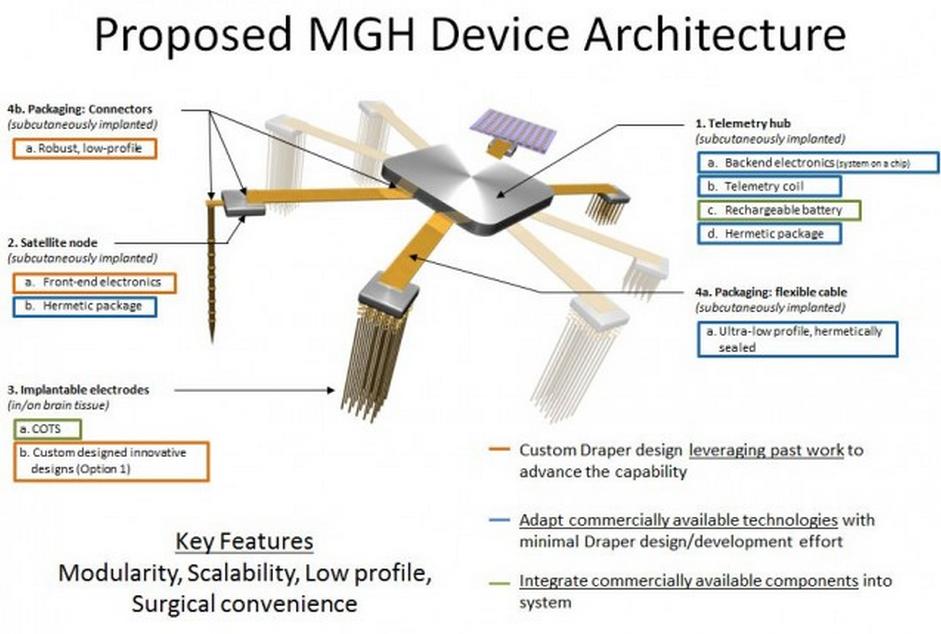
Through the Restoring Active Memory (RAM) program, DARPA seeks to accelerate the development of technology able to address this public health challenge and help servicemembers and others overcome memory deficits by developing new neuroprosthetics to bridge gaps in the injured brain.

The end goal of RAM is to develop and test a wireless, fully implantable neural-interface medical device for human clinical use, but a number of significant advances will be targeted on the way to achieving that goal.”

Video

DARPA Developing Device to Restore Memory

Published July 15, 2014 by DoD News

DARPA’s Restoring Active Memory (RAM) program seeks to accelerate the pace of neuro-technology and restore lost memories.

https://www.youtube.com/watch?v=b7mMvzE-O3c

DOD/DARPA Articles

DARPA’s Memory Restoration Program

by JTozer July 15, 2014

We all forget things from time to time. 

The grocery list.  Our wallets.  Phone numbers.  That guy at the party who clearly remembers you but you can’t for the life of you remember his name. Forgetting things seems like it’s almost part of the human experience.  For the most part, these are easily corrected mistakes.  You go get the list, find your wallet, charge your phone, smile politely, and move on.

But for people with traumatic brain injuries ...

OnAir Post: RAM, DARPA program

SUBNETS, a DARPA Program

The Systems-Based Neurotechnology for Emerging Therapies (SUBNETS) was created in response to a pressing need. Despite the continued best efforts of the Departments of Defense and Veterans Affairs to protect the health of U.S. servicemembers and veterans, the effects of neuropsychological illness brought on by war, traumatic injuries, and other experiences remain challenging to treat.

The SUBNETS vision is distinct from current therapeutic approaches in that it seeks to create an implanted, closed-loop diagnostic and therapeutic system for treating, and possibly even curing, neuropsychological illness.

DARPA Articles

Systems-Based Neurotechnology for Emerging Therapies (SUBNETS)

by Dr. Justin Sanchez (BRAIN 2015 profile)

The Systems-Based Neurotechnology for Emerging Therapies (SUBNETS) program was created in response to a pressing need. Despite the continued best efforts of the Departments of Defense and Veterans Affairs to protect the health of U.S. servicemembers and veterans, the effects of neuropsychological illness brought on by war, traumatic injuries, and other experiences remain challenging to treat. Current approaches—surgery, medications, and psychotherapy—can often help to alleviate the worst effects of illnesses such as major depression and post-traumatic stress, but they are imprecise and not universally effective. Through SUBNETS, ...

OnAir Post: SUBNETS, a DARPA Program

Justin Sanchez, PhD – DARPA


DARPA program manager exploring neurotechnology, brain science and systems neurobiology, formerly Director of the Neuroprosthetics Research Group at Miami Ex Officio Member of Multi-Council Working Group 

Dr. Sanchez has developed new methods for signal analysis and processing techniques for studying the unknown aspects of neural coding and functional neurophysiology. His experience covers in vivo electrophysiology for brain-machine interface design in animals and humans.

Web Information

DARPA Webpage:  darpa.mil/staff/dr-justin-sanchez

Neuroprosthetics Research Group Webpage: bme.miami.edu/nrg/faculty/faculty_list

Webpage:

Contact Information

Email:

Phone: 703.526.6630 (main number)

Address: 675 North Randolph Street Arlington, VA 22203-2114

Biosketch

Dr. Justin Sanchez joined DARPA as a program manager in 2013 to explore neurotechnology, brain science and systems neurobiology.

Before coming to DARPA, Dr. Sanchez was an Associate Professor of Biomedical Engineering and Neuroscience at the University of Miami, and a faculty member of the Miami Project to Cure Paralysis. He directed the Neuroprosthetics Research Group, where he oversaw development of neural-interface medical treatments and neurotechnology for treating paralysis and stroke, and for deep brain stimulation for movement disorders, Tourette’s syndrome and Obsessive-Compulsive Disorder.

Dr. Sanchez has developed new methods for signal analysis and processing techniques for studying the unknown aspects of neural coding and functional neurophysiology. His experience covers in vivo electrophysiology for brain-machine interface design in animals and humans where he studied the activity ...

OnAir Post: Justin Sanchez, PhD – DARPA

Geoffrey Ling, MD, PhD – DARPA


Director, Biological Technologies Office, DARPA Ex Officio member of the Advisory Committee to the NIH Director

Dr Ling’s Revolutionizing Prosthetics program developed advanced arm prostheses controlled either non-invasively or directly by a user’s brain. His Preventing Violent Explosive Neuro Trauma program developed new understanding and treatment of blast-induced traumatic brain injury (TBI). He has spent his career providing critical care to patients suffering from neurological trauma (TBI).

Web Information

DARPA Webpage: darpa.mil/staff/dr-geoffrey-ling

LinkedIn page:  Linkedin.com/pub/geoffrey-ling/3/42/645

Wikipedia Entry: wikipedia.org/wiki/Geoffrey_Ling

Contact Information

Email:    contact.darpa.mil/contact?people=/staff/dr-geoffrey-ling

Phone: (703) 526-6630 (main number)

Address: Defense Advanced Research Projects Agency 675 North Randolph Street Arlington, VA 22203-2114

Biosketch

From DARPA page

Dr. Geoffrey Ling is the founding director of the Biological Technologies Office. He began his DARPA service in 2004 as a Program Manager in the Defense Sciences Office (DSO). He created and managed a broad research portfolio, spanning neuroscience, infectious disease, pharmacology, and battlefield medicine. His Revolutionizing Prosthetics program developed advanced arm prostheses controlled either non-invasively or directly by a user’s brain. His Preventing Violent Explosive Neuro Trauma program developed new understanding and treatment of blast-induced traumatic brain injury (TBI). He was the 2009 DARPA Program Manager of the Year and served as the DSO Deputy Director from 2013-2014.

Dr. Ling has spent his career providing critical care to ...

OnAir Post: Geoffrey Ling, MD, PhD – DARPA

James Giordano, PhD – Georgetown


Chief of the Neuroethics Studies Program in the Pellegrino Center for Clinical Bioethics Professor, Department of Neurology, and Department of  Biochemistry Senior Science Advisory Fellow, DOD

Dr. Giordano’s ongoing research focuses upon the use of advanced neurotechnologies to explore the neurobiology of pain and other neuropsychiatric spectrum disorders; the neuroscience of moral decision-making, and the neuroethical issues arising from the use of neuroscience and neurotechnology in research, clinical medicine, public life, international relations and policy, and national security and defense.

Web Information

Georgetown web page: explore.georgetown.edu/people/jg353/

Center for Clinical Bioethicsclinicalbioethics.georgetown.edu/about

CCNELSI websiteccnelsi.com/index.html

Neuroethics Studies Program web page: clinicalbioethics.georgetown.edu/neuroethicsprogram 

Neuroethics Studies Program (BRAIN 2015 profile): brain2015.onair.cc/neuroethics-studies-program

Neurobioethics.org website: neurobioethics.org/

NeuroBioEthics Blog: neurobioethics.wordpress.com/

Twitter handle: twitter.com/NeuroBioEthics?lang=en

Amazon author’s pageamazon.com/James-Giordano/

Journal of Philosophy, Ethics and Humanities in Medicine website: peh-med.com/

Contact Information

Email: james.giordano@georgetown.edu

Phone: 202-687-1160

Biosketch

Dr. James Giordano is Chief of the Neuroethics Studies Program in the Pellegrino Center for Clinical Bioethics, and Professor in the Department of Neurology and Department of Biochemistry, and Co-director of the O’Neill-Pellegrino Program in Brain Science and Global Health Law and Policy at Georgetown University Medical Center, Washington, DC, USA. He is Clark Faculty Fellow of Neurosciences and Ethics at the Human Science Center of Ludwig Maximilians Universität, Munich, Germany, where he previously ...

OnAir Post: James Giordano, PhD – Georgetown

Skip to toolbar