Noah Hochberg

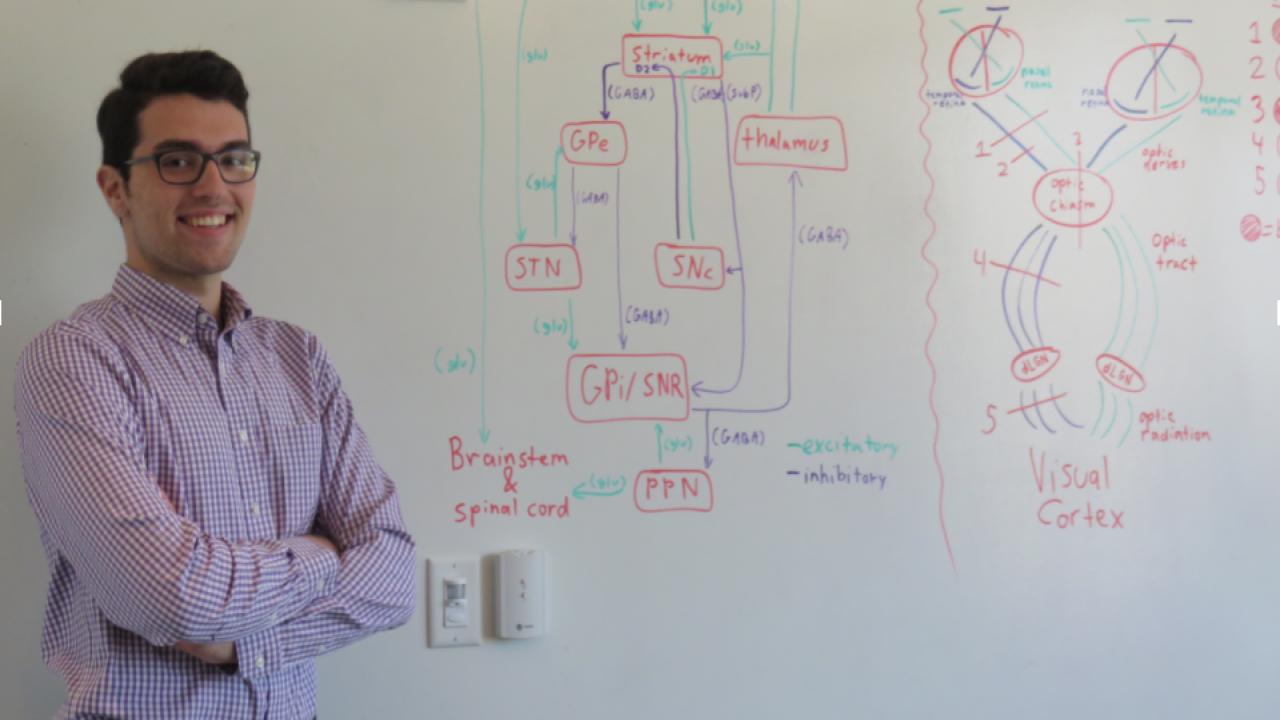
I am an undergraduate student majoring in neuroscience.  I discovered neuroscience in a freshman psychology course, and after completing a course entitled brain and behavior during sophomore year, I declared my major.  Currently, my interests in neuroscience include the eye and the ocular system, addiction and the opioid epidemic, neural recording and mapping, neuroanatomy and physiology, psychopharmacology, pain, movement, neurodegenerative disorders, mental health, etc.  The more I delve into my major, the more I will narrow down my interests.  I am working towards a position in graduate school after Lawrence to obtain either a masters or doctorate in neuroscience.

OnAir Post: Noah Hochberg

Wassim Omais

Research Interests:
My primary research interests are algorithms and data structures. I’m particularly interested in algorithms that employ some degree of randomization (Such as treaps and skip lists). Other topics of interest include machine learning and computer vision algorithms as well.

OnAir Post: Wassim Omais

Saarthak Sethi

Research Interests:
My primary research interest is computer science. I am passionate about software development, robotics, artificial intelligence, machine learning, computer vision, and graphic design.

OnAir Post: Saarthak Sethi

Suchet Taori

Research Interests:
My primary research interest lies in the field of molecular biology; more specifically. Neuroscience. I see myself as an M.D. P.h.D. conducting research on various and pertinent neurodegenerative diseases. I also have a keen passion for business and the stock market; especially in creating algorithms to help predict stock market changes.

OnAir Post: Suchet Taori

William R. Kochen

Summary

Second year Cognitive Behavioral Neuroscience graduate student President, Cure Mental Illness Club at GMU

Bill Kochen research is focused on the role of metals in Tauopathies and Traumatic Brain Injuries.

Information

Webpage:  psychology.gmu.edu/people/wkochen   CMI Club

Email: wkochen@gmu.edu Phone: Office Hours: By appointment Address: David King Hall 2024 Fairfax, Va. 22030

About

Bill Kochen is a second year Cognitive Behavioral Neuroscience graduate student in Dr. Flinn’s lab researching the role of biometals in neurological disorders. Bills undergraduate research was in comparative neuroanatomy in the lab of Dr. Alice Powers at Stony Brook University. Since coming to mason, his research has moved from neuroanatomy to the role of biometals in tauopathies (a protein dysfunction implicated in Alzheimer’s Disease, Picks Disease and Parkinsons Disease). A study finishing this summer looks at the role of elevated zinc in the drinking water of mice expressing human tau dysfunction in their brain and the effects of this Zinc on the behavior and pathology of these mice.

The Flinn Lab recently received a Controlled Cortical Impact device and research is expected to start this summer looking at the role of social behavior in the process of recovery from Traumatic Brain Injuries. Other projects starting this summer involve Zinc supplementation in wild type mice and future research will examine the role of zinc supplementation/chelation ...

OnAir Post: William R. Kochen

Daniel McHail

Information

LinkedIn page  Research Gate page   PBNJ Lab

Email: dmchail@gmu.edu


OnAir Post: Daniel McHail

Katelyn Boggs

Summary

Doctoral student, GMU Cognitive and Behavioral Neuroscience

My research interests include the role of trace metals in Alzheimer’s disease pathology, specifically the homeostasis of dietary copper and zinc levels. Currently, Katelyn is investigating the role of copper/zinc homeostasis on biomarkers of neuroinflammation and circadian rhythms in a mouse model of Alzheimer’s disease working with Dr. Jane Flinn.


Information

Mason webpage   LinkedIn   ResearchGate

Email:  Address: George Mason University Psychology Department 4400 University Blvd Fairfax, VA 22030


Biosketch

Education

She received her B.S. degree from George Mason University in Spring 2012 and began her graduate career at GMU in Fall 2012.

Work Experience

Graduate Student Instructor George Mason University September 2012 – Present (3 years 9 months)

Research Assistant Krasnow Institute of Higher Education February 2011 – Present (5 years 4 months)

Medical Receptionist Internal Medicine and Allergy Associates June 2011 – July 2014 (3 years 2 months)


Research

Research Interests in role of metals in Alzheimer’s disease pathology, biomarkers of neuroinflammation in Alzheimer’s disease, and circadian rhythm disturbance in Alzheimer’s disease.

Posters

Nesting E4/WT Study

Introduction

Nest building by mice is an innate behavior that provides the animal with shelter and temperature regulation. Because nest building is instinctive for mice, it is often used to assess animal welfare. The ability of mice to build nests is influenced by several factors including temperature ...

OnAir Post: Katelyn Boggs

Caroline Neely

Summary

Fourth year Cognitive Behavioral Neuroscience graduate student President, Students in Neuroscience

Caroline Neely research focuses on cognition and human behavior in Dr. Jane Flinn’s Alzheimer’s disease and learning impairment laboratory.


Information

Webpage:  psychology.gmu.edu/people/cneely3   LinkedIn page

Email: cneely3@gmu.edu Phone:  703.993.5455 Office Hours: Mondays 10:30 – 11:30 AM; appointment preferred Address:  David King Hall 2024 Fairfax, Va. 22030


About

Since joining the Mason community, Caroline has worked in the field of animal behavior in order to understand the biological and cellular underpinnings of maladaptive associative learning. Currently, her work focuses on fear conditioning and extinction, two forms of associative learning that can be impaired in both post-traumatic stress disorder (PTSD) and Alzheimer’s disease (AD).

Caroline serves as a mentor for undergraduate students enrolled in NEUR 395/405. As a former adjunct faculty member of GMU’s Department of Criminology, Law, and Society, she conducted NIDA-sponsored research that assessed the relationship among crime, commercial/residential density, and community health in Baltimore, MD. Caroline also served as an affiliate of the Wake Forest University School of Medicine Department of Public Health Sciences.

Education

BA Psychology, Neuroscience, Spanish – Wake Forest University, Winston-Salem, NC, 2013

MA Psychology/Cognitive Behavioral Neuroscience – George Mason University, Fairfax, VA, 2015


Current Research

Traumatic brain injury; fear conditioning and extinction; NMDAR subunit expression; animal models of PTSD; hippocampus, basolateral amygdaloid complex, ...
OnAir Post: Caroline Neely

Maggie Greer


Summary

Student, Neuroethics concentration, George Mason University Master of Arts in Interdisciplinary Studies

My goal upon entering the Neuroethics MAIS program is to acquire essential knowledge and practical experience so that I can effectively contribute to the collective discussion aiming to accurately predict, discern, and employ ethical policies ensuring responsible scientific practice and healthcare for the betterment of society as whole.


Biosketch

Ms Greer recently completed my B.S. in Neuroscience and currently work at the Krasnow Institute for Advanced Studies through the OSCAR Students as Scholars Program.  I do experiments  utilizing techniques in molecular neurobiology, electrophysiology, and molecular cloning;  I also perform data analysis for several projects in the Physiological and Behavioral Neuroscience in Juveniles (PBNJ) Lab with Dr. Ted Dumas.  My undergraduate experience at Mason has enlightened me to many fascinating developments in cutting-edge neuroscience research and their implications for society.  My goal upon entering the Neuroethics MAIS program is to acquire essential knowledge and practical experience so that I can effectively contribute to the collective discussion aiming to accurately predict, discern, and employ ethical policies ensuring responsible scientific practice and healthcare for the betterment of society as whole.  I realize the importance of integrating ethics into neuroscience research at all phases of the scientific process, implementing ...

OnAir Post: Maggie Greer

Sumit Nanda

Sumit Nanda research focuses on modelling and simulation of dendritic morphology.

OnAir Post: Sumit Nanda

Katie Yang, PhD candidate, Wisconsin


Katie Yang, a doctoral candidate in neuroscience at the University of Wisconsin School of Medicine and Public Health, is a recipient of the prestigious Gilliam Fellowship for Advanced Study from the Howard Hughes Medical Institute (HHMI).

Katie’s research focus is on the peripheral mechanisms of vocal and swallowing deficits in a rat model of Parkinson Disease. Katie is a member of the lab of Dr. Michelle Ciucci, assistant professor of surgery, and is one of two UW-Madison graduate students to earn the fellowship.

Web Information

Wisconsin webpagentp.neuroscience.wisc.edu/ricks.htm

Contact Information

Email: kricks@wisc.edu and katie@onair.cc


OnAir Post: Katie Yang, PhD candidate, Wisconsin

Skip to toolbar