John Maunsell, PhD – Chicago


Professor, Department of Neurobiology Director, Grossman Institute for Neuroscience, Quantitative Biology and Human Behavior

Maunsell’s research is aimed at understanding how neuronal signals in visual cerebral cortex generate perceptions and guide behavior. Our approach is to record from individual neurons in trained, behaving monkeys and mice while they perform visual tasks. Another line of research has been exploring the more general question of how the activity of given neurons contributes to specific visual behaviors.

Web Information

Webpage: neurobiology.uchicago.edu/page/john-maunsell Neuroscience at University of Chicago  BRAIN Initiative Grant – “The role of patterned activity in neuronal codes for behavior”

Contact Information

Emailmaunsell@uchicago.edu Phone: (773) 702-3203 Address: The University of Chicago 5812 S Ellis Street, MC0912 Chicago, IL 60637


Biography

Since 2007, Maunsell has served as editor-in-chief of The Journal of Neuroscience, one of the top peer-reviewed journals in its field and primary publication of the Society for Neuroscience, the largest neuroscientist organization in the world. Maunsell brings to the University of Chicago an intimate knowledge of the people, projects and landscape of the international neuroscience research community.

Maunsell’s honors include election to the American Association for the Advancement of Science, American Academy of Arts and Sciences and appointment as a Howard Hughes Medical Institute investigator. Previous to Harvard, he served on the faculty of the ...

OnAir Post: John Maunsell, PhD – Chicago

Neuroscience at University of Chicago

Some of the more significant neuroscience research centers include: the Center of Cognitive & Social Neuroscience; Center for Integrative Neuroscience and Neuroengineering; Brain Research Imaging Center; Center for Integrative Neuroscience and Neuroengineering; Center for Peripheral Neuropathy;  and the Grossman Institute for Neuroscience, Quantitative Biology and Human Behavior.

OnAir Post: Neuroscience at University of Chicago

How zebrafish advance brain research

https://www.youtube.com/watch?v=662nJsV7GSIVideo can’t be loaded because JavaScript is disabled: How are zebrafish advancing brain research? (https://www.youtube.com/watch?v=662nJsV7GSI)

Zebrafish brain research is helping to give scientists like Melina Hale a better understanding of how neural circuits and neurons are used in different behaviors.

NSF BRAIN Initiative Published APRIL 2, 2014

OnAir Post: How zebrafish advance brain research

The octopus’ nervous system

https://www.youtube.com/watch?v=kVElsNKR09sVideo can’t be loaded because JavaScript is disabled: Why the octopus’ nervous system makes it such a successful predator? (https://www.youtube.com/watch?v=kVElsNKR09s)

Why the octopus’ nervous system makes it such a successful predator?

The nervous system of an octopus is a complex system, involving the invertebrate’s eyes, brain and tentacles. Researcher Clifton Ragsdale is currently pioneering the use of modern molecular techniques to study how the octopus’s unique nervous system processes visual information, and if its processing system significantly differs from those of vertebrates.

NSF BRAIN Initiative Published APRIL 2, 2014

OnAir Post: The octopus’ nervous system

Evolving Brain: Mysteries of the Brain

https://www.youtube.com/watch?v=BUzeEpcO238

Using amazing new technologies, evolutionary neuroscientist Melina Hale and her graduate students at the University of Chicago are discovering that the basic movements of one tiny fish can teach us big ideas about how the brain’s circuitry works.

“Mysteries of the Brain” is produced by NBC Learn in partnership with the NSF.


NSF BRAIN Initiative Published June 10, 2015

OnAir Post: Evolving Brain: Mysteries of the Brain

Grossman Institute – Chicago

Principal Investigator: John Maunsell Neuroscience at University of Chicago

Grossman Institute for Neuroscience, Quantitative Biology and Human Behavior is a new Institute designed to establish a group of scholars working at the intersection of quantitative biology, neuroscience, and the study of social and individual behaviors. The Institute will build upon existing strengths in these fields to address fundamental questions about the biological, social, and environmental factors that shape social behaviors and inter-individual variation in model organisms and humans.


Web Information

Website: uchicago.edu/grossman_institute_for_neuroscience_quantitative_biology_and_human_behavior BRAIN Initiative Grant – “The role of patterned activity in neuronal codes for behavior”

Contact Information

Phone: 773.702.1234

Address: The University of Chicago Edward H. Levi Hall 5801 South Ellis Avenue Chicago, Illinois 60637

Research

The Grossman Institute for Neuroscience, Quantitative Biology, and Human Behavior is the intellectual home for a diverse group of scholars and scientists working together to advance our understanding of the brain. By utilizing a multidisciplinary approach, the Institute will recruit faculty members from such areas as Chemistry, Cognitive Sciences, Computer Science, Genetics, Molecular Biology, Statistics and many more to reveal how the human brain and our social and physical environments interact.

Articles

Inquiring minds

University of Chicago Magazine Nov-Dec. 2014 by Kevin Jiang

Neuroscientist John Maunsell leads a new institute’s research into ...

OnAir Post: Grossman Institute – Chicago

Taking genetics out of optogenetics

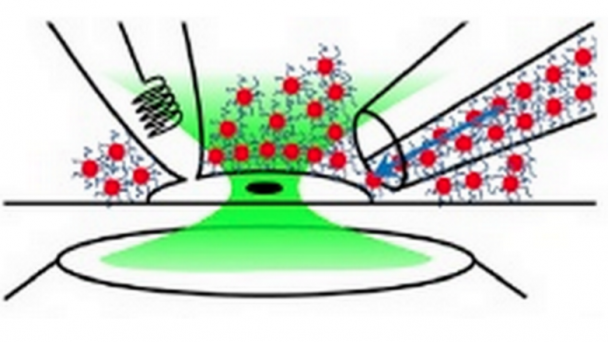
Light can be used to activate normal, non-genetically modified neurons through the use of targeted gold nanoparticles—a new technique that could hold promise for treating diseases such as macular degeneration.

“Many optogenetic experimental designs can now be applied to completely normal tissues or animals, greatly extending the scope of these research tools and possibly allowing for new therapies involving neuronal photostimulation.”

Neuron 2015.02.033

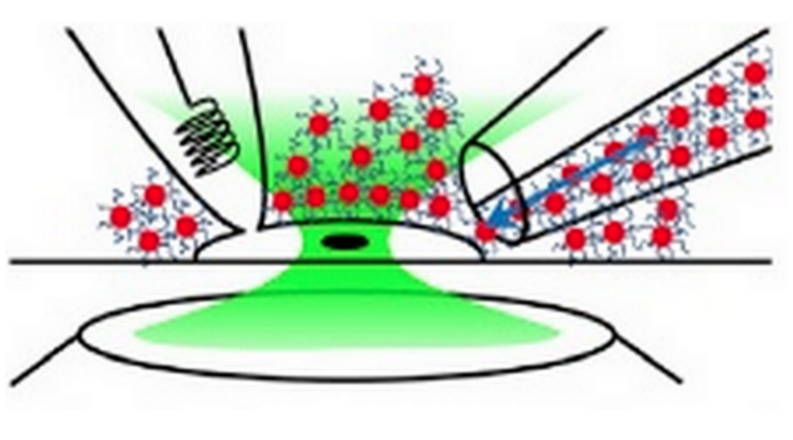
Funtionalized heated gold nanoparticles are not washed away, allowing them to serve a neural stimulators (credit: Joa˜ o L. Carvalho-de-Souza/Neuron)

Press Release

From University of Chicago News 3/12/15 by Kevin Jiang

New technique uses light to take genetics out of optogenetics

Gold nanoparticles enable stimulation of non-genetically modified neurons

Light can be used to activate normal, non-genetically modified neurons through the use of targeted gold nanoparticles—a new technique that could hold promise for treating diseases such as macular degeneration, scientists from the University of Chicago and the University of Illinois at Chicago report March 12 in the journal Neuron. This technique represents a significant technological advance with potential advantages over current optogenetic methods.

“This is effectively optogenetics without genetics,” said study senior author Francisco Bezanilla, the Lillian Eichelberger Cannon Professor of Biochemistry and Molecular Biology at ...

OnAir Post: Taking genetics out of optogenetics

Patterned activity and codes for behavior

Principal Investigator: John Maunsell Neuroscience at University of Chicago Title: “The role of patterned activity in neuronal codes for behavior” BRAIN Category: Understanding Neural Circuits (RFA NS-14-009)

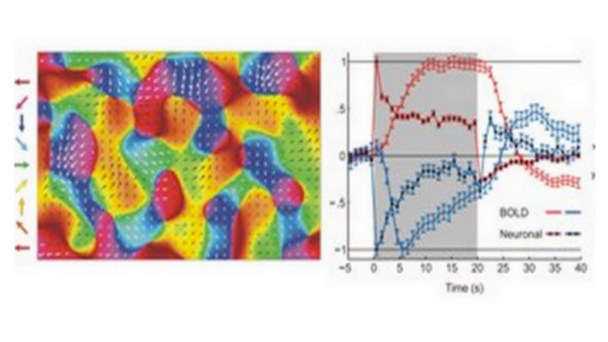
Dr. Maunsell’s team will explore how large populations of neurons process visual information, using a newly developed light stimulation technique to induce brain cell activity in the visual cortex of mice.

NIH Webpages

Project Description

A key aspect of brain function is how the activity of neuronal populations encodes information that is used to guide behavior. A longstanding model system to understand population coding is the visual cerebral cortex, because its structure and anatomy are well understood, and because visual stimuli can be presented to subjects with high levels of temporal and spatial control. Thousands or more neurons fire action potentials in response to a single visual stimulus, and an important open question is how this population response carries information – how the detailed timing and pattern of these spikes across neurons is decoded to guide behavior. Because it is known that genetics controls the identity and morphology of neurons, and influences which other neurons they form synaptic partners with, it appears likely that the precise details of which neurons in a population fire spikes is vitally important for behavior. But ...

OnAir Post: Patterned activity and codes for behavior

Skip to toolbar