University of Michigan Neuroscience

The longest-standing neuroscience graduate program in the United States, we are a collegial and interactive group that performs research across the breadth of the neuroscience field.

The University of Michigan Neuroscience program captures the excitement and interdisciplinary collaboration intrinsic to the field of neuroscience by drawing on the expertise of over 120 faculty members from more than 20 departments.Primary  research fields include: Sensory & Computational Neuroscience, Developmental Neuroscience, Cognitive Neuroscience,Behavioral Neuroscience,Molecular Neuroscience, and Clinical Neuroscience.

Web Information

Neuroscience Graduate Program website: neuroscience.med.umich.edu/ BRAIN Initiative Grant – ” Modular High-Density Optoelectrodes for Local Circuit Analysis”

Contact Information

Email: neuroscience.program@umich.edu Phone: (734) 763-9638 Address: Neuroscience Graduate Program 4137 Undergraduate Science Building (USB) 204 Washtenaw Ave. Ann Arbor, MI 48109-2215

Letter from Director

Welcome! The Graduate Program at the University of Michigan was constituted in 1971, making it the longest-standing neuroscience graduate program in the United States. We are a collegial and interactive group of 60+ students and 120 faculty that perform research across the breadth of the neuroscience field. Neuroscience graduate students on this campus form a cohesive group, which promotes interactions among the faculty, making the Graduate Program the nexus of the neuroscience community. Graduates receive a Ph.D. in Neuroscience, which provides tremendous flexibility in choosing one’s career path. There are more than ...

OnAir Post: University of Michigan Neuroscience

Brain States and Consciousness: Mysteries of the Brain

https://www.youtube.com/watch?v=rzZkaaavC28

“Neurobiologist Orie Shafer at the University of Michigan is trying to understand how the brain’s cells communicate in order to control sleep patterns. To help solve this mystery, Shafer is teaming up with mathematician Victoria Booth to study a tiny and very unlikely specimen: the fruit fly. “

Mysteries of the Brain” is produced by NBC Learn in partnership with the NSF.”

NSF BRAIN Initiative Published June 17, 2015

OnAir Post: Brain States and Consciousness: Mysteries of the Brain

Euisik Yoon, PhD – Michigan


Professor oElectrical Engineering and Computer Science and Biomedical Engineering, University of Michigan Principal Investigator, Yoon Lab

Yoon’s research group realizes self-contained microsystems that combine and process natural signals (such as bio, chemical, optical and thermal signals) as well as electrical signals on a single chip platform by integrating new MEMS/nano structures with low-power, wireless VLSI circuits and systems.

Web Information

Electrical Engineering and Computer Science webpage: web.eecs.umich.edu/~esyoon/ Biomedical Engineering webpage:  bme.umich.edu/people/index.php?un=esyoon University of Michigan Neuroscience  BRAIN Initiative Grant – ” Modular High-Density Optoelectrodes for Local Circuit Analysis”

Contact Information

Email: esyoon@umich.edu Phone: (734) 615-4469 Address: 2400 EECS Bldg., 301 Beal Avenue Ann Arbor, MI 48109-2122


Biography

Euisik Yoon received the B.S. and M.S. degrees in electronics engineering from Seoul National University in 1982 and 1984, respectively, and the Ph.D. degree in electrical engineering from the University of Michigan, Ann Arbor, in 1990.

From 1990 to 1994 he worked for the Fairchild Research Center of the National Semiconductor Corp. in Santa Clara, CA, where he engaged in researching deep submicron CMOS integration and advanced gate dielectrics. From 1994 to 1996 he was a Member of the Technical Staff at Silicon Graphics Inc. in Mountain View, CA, where he worked on the design of the MIPS microprocessor R4300i and the RCP 3-D graphic coprocessor. He took ...

OnAir Post: Euisik Yoon, PhD – Michigan

Yoon Lab – Michigan

Principal Investigator: Euisik  Yoon University of Michigan Neuroscience

The mission of the Yoon lab is to build self-contained microsystems that will combine and process natural signals (such as bio, chemical, optical and thermal signals) as well as electrical signals on a single chip platform by integrating new MEMS/nano structures with low-power, wireless VLSI circuits and systems. Currently, we have three main research thrusts: microfluidic systems, MEMS neural interfaces, and CMOS imaging and neural interfacing ICs.

Web Information

Website:  yoon.eecs.umich.edu/ BRAIN Initiative Grant – ” Modular High-Density Optoelectrodes for Local Circuit Analysis”

Contact Information

Email: esyoon@umich.edu Address: 1301 Beal Avenue, Ann Arbor

Research

The mission of our lab is to build self-contained microsystems that will combine and process natural signals (such as bio, chemical, optical and thermal signals) as well as electrical signals on a single chip platform by integrating new MEMS/nano structures with low-power, wireless VLSI circuits and systems. Currently, we have three main research thrusts: microfluidic systems, MEMS neural interfaces, and CMOS imaging and neural interfacing ICs.


Advanced Neural Probes

Mapping the brain and peripheral circuits may be the grandest challenge in a all of science today. Our mission is to help neuroscientists, neurologists, and other clinicians understand these amazingly complex circuits with tools that can monitor neural activity or recreate ...

OnAir Post: Yoon Lab – Michigan

Optoelectrodes for Local Circuit Analysis

Principal Investigator: Euisik  Yoon University of Michigan Neuroscience  Title: ” Modular High-Density Optoelectrodes for Local Circuit Analysis” BRAIN Category: Large-Scale Recording-Modulation – New Technologies (RFA NS-14-007)

In this project, Dr. Yoon’s team will make devices for optogenetics, a technique that enables scientists to turn neurons on and off with flashes of light, more precise and diverse by integrating multiple light sources in such a way as to enable the control of specific neuronal circuits.

NIH Webpages

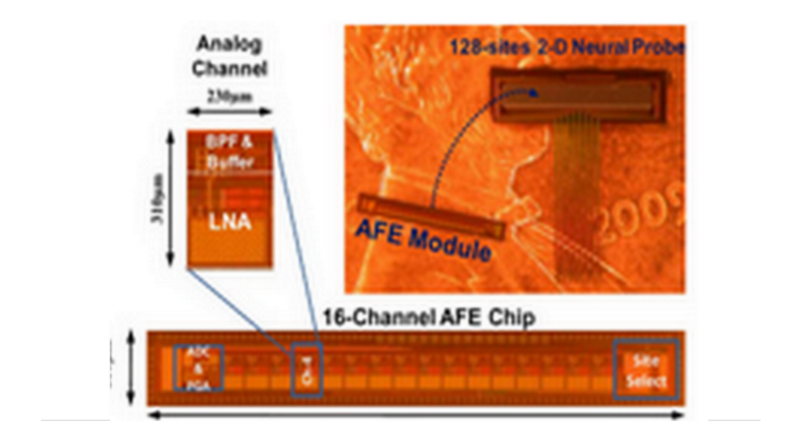
Analog Front-End Module With Moderate Inversion and Power-Scalable Sampling Operation for 3-D Neural MicrosystemsWe report an analog front-end prototype designed in 0.25 CMOS process for hybrid integration into 3-D neural recording microsystems. For scaling towards massive parallel neural recording, the prototype has investigated some critical circuit challenges in power, area, interface, and modularity.

Project Description

A number of scientific questions, especially in local circuit analysis, require manipulating neurons in vivo at multiple sites independently at high spatial and temporal resolutions by perturbing a controlled number and simultaneously recorded neurons. Optogenetic stimulation is cell-type specific which has proven to be the most powerful means of circuit control. Several laboratories have developed solutions to deliver optical stimulation to deep brain structures whilst simultaneously recording neurons. However, stimulation ...

OnAir Post: Optoelectrodes for Local Circuit Analysis

Skip to toolbar