Pierre and Marie Curie University

Pierre and Marie Curie University (UPMC), also known as Paris 6 has more than 5,000 researchers and professors working in 100 laboratories across four divisions: Modeling & Engineering; Energy, Matter & the Universe; Living Earth & Environment; Life & Health.

The research ranges from fundamental to applied, with the aim to push the boundaries of knowledge and to explore major issues of sustainable development that preoccupy our society in the twenty-first century, including health, climate change, water, biodiversity, energy, and communications.

Web Information

Website: http://www.upmc.fr/en/research.html Wikipedia Entry: wikipedia.org/wiki/Pierre_and_Marie_Curie_University Brain Initiative Grant – “Three Dimensional Holography for Parallel Multi-target Optogenetic Circuit Manipulation”

Contact Information

Phone: +33 1 44 27 44 27 Address: UPMC 4 place Jussieu 75252 Paris cedex 05, France

Research 

UPMC has more than 5,000 researchers and professors working in 100 laboratories across four divisions: Modeling & Engineering; Energy, Matter & the Universe; Living Earth & Environment; Life & Health. The research ranges from fundamental to applied, with the aim to push the boundaries of knowledge and to explore major issues of sustainable development that preoccupy our society in the twenty-first century, including health, climate change, water, biodiversity, energy, and communications.

Knowledge production happens at all levels, in national and international research laboratories, and with industrial partners through technology transfer and innovation. UPMC has particularly focused on multidisciplinary approaches to ...

OnAir Post: Pierre and Marie Curie University

Serge Picaud, PhD – Vision Institute


Head of the Department of Visual Information Processing Vision Institute, Pierre and Marie Curie University

The goal of Serge Picaud’s three-dimensional holography research is to enable Neuroscientists to manipulate neural circuits in order to discover how patterns of activity relate to sensation, perception and cognition. This capability is essential for discovering how communication between neurons gives rise to healthy brain function. These insights will improve our ability to identify effective targets and methods for treating neurological diseases and disorders.


Web Information

Webpage: institut-vision.org/-picaud Brain Initiative Grant

Contact Information

Email: serge.picaud@inserm.fr Phone: 33 1 53 46 25 92 Address: The Vision Institute 17 rue Moreau 75012 Paris – France


Biography

1987-1988 Max-Planck Institut of Brain Research, (Germany,) Pr H. Wässle, 1990 PhD Marseille University, Postdoc, 1991-1995 University of Berkeley (USA) Pr. F. Werblin. 1995-2002 INSERM-ULP Strasbourg (France) Dr Dreyfus – Pr Sahel 2002 – now INSERM-UPMC Paris (France) Pr Sahel

Research

Our team investigates cellular mechanisms in retinal information processing to take advantage of this knowledge to design therapeutic or rehabilitating strategies. This project has first focused on the photoreceptor synapse with a specific emphasis on its inhibitory feedbacks. We thus demonstrated the presence of GABA and glycine receptors in mammalian cone photoreceptors.

In parallel, we examined the pathological role of GABA when discovering the origin for the toxicity of an anti-epileptic drug inhibiting the GABA-transminase ...

OnAir Post: Serge Picaud, PhD – Vision Institute

IDV – The Vision Institute

Research Director: Serge Picaud Pierre and Marie Curie University

Built in the heart of the Quinze-Vingts National Eye Hospital, the Vision Institute is one of the most important research centers in Europe on eye diseases.The Institute’s goal is to discover, test and develop treatments and technological innovations of tomorrow in order to prevent or limit visual impairment and to improve the autonomy and the quality of life of patients.

Web Information

Website:  institut-vision.org/ Brain Initiative Grant

Contact Information

Email: contact@institut-vision.org Phone: 33 1 53 46 26 48 Address: The Vision Institute 17 rue Moreau 75012 Paris – France

OnAir Post: IDV – The Vision Institute

3D Holography for Optogenetic Manipulation

Principal Investigator: Serge Picaud Pierre and Marie Curie University Title: “Three Dimensional Holography for Parallel Multi-target Optogenetic Circuit Manipulation” BRAIN Category: Large-Scale Recording-Modulation – Optimization (RFA NS-14-008)
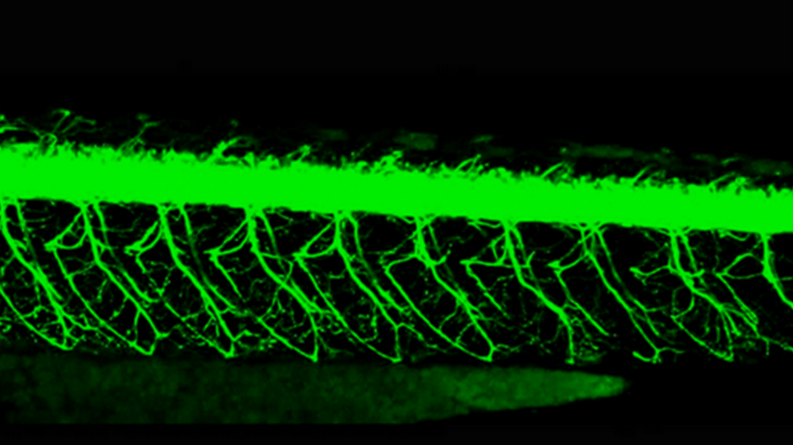
Dr. Picaud’s team will continue its development of holographic imaging to use lasers to induce the natural electrical activity of neurons and test theories of how circuits produce behaviors in a range of animal models.

NIH Webpages

Zebrafish motoneurons visible thanks to a green fluorescent molecule, the GFP (Green Fluorescent Protein)© Inserm/Leclerc, Philippe

Project Description

Understanding communication between neurons, who is talking to whom, and what language they are speaking, is essential for discovering how brain circuits underlie brain function and dysfunction. Over the past decades, Neuroscience has made exponential progress toward recording and imaging communication between neurons. In addition, geneticists have recently developed the capability to manipulate neurons with light through the expression of light-activated microbial proteins called “opsins.” Now, neuroscientists can drive neural circuits in order to determine how they give rise to sensation, perception, and cognitive function. In order to take full advantage of “optogenetic” tools, we are developing holographic methods to deliver patterned light into brain tissue, to enable simultaneous activation of multiple neurons, independently controlling the strength and ...

OnAir Post: 3D Holography for Optogenetic Manipulation

Skip to toolbar