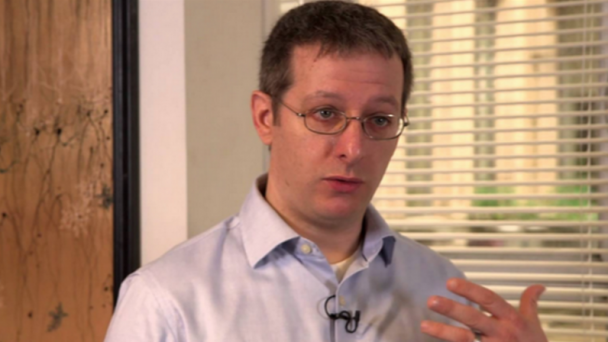
Steven Chase, PhD – CMU

Assistant Professor, Center for the Neural Basis of Cognition and Biomedical Engineering Principal Investigator, Chase Lab

Dr. Chase uses brain-computer interfaces to study motor learning and skill acquisition. His work stands to provide a better understanding of how movement information is represented in networks of neurons in the brain and will inform the development of neural prosthetics.

Web Information

Department web page: https://www.bme.cmu.edu/people/faculty1.html#Chase

Lab websitehttp://www.cnbc.cmu.edu/~schase/index.php

Contact Information

Email: schase@andrew.cmu.edu

Phone: 412 268 5512

Address: Hamerschlag Hall C122 Carnegie Mellon University 5000 Forbes Avenue Pittsburgh, PA 15213

Biosketch

Steve Chase received his BS in Applied Physics from Caltech in ’97, his MS in Electrical Engineering from UC Berkeley in ’99, and his PhD in Biomedical Engineering from Johns Hopkins in ’06. He recently completed his post-doctoral training under the joint mentorship of Dr. Robert Kass (Carnegie Mellon, Statistics) and Dr. Andrew Schwartz (University of Pittsburgh, Neurobiology), where he used brain-computer interfaces to study adaptation and plasticity in the primary motor cortex. His research probes the coding and flow of information in neural populations.

Research

Brain-computer interface, or BCIs, are a promising technology for alleviating motor deficits caused by injury or disease. These devices can read out motor intent by recording directly from populations of motor cortical neurons, and ...

OnAir Post: Steven Chase, PhD – CMU
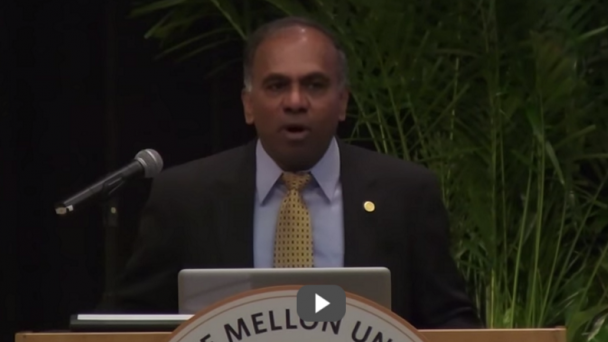
CMU BrainHub Launch: Opening Remarks

https://www.youtube.com/watch?v=jp0arbSpQPMVideo can’t be loaded because JavaScript is disabled: BrainHub Launch: Opening Remarks (https://www.youtube.com/watch?v=jp0arbSpQPM)

Carnegie Mellon University president Dr. Subra Suresh and interim provost Nathan Urban delivered opening remarks at the launch of CMU BrainHub, a new initiative that focuses on understanding the human brain — one of the grand challenges of the 21st century.

Understanding how the brain works is one of the biggest puzzles left for science to solve. Answers to critical questions in neuroscience lie at a pivotal intersection between biology, cognitive psychology, computer science, statistics and engineering – areas where Carnegie Mellon University excels. And the world has taken notice of our excellence, putting CMU at the hub of unique global partnerships in the name of brain research.

For more information: cmu.edu/brainhub

Pulbished on Aug. 26, 2014 by Carnegie Mellon

OnAir Post: CMU BrainHub Launch: Opening Remarks

Carnegie Mellon ‘BrainHub’

The Carnegie Mellon University (CMU) BrainHub initiative spans across CMU’s colleges and schools, involving nearly 50 faculty and over 150 scientists.

A major facet of this initiative is increasing collaboration among faculty from disciplines such as computer science and engineering with those taking biological and behavioral approaches to neuroscience. Linking brain science to behavior via the application of machine learning, statistics, and computational modeling will be a hallmark of CMU’s efforts, along with commercialization of the new technologies and applications.


Web Information

Brain Hub:  cmu.edu/research/brain

Neuroscience Programs and Centers:  cmu.edu/neuro/


Contact Information

Email: gbalbier@andrew.cmu.edu Phone: 412-268-9718 Address: Brain Hub 5000 Forbes Avenue Pittsburgh, PA 15213

Executive Director: Gerry Balbier Facutly Experts


Research Areas

Sharing the World’s Brain Research Data

Researchers around the world are collecting vast amounts of data from the brain at a rapid pace. We believe that much can be learned by combining the global collection of data. We are creating new tools that will index, aggregate and share this global data, making it accessible in powerful new ways. Faculty experts in this area »

Mapping & Exploring the Interconnectivity of the Brain and Behavior

The brain is made up of billions of neurons, which make billions of connections to communicate information. While scientists have been ...

OnAir Post: Carnegie Mellon ‘BrainHub’

Neural Variability During Motor Learning

Principal Investigator: Steven Chase, CMU Title:  The Structure of Neural Variability During Motor Learning BRAIN Category: Individuality and Variation

This study will investigate the neural correlates of motor variability and establish the connections between neural variability, behavioral performance, and learning.

Abstract

Movements are inherently variable: one never throws a dart or a basketball in exactly the same way twice. On the face of it, this variability in behavior is detrimental to performance, preventing one from consistently hitting the bull’s-eye or making the basket. However, computational theories posit that motor variability may also serve a functional role, enabling exploration and learning of more efficient movements. This creates an intriguing duality: while variability should be minimized for short-term motor performance (to act reliably), it should be maximized for long-term performance (to promote learning). During practice, variability might be useful for developing motor skill. When it’s game time, however, variability should be suppressed to the greatest extent possible. Might the central nervous system set the amount of variability in a context-appropriate fashion? This study will investigate the neural correlates of motor variability and establish the connections between neural variability, behavioral performance, and learning.

Neural variability lies at the heart of several theoretical computational models, from implementations of probabilistic computation to Hebbian ...

OnAir Post: Neural Variability During Motor Learning

Skip to toolbar