UMD Neuroscience and Cognitive Science

The Neuroscience and Cognitive Science (NACS) Graduate Program offer cutting-edge interdisciplinary training in several areas: Cellular and Molecular Neuroscience; Cognitive Neuroscience; Cognitive Science; Computational Neuroscience; and Systems Neuroscience.

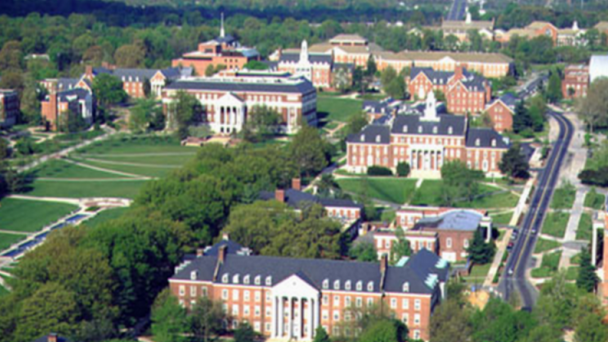
These research activities are carried out in laboratories housed in six colleges and 17 different departments on the University of Maryland, College Park campus. Through our official partnership with the National Institutes of Health and active collaboration with Children’s National Medical Center, NACS graduate students may also receive research training.

Web Information

Website: nacs.umd.edu/ BRAIN Initiative Grant – “Crowd coding in the brain: 3D imaging and control of collective neuronal dynamics”

Contact Information

Email: NACS@umd.edu Phone:  301-405-8910 Address:2131 Biology-Psychology Bldg, University of Maryland, College Park, MD 20742

Organization

Director: Jens Herberholz

About the Program

Overall Philosophy

The Neuroscience and Cognitive Science (NACS) Program strives to educate exceptional scientists whose integrative training will form the basis for significant scientific contributions.  This is a research doctoral program designed on an apprenticeship model:  students train to become professional scientists by doing independent research and participating in all aspects of the profession under the guidance of a mentor.

Graduate Program

Students receive their doctorates from NACS. Support is available from training grants, research and teaching assistantships, and university fellowships and includes tuition and health benefits. Students have extensive opportunities for interaction through classes, seminars, special programs, and ...

OnAir Post: UMD Neuroscience and Cognitive Science
Patrick Kanold, PhD – UMD


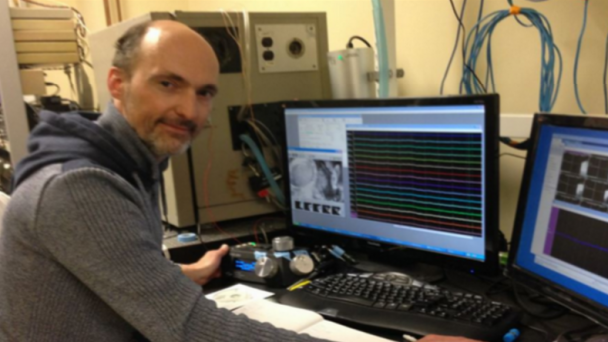
Associate Professor of Biology Director, Kanold Lab

Dr. Kanold studies the development and plasticity of the brain, in particular how periods of learning and plasticity are initiated and controlled. His work focuses on the development of the central auditory and visual system in particular on the role of early cortical circuits in brain wiring. He uses advanced neurophysiological, in vivo imaging, optogenetic, molecular and computational techniques.


Web Information

Webpage:  biology.umd.edu/patrick-kanold.html UMD Neuroscience and Cognitive Science  BRAIN Initiative Grant – “Crowd coding in the brain: 3D imaging and control of collective neuronal dynamics”

Contact Information

Emailpkanold@umd.edu Phone: 301.405.5741 Address: 1116 Bioscience Research Building College Park, MD 2074


Biography

Awards

2007 Ralph E Powe Award 2010 Alfred P. Sloan Foundation 2013 NOHR/ARo Burt Evans Award

Education

Dipl. Ing (M.Sc.), Technische Universität Berlin, Germany, 1994 Ph.D., Johns Hopkins University, 2000 PostDoc, Harvard Medical School 2000-2005 Instructor, Harvard Medical School 2005-2006


Research

Dr. Kanold studies the development and plasticity of the brain, in particular how periods of learning and plasticity are initiated and controlled. His work focuses on the development of the central auditory and visual system in particular on the role of early cortical circuits in brain wiring. He uses advanced neurophysiological, in vivo imaging, optogenetic, molecular and computational techniques. His work furthers our understanding of how prenatal and postnatal brain injury ...

OnAir Post: Patrick Kanold, PhD – UMD

Kanold Lab – UMD

Principal Investigator: Patrick Kanold UMD Neuroscience and Cognitive Science
The major focus in the lab is to understand how information about the world is represented/encoded in the brain, the circuits present in the adult and developing brain and their influence of brain development and plasticity. One focus is on probing the response of the brain to sensory stimuli and the other is to record from small sub-circuits and study their responses and circuit behavior in great detail. 


Web Information

Website:  clfs.umd.edu/biology/kanold BRAIN Initiative Grant – “Crowd coding in the brain: 3D imaging and control of collective neuronal dynamics”

Contact Information

Emailpkanold@umd.edu Phone: 301.405.5741 Address: 1116 Bioscience Research Building College Park, MD 2074

Research

How do our brains work, wire up, and change?

      The human brain is a tremendously complex neuronal circuit that we don’t really understand. For example we do not know how sensory information about the world is encoded in neuronal population activity and transformed into a percept.

    Moreover, somehow during development all the highly specific connections in the brain are made so that we can function normally. It is clear now that we do not come hard-wired but that interaction with the environment plays a major role in shaping our brain. In particular during

OnAir Post: Kanold Lab – UMD

Crowd coding in the brain

Principal Investigator: Patrick Kanold UMD Neuroscience and Cognitive Science Title: “Crowd coding in the brain: 3D imaging and control of collective neuronal dynamics” BRAIN Category: Understanding Neural Circuits (RFA NS-14-009)

Dr. Kanold and his team propose cutting edge methods to stimulate neurons at different depths in the auditory cortex, and will use new computational methods to understand complex interactions between neurons in mice while testing their ability to hear different sounds.

NIH Webpages

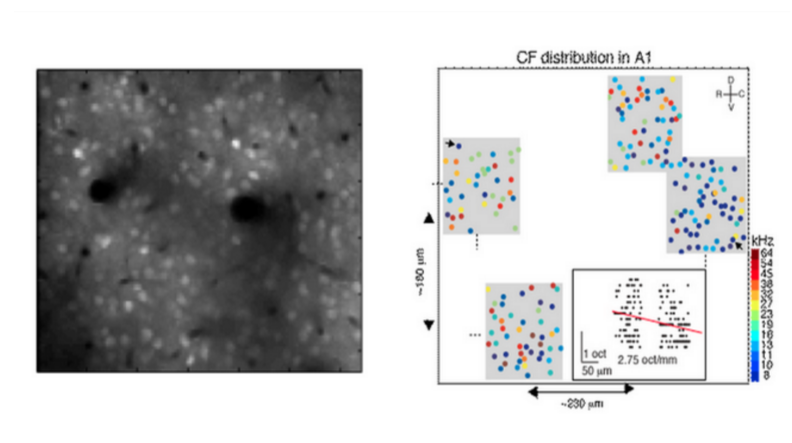
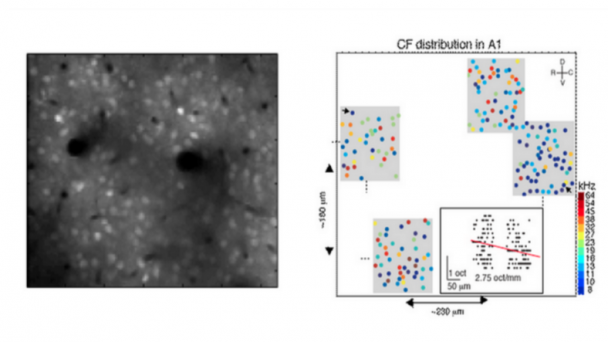
To overcome this we extensively use in vivo 2-photon imaging which can detects the activity of many single neurons in the brain of a living animal. the image below on the left shows many neurons in the brain loaded with a Ca-indicator dye which reports neuronal activity.

Project Description

The cortex is a laminated structure that is thought to underlie sequential information processing. Sensory input enters layer 4 (L4) from which activity quickly spreads to superficial layers 2/3 (L2/3) and deep layers 5/6 (L5/6) and other cortical areas eventually leading to appropriate motor responses. Sensory responses themselves depend on ongoing, i.e. spontaneous cortical activity, usually in the form of reverberating activit from within or distant cortical regions, as well as the state and behavioral context of the animal. Receptive ...

OnAir Post: Crowd coding in the brain

Skip to toolbar