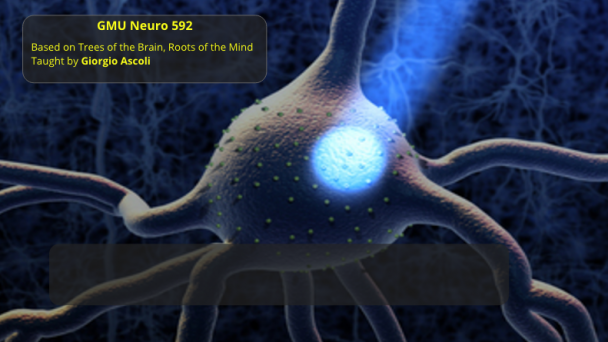
The human brain is often described as the most complex object in the universe. Tens of billions of nerve cells-tiny tree-like structures—make up a massive network with enormous computational power.
GMU Neuro592 is based on the book, Trees of the Brain, Roots of the Mind, by Giorgio Ascoli. This course reveals another aspect of the human brain: the stunning beauty of its cellular form. Doing so, Giorgio makes a provocative claim about the mind-brain relationship.
Syllabus
Special Topics in Neuroscience: Neurons, Connectomes, & Cognition
NEUR 592 Wednesdays 1:30-4:15p, Krasnow 229
Link: http://krasnow1.gmu.edu/cn3/neur592.pdf
Prerequisites:
Neur 327, Neur 335, Psyc 372, or permission of instructor.Graduate and undergraduate students in the neuroscience, psychology, biology, physics, philosophy, and bioengineering programs are especially encouraged to enroll.
Course Goals:
This broad-spanning exploration of the brain-mind relationship aims to connect fundamental aspects of cognitive and behavioral phenomena, such as learning from experience, with basic operating principles of neural architecture. The course also surveys numerous topics of contemporary research and includes a hands-on virtual lab of modern web-based tools for neuroscience research.
Contents in Brief:
Parties in the brain-mind relationship: neurons, networks, activity dynamics, mental states, knowledge, and plasticity. Neuron types: morphology, electrophysiology, biochemistry, development, and function. Connectomes: projectomes, synaptomes, mesoscopic maps, neural circuits, and potential connectivity. ...