Rebecca Burwell 11.21.16


Summary

TITLE:  Circuit analysis of posterior parietal function SPEAKER:  Rebecca Burwell, Brown University

DATE: Monday, 21 November, 2016 TIME: 4:00-5:00pm LOCATION: Lecture Room (Room 229) Krasnow Institute Building George Mason University, Fairfax, VA


Abstract

Parahippocampal connections with posterior parietal cortex and the thalamus are well documented for the rodent and primate brains, but there are many open questions about the functions of these circuits. In the rodent brain, the postrhinal cortex, posterior parietal cortex , and the lateral posterior nucleus of the thalamus (LPO) are robustly interconnected. Similar patterns of connectivity are evident in the primate parahippocampal cortex (postrhinal homolog), posterior parietal cortex, and the pulvinar (LPO homolog). We used neuroanatomical tracing in combination with electrophysiology and optogenetic manipulations in behaving rats to address the function of the posterior parietal cortex in this circuit.

I will present evidence that both the posterior parietal cortex and the LPO are important for translating visual information into appropriate behavioral actions. I will also show functional differentiation in the rat posterior parietal cortex such that dorsal and caudal subdivisions contribute differently to stimulus driven attention. These findings have implications for the role of the posterior parietal cortex in memory and other cognitive functions.


Presentation

Coming soon


Slides


About the Krasnow Seminars


OnAir Post: Rebecca Burwell 11.21.16

Ted Dumas 11.7.16


Summary

TITLE:  The Hitchhiker’s guide to optical voltage sensors and beyound” SPEAKER:  Ted Dumas, Krasnow Institute, George Mason University

DATE: Monday November 7, 2016 TIME: 4:00-5:00pm LOCATION: Lecture Room (Room 229) Krasnow Institute Building George Mason University, Fairfax, VA


Slides


Information

Each Monday afternoon during the academic year, the Krasnow Institute hosts a seminar at 4:00 p.m. at which an invited guest speaker gives a presentation on a topic in the cognitive sciences.  Presentations are finished by 5:00 p.m. and a discussion period follows.  All are welcome.

All meetings will be held on the George Mason University Fairfax campus in Lecture Room 229 of the Krasnow Institute building.  Please see driving directions to the Krasnow Institute building and campus parking options. Email:  smacken@gmu.edu (Stu Mackensie)

Phone: (703) 993-4333

OnAir Post: Ted Dumas 11.7.16

Krasnow Monday Seminar -10.31.16

DATE: Monday, 31 October, 2016
TIME: 4:00-5:00pm
LOCATION: Lecture Room (Room 229)
Krasnow Institute Building
George Mason University, Fairfax, VA

OnAir Post: Krasnow Monday Seminar -10.31.16

Patrick Gillevet – PhD, GMU

TOPIC:   The Selfish Microbiome and Ecology of Cognition

SPEAKER:  Patrick Gillevet, Director, Microbiome Analysis Center, George Mason University

DATE:  Monday, Dec. 7, 2015  TIME:  4:00-5:00 pm

LOCATION:   Lecture Room (Room 229)  Krasnow Institute Building, George Mason University, Fairfax, VA

Abstract

The focus of MBAC research is the study of dysbiosis of the microbial communities (microbiomes) that reside in the human gut, mouth, urogenital, and respiratory tracts, to model the homeostatic interactions between microbiome function and the host’s physiology. We define these metabolic and immune interactions as the “metabiome”. It has now become apparent that the human microbiome is implicated in social behavior, reproduction, growth, cognition, as well as many diseases. Current concepts and research will be presented that focus on how the gut-brain-liver axis influences human behavior and cognition. Thus, the human microbiome is an integral component of the human ecosystem and is a major driver of the system. In fact, one could even say that the human host is there merely to propagate the “selfish microbiome.”


Web Information

Websites: http://mbac.gmu.edu

Contact Information

Email:

Phone: 703-993-1057

Address: DK 3026 (Fairfax) and PW-OB 426 (Prince William)

Biosketch

Dr. Gillevet has been the lead scientist at the Environmental Biocomplexity and Ecology group ...

OnAir Post: Patrick Gillevet – PhD, GMU

Krasnow Monday Seminar – Margaret Johnson 2/23/15

Topic

 Modeling protein interactions and assembly with single-particle reaction-diffusion in solution and the membrane

Speaker

Margaret Johnson, Assistant Professor Department of Biophysics, John Hopkins University

Date

Monday, February 23, 2015

Time

4:00-5:00 pm

Location

Lecture Room (Room 229)  Krasnow Institute Building, George Mason University, Fairfax, VA

Abstract

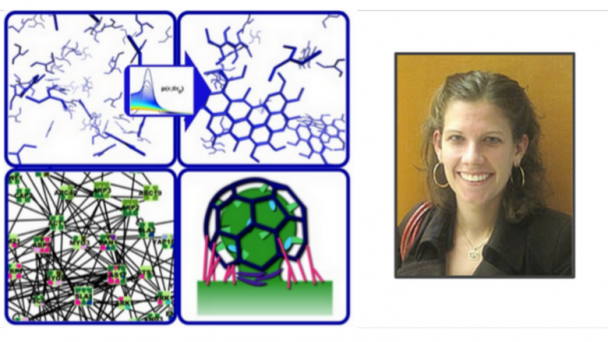
We recently developed a free-propagator reweighting (FPR) algorithm that solves reaction-diffusion (RD) dynamics of systems at single particle resolution both accurately and efficiently. The full spatio-temporal resolution of this RD method allows us to model complex biological systems where details like spatial gradients or particle assembly render simple rate-based kinetics insufficient. The treatment of proteins at single-particle resolution also allows us to begin building in further molecular details into the physics of the binding interactions, such as multiple domains in proteins, rotational and orientational effects, and interaction potentials. We have recently used our method to quantify the effect of membrane recruitment in altering the equilibrium and time-scales of protein binding interactions relative to their behavior in solution, which has implications for understanding the mechanisms of clathrin-coat formation in the early stages of endocytosis. Finally, we have used our RD simulations and new theoretical results to characterize the limitations of modeling reactions dynamics in 2D using simple rate-based kinetics. The use of ...

OnAir Post: Krasnow Monday Seminar – Margaret Johnson 2/23/15

Krasnow Monday Seminar 3/16/15 Michael A. Burman

TOPIC:  Limbic System Development Underlying the Emergence of Classical Fear Conditioning in the Rat

SPEAKER:  Michael A. Burman, Assistant Professor Dept. of Psychology & Center for Excellence in the Neurosciences University of New England

DATE:  Monday, March 16, 2015  TIME:  4:00-5:00 pm

LOCATION:   Lecture Room (Room 229)  Krasnow Institute Building, George Mason University, Fairfax, VA

Abstract

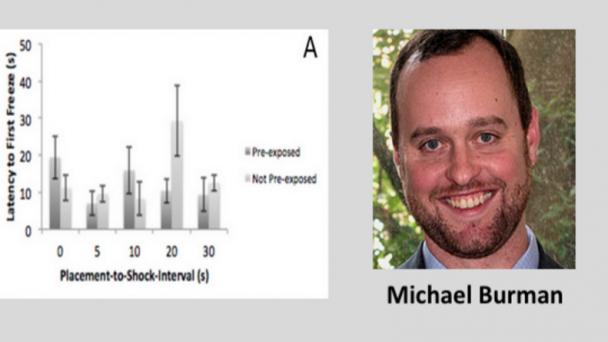
Fear and anxiety disorder have a lifetime incidence of over 25% of the population.  Although the neural circuitry involved in fear conditioning in mature organisms is well understood, the development of these circuits is less well studied. However, the extant literature does suggest that the third and forth weeks of life in rodents appear to be a time of significant change in both the cognitive and behavioral mechanisms of fear as well as the underlying neurobiology.  The current experiments further examine the behavioral and neurological changes that occur during this period, with a focus on medial temporal lobe cortex, the hippocampus and the amygdala.  Here, I will discuss two sets of experiments.  The first examines ontogeny of contextual fear conditioning by separating the contextual and aversive learning.  These experiments will conclude that some aspects of hippocampus-dependent learning may be occurring earlier than previously believed.  ...

OnAir Post: Krasnow Monday Seminar 3/16/15 Michael A. Burman

Select Krasnow Monday Seminars

Each Monday afternoon during the academic year, the Krasnow Institute hosts a seminar at 4:00 p.m. at which an invited guest speaker gives a presentation on a topic in the cognitive sciences.  Presentations are finished by 5:00 p.m. and a discussion period follows.  All are welcome.

All meetings will be held on the George Mason University Fairfax campus in Lecture Room 229 of the Krasnow Institute building.  Please see driving directions to the Krasnow Institute building and campus parking options.

Web Information

Seminar web pagehttps://krasnow.gmu.edu/blog/category/upcomingmondayseminars/

Contact Information

Email:  smacken@gmu.edu (Stu Mackensie)

Phone: (703) 993-4333

Address: The Krasnow Institute for Advanced Study Mail Stop 2A1, George Mason University Fairfax, VA 22030

Michael Hawrylycz – 10/5/2015

Tittle: Spatial Mapping of Multimodal Data in Neuroscience

Presenter: Dr.Michael Hawrylycz, Investigator, Allen Institute

Abstract

Spatial mapping of multimodal data in neuroscience employs techniques that are essential for the construction of digital atlases of the brain. Such atlases are increasingly used in the study of both humans and model organisms and enable scientists to access and analyze data in novel and meaningful ways. A broad spectrum of neuroinformatics methods from data mapping, analysis, and visualization are employed in the development of effective digital atlases. ...

OnAir Post: Select Krasnow Monday Seminars

Skip to toolbar