Giorgio Ascoli

Founding Editor-in-Chief, Neuroinformatics

The main effort of Dr. Ascoli's lab is to connect the cellular organization of brain networks to cognitive functions such as learning and memory. His laboratory hosts and curates a central inventory of digitally reconstructed neurons in NeuroMorpho.Org and Hippocampome knowledge  base and has developed L-Neuron, a neuron modeling  tool. His  long-term scientific and philosophical goal consists in establishing a working model for the highest cognitive functions such as human consciousness.

OnAir Post: Giorgio Ascoli

Trees of the Brain Presentation

This inaugural event of the series, which is sponsored by the George Mason University Bookstore, was held in the Fenwick Library Main Reading Room, on Tuesday, March 29th, at 2:30 p.m.

OnAir Post: Trees of the Brain Presentation

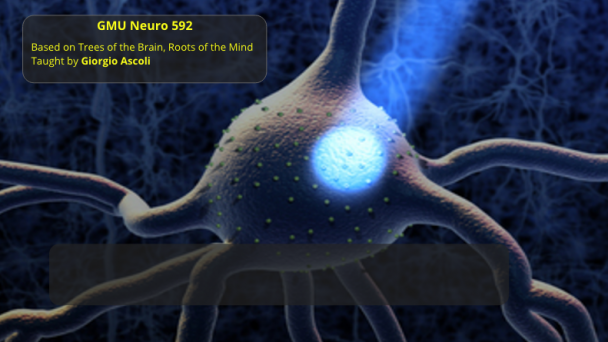
GMU Neuro592

The human brain is often described as the most complex object in the universe. Tens of billions of nerve cells-tiny tree-like structures—make up a massive network with enormous computational power.

GMU Neuro592 is based on the book, Trees of the Brain, Roots of the Mind, by Giorgio Ascoli. This course reveals another aspect of the human brain: the stunning beauty of its cellular form. Doing so, Giorgio makes a provocative claim about the mind-brain relationship.


Syllabus

Special Topics in Neuroscience: Neurons, Connectomes, & Cognition

NEUR 592 Wednesdays 1:30-4:15p, Krasnow 229

Link: http://krasnow1.gmu.edu/cn3/neur592.pdf

Prerequisites:

Neur 327, Neur 335, Psyc 372, or permission of instructor.Graduate and undergraduate students in the neuroscience, psychology, biology, physics, philosophy, and bioengineering programs are especially encouraged to enroll.

Course Goals:

This broad-spanning exploration of the brain-mind relationship aims to connect fundamental aspects of cognitive and behavioral phenomena, such as learning from experience, with basic operating principles of neural architecture. The course also surveys numerous topics of contemporary research and includes a hands-on virtual lab of modern web-based tools for neuroscience research.

Contents in Brief:

Parties in the brain-mind relationship: neurons, networks, activity dynamics, mental states, knowledge, and plasticity. Neuron types: morphology, electrophysiology, biochemistry, development, and function. Connectomes: projectomes, synaptomes, mesoscopic maps, neural circuits, and potential connectivity. ...

OnAir Post: GMU Neuro592

Trees of the Brain, Roots of the Mind – by Giorgio Ascoli

The human brain is often described as the most complex object in the universe. Tens of billions of nerve cells-tiny tree-like structures—make up a massive network with enormous computational power.

In this book, Giorgio Ascoli reveals another aspect of the human brain: the stunning beauty of its cellular form. Doing so, he makes a provocative claim about the mind-brain relationship.

Information

MIT Press Webpagehttps://mitpress.mit.edu/books/trees-brain-roots-mind

Trees of the Brain website

Overview

If each nerve cell enlarged a thousandfold looks like a tree, then a small region of the nervous system at the same magnified scale resembles a gigantic, fantastic forest. This structural majesty—illustrated throughout the book with extraordinary color images—hides the secrets behind the genesis of our mental states. Ascoli proposes that some of the most intriguing mysteries of the mind can be solved using the basic architectural principles of the brain. After an overview of the scientific and philosophical foundations of his argument, Ascoli links mental states with patterns of electrical activity in nerve cells, presents an emerging minority opinion of how the brain learns from experience, and unveils a radically new hypothesis of the mechanism determining what is learned, what isn’t, and why. Finally, considering ...

OnAir Post: Trees of the Brain, Roots of the Mind – by Giorgio Ascoli

Skip to toolbar