Giorgio Ascoli

Founding Editor-in-Chief, Neuroinformatics

The main effort of Dr. Ascoli's lab is to connect the cellular organization of brain networks to cognitive functions such as learning and memory. His laboratory hosts and curates a central inventory of digitally reconstructed neurons in NeuroMorpho.Org and Hippocampome knowledge  base and has developed L-Neuron, a neuron modeling  tool. His  long-term scientific and philosophical goal consists in establishing a working model for the highest cognitive functions such as human consciousness.

OnAir Post: Giorgio Ascoli

Hippocampome Portal

Knowledge concerning dentate gyrus, CA3, CA2, CA1, subiculum, and entorhinal cortex is distilled from published evidence and is continuously updated as new information becomes available. Each reported neuronal property is documented with a pointer to, and excerpt from, relevant published evidence, such as citation quotes or illustrations.

Link to Hippocampome Hub

OnAir Post: Hippocampome Portal

Neuromorpho.org

NeuroMorpho.Org is the largest collection of publicly accessible 3D neuronal reconstructions. The goal of NeuroMorpho.Org is to provide dense coverage of available reconstruction data for the neuroscience community enabling the full and continuing research potential of existing digital reconstruction data.

Website: neuromorpho.org

OnAir Post: Neuromorpho.org

BigNeuron

The key idea is to create a single platform on which all algorithms can be run, compared, and their results combined to form reconstructions better than any one could achieve alone.

Link to BigNeuron Hub

See also Allen Cell Type Data Bases post.

OnAir Post: BigNeuron

Computational Neuroanatomy Group – GMU

We are specifically interested in the description and generation of dendritic morphology, and in its effect on neuronal electrophysiology. In the long term, we seek to create large-scale, anatomically plausible neural networks to model entire portions of a mammalian brain (such as a hippocampal slice, or a cortical column).

OnAir Post: Computational Neuroanatomy Group – GMU

Crowdsourcing Brain Data

National Academies Keck Futures Initiative is a step toward giving researchers another tool in their work. It’s a data overload worth organizing because, as Ascoli points out, such a “knowledge base” could reveal patterns, show untapped areas for future research and cut duplication.

OnAir Post: Crowdsourcing Brain Data

Todd Gillette

Todd's dissertation was titled "Comparative topological analysis of neuronal arbors via sequence representation and alignment".

In addition to being the lead curator for NKN, Todd is overseeing the development of the Neuroscience Aircasts.

Todd has participated in the Allen Institute BigNeuron hackathon at Janelia and will be involved in the Oak Ridge hackathon Nov. 16-20, 2015.

OnAir Post: Todd Gillette

David Hamilton

PhD, Neuroscience at George Mason University Dissertation title: “Machine-readable Knowledge Management of Neuron Properties.”

David said “Neuroscience is the most interesting and potentially useful field of study available to me at this stage in my career. I was trained as an electrical engineer, worked most of my life as a software engineer, but desire to learn how the brain works to glean useful architectural aspects for continued advancement in problem solving.”

Web Information

LinkedIn page:   https://www.linkedin.com/pub/david-hamilton/38/91/5aa

Contact Information

Email:

Phone:

Address:

Biography

Education

George Mason University

PhD Candidate, Neuroscience   2007 – 2016

Estimated time-frame for dissertation final defense: Summer 2016. Dissertation title: “Machine-readable Knowledge Management of Neuron Properties.”

Activities and Societies: Society for Neuroscience, AAAS, IEEE

Loyola College in Maryland

MS, Electrical Engineering 1978 – 1981

Penn State University

BS, Electrical Engineering  1973 – 1977

Work Experience

Neuroscience PhD Candidate

George Mason University 2007 – Present (8 years)Fairfax, VAExpect to defend Spring 2016

Software Engineer

Northrop Gruman Information Systems –July 2004 – Present (11 years 2 months)

Software & Systems Research & Development

VP Software Development NeuralTech November 1994 – June 2004 (9 years 8 months) Merchant Dispute ...

OnAir Post: David Hamilton

Sumit Nanda

Sumit Nanda research focuses on modelling and simulation of dendritic morphology.

OnAir Post: Sumit Nanda

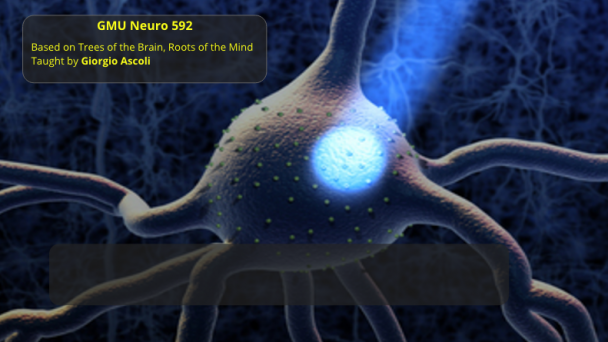
GMU Neuro592

The human brain is often described as the most complex object in the universe. Tens of billions of nerve cells-tiny tree-like structures—make up a massive network with enormous computational power.

GMU Neuro592 is based on the book, Trees of the Brain, Roots of the Mind, by Giorgio Ascoli. This course reveals another aspect of the human brain: the stunning beauty of its cellular form. Doing so, Giorgio makes a provocative claim about the mind-brain relationship.


Syllabus

Special Topics in Neuroscience: Neurons, Connectomes, & Cognition

NEUR 592 Wednesdays 1:30-4:15p, Krasnow 229

Link: http://krasnow1.gmu.edu/cn3/neur592.pdf

Prerequisites:

Neur 327, Neur 335, Psyc 372, or permission of instructor.Graduate and undergraduate students in the neuroscience, psychology, biology, physics, philosophy, and bioengineering programs are especially encouraged to enroll.

Course Goals:

This broad-spanning exploration of the brain-mind relationship aims to connect fundamental aspects of cognitive and behavioral phenomena, such as learning from experience, with basic operating principles of neural architecture. The course also surveys numerous topics of contemporary research and includes a hands-on virtual lab of modern web-based tools for neuroscience research.

Contents in Brief:

Parties in the brain-mind relationship: neurons, networks, activity dynamics, mental states, knowledge, and plasticity. Neuron types: morphology, electrophysiology, biochemistry, development, and function. Connectomes: projectomes, synaptomes, mesoscopic maps, neural circuits, and potential connectivity. ...

OnAir Post: GMU Neuro592

Skip to toolbar