Hippocampome.org v1.1 and beyond

Authors: Diek W. Wheeler, Charise White, Alexander O. Komendantov, Christopher L. Rees, David J. Hamilton, Siva Venkadesh, Keivan Moradi, Giorgio A. Ascoli

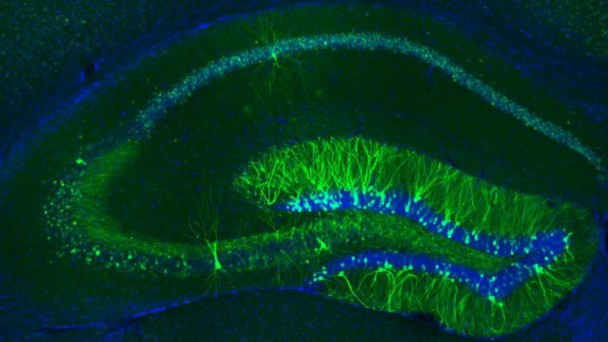
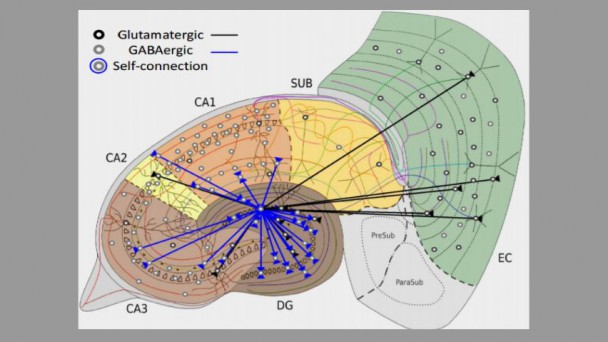
Hippocampome.org was officially launched in 2015. Releases since then and slated for the coming year constitute multidimensional expansions of this knowledge base: Neuron Term Portal (available), Clickable connectivity matrix (available), Firing patterns, Molecular biomarker inferences, Izhikevich modeling parameters, Allen Mouse Brain Atlas data addition, and New neuron types.

OnAir Post: Hippocampome.org v1.1 and beyond

A Decade of NeuroMorpho.Org

NeuroMorpho.Org is the largest centrally curated online repository of digital reconstructions of axonal and dendritic morphologies.

This public resource freely provides light and electron microscopy tracings contributed by more than 220 labs worldwide from over 500 publications.

OnAir Post: A Decade of NeuroMorpho.Org

Profiles of Hippocampal Principal Neurons

Poster Title: Large-scale genetic profiles of hippocampal principal neurons through Allen Brain Atlas mining
Authors: David J. Hamilton, Charise M. White, Christopher L. Rees, Diek W. Wheeler, Giorgio A. Ascoli

OnAir Post: Profiles of Hippocampal Principal Neurons

Biorealistic Hippocampal Modeling

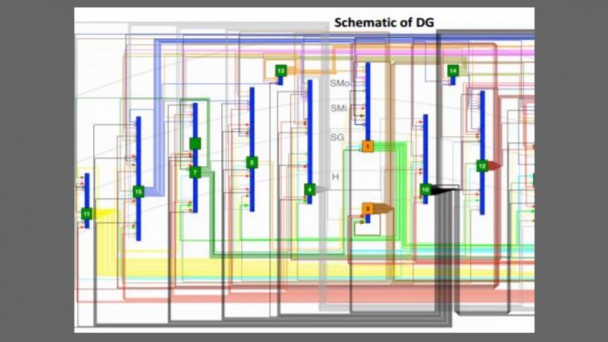
The field of machine learning, which historically has utilized multilayered artificial neural networks and, more recently, "Deep Learning" to characterize large datasets, will benefit from exploiting specific organizational and functional principles garnered from hippocampal circuitry. Using knowledge available in Hippocampome.org, it is now possible to construct spiking neural network (SNN) models of the rodent hippocampus.

OnAir Post: Biorealistic Hippocampal Modeling

Models capturing hippocampal neuronal behaviors

Authors: Siva Venkadesh, Alexander O. Komendantov, David J. Hamilton, Diek W. Wheeler, Stanislav Listopad2, Jeffrey L. Krichmar3, Giorgio A. Ascoli1

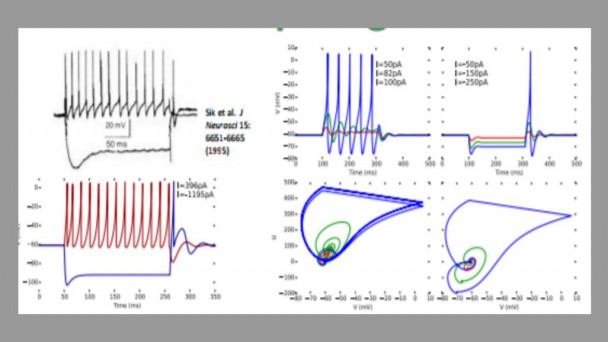
Hippocampome.org is a knowledge base of neuron types in the rodent hippocampal formation upon which we aim to build a full-scale model of the hippocampus. Simulation costs of biophysically detailed Hodgkin-Huxley-type neuronal models often impose limits on the scale of biologically realistic network models. Therefore, our immediate modeling goal is to create computationally efficient models that quantitatively reproduce various firing-pattern features of hippocampal neuron types.

OnAir Post: Models capturing hippocampal neuronal behaviors

Poster #8 – Title


Summary

Invitations to share screen within Hangout


Poster

PDF here


Presentation


Section I-


Section II-


Section III-


Section IV-

OnAir Post: Poster #8 – Title

BigNeuron

A community effort to find out what is exactly the state-of-the-art of single neuron reconstruction, standardize the protocols, and establish a Big Data resource for neuroscience.

OnAir Post: BigNeuron

Circuitry Profiling in the Drosophila Brain

Prominent research efforts are unveiling how circuits constitute the basic functional units of nervous systems.

Among them, Drosophila is currently the species with more promising results in mapping brain-wide connections at the
individual neuron level. The pioneering FlyCircuit Database has already traced and co-registered the neurite wiring corresponding to approximately 10% (v1.0) and 23% (v1.1) of the cells in the Drosophila brain.

OnAir Post: Circuitry Profiling in the Drosophila Brain

Digital Reconstructions of Neuronal Morphology

We present the definition of a novel multichannel file structure and corresponding Vaa3D plug-in to handle this new type of data. We also introduce a design to tag dynamic structural changes in a time-coded manner. Next, we illustrate ongoing progress in using the multichannel/time-lapse system on developing neurons in the Drosophila larva. Time-varying images of overall neuronal morphology along with fluorescently labeled subcellular cytoskeletal components are digitally traced into the aforementioned file structures. These new reconstructions enable complete statistical analysis of the structural changes and the underlying molecular processes.

OnAir Post: Digital Reconstructions of Neuronal Morphology

G Protein-binding SfN Poster

Download (PDF, 20KB)

A G protein-binding domain within the α7 nicotinic receptor enables downstream calcium signaling beyond the time course of channel activation

By Justin R. King1, Ming-Kuan Lin2,  Nadine Kabbani

Affiliations: 

1Department of Molecular Neuroscience, Krasnow Institute for Advanced Study, George Mason University, Fairfax, VA 22030, 2INOVA Neuroscience Program, Annandale, VA 22003

Supported by the Wings for Life Spinal Cord Research Foundation

 PDF version

Abstract

α7 nicotinic acetylcholine receptors (nAChRs) play an important role in synaptic transmission via regulation of intracellular signaling pathways. In recent studies, we demonstrated an important functional role for α7 nAChR interactions with intracellular heterotrimeric GTP binding proteins (G proteins) in cell signaling. Here, we show that direct coupling of the intracellular loop of the α7 receptor to Gαq enables a downstream calcium signaling response that persists beyond the time course of channel activation. This process is made possible via an evolutionary preservation of a G protein-binding cluster (GPBC) within the M3-M4 loop of nAChRs. A specific mutation of the GPBC in α7 (α7345-348A) abolishes interaction with G proteins while having no effect on the synthesis, cell-surface trafficking, or -bungarotoxin binding properties of the receptor. Expression of α7345-348A does however significantly attenuate the choline induced calcium signaling response. ...
OnAir Post: G Protein-binding SfN Poster

Skip to toolbar