WVU Center for Neuroscience

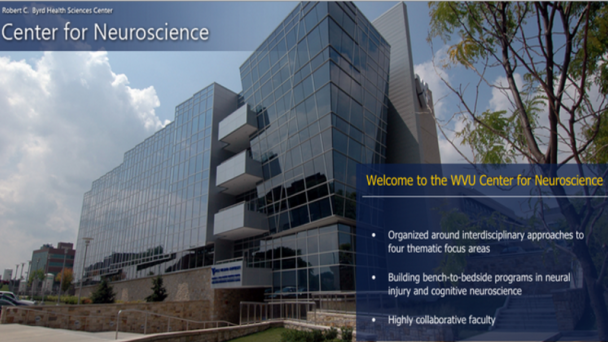
The Center for Neuroscience (CN) mission is to advance knowledge in basic and translational neuroscience through team-based interdisciplinary research.

The CN functions to integrate all neuroscience research activities across a collaborative enterprise of 40 laboratories throughout the WVU campus. Our faculty members are highly interactive and participate with trainees in regular scientific and social events where we explore recent breakthroughs and discuss the major topics in neuroscience research.


Web Information

Website: hsc.wvu.edu/wvucn/ BRAIN Initiative Grant – “Imaging the Brain in Motion: The Ambulatory Micro-Dose, Wearable PET Brain Imager”

Contact Information

Email: mpscott@hsc.wvu.edu Phone: 304.293.2930 Address: WVU Center for Neuroscience PO Box 9304 Morgantown, WV 26506-9304

Organization

Director: George Spirou

WVU Health Sciences Center

Message from the Director

The Center for Neuroscience (CN) mission is to advance knowledge in basic and translational neuroscience through team-based interdisciplinary research.

The CN functions to integrate all neuroscience research activities across a collaborative enterprise of 40 laboratories throughout the WVU campus. Our faculty members are highly interactive and participate with trainees in regular scientific and social events where we explore recent breakthroughs and discuss the major topics in neuroscience research.

Rather unique for research institutions, the WVU CN serves as the hub of activity across a broad array of neuroscience research topics to serve the entire ...

OnAir Post: WVU Center for Neuroscience
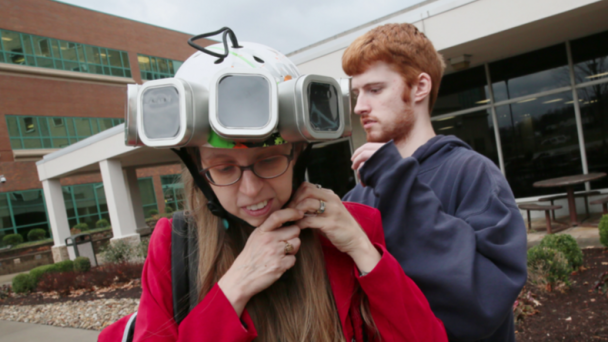
Micro-Dose, Wearable PET Brain Imager

Principal Investigator:  Julie Brefczynski-Lewis WVU Center for Neuroscience Title: Imaging the Brain in Motion: The Ambulatory Micro-Dose, Wearable PET Brain Imager BRAIN Category: Next Generation Human Imaging (RFA MH-14-217)

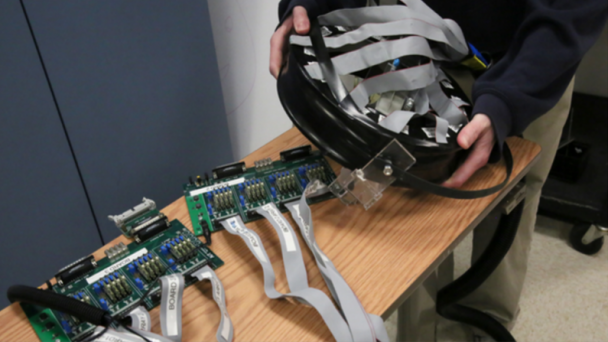
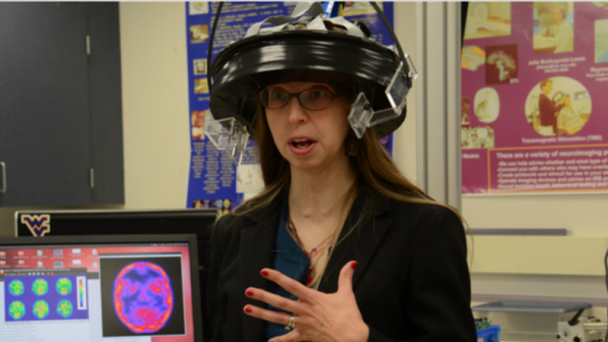
Dr. Brefczynski-Lewis and co-workers will engineer a wearable PET scanner that images activity of the human brain in motion – for example, while taking a walk in the park.

NIH Webpages

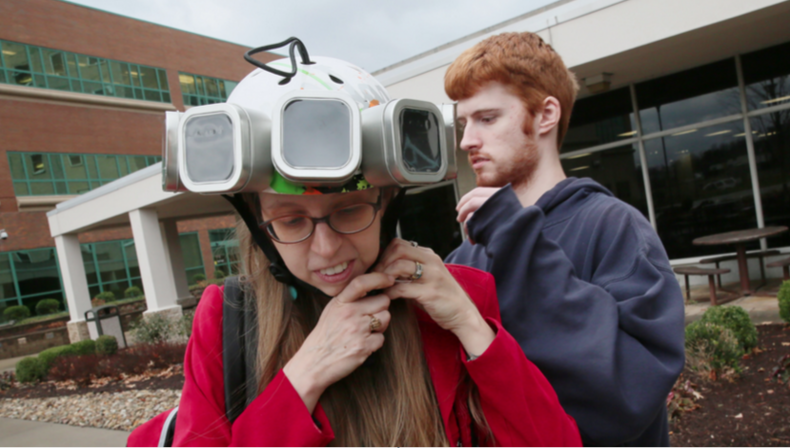
Brefczynski-Lewis, assisted by graduate student Chris Bauer, dons her PET-helmet prototype to demonstrate the device’s portability. (Lois Raimondo/For The Washington Post)

Project Description

Our vision is to design the first truly mobile molecular brain imager that can be used on healthy subjects to study the functioning of the human brain during motion. The ultimate goal is to be able to image subjects during a proverbial “walk in the park” and other natural activities. We selected PET technology as the most likely to succeed in the next decade to provide the desired functionality of such a brain imager. While MRI is an exceptionally powerful and versatile imaging modality, and there are even upright MRIs for structural brain scans, for functional fMRI scans the subjects must stay still and in horizontal position inside a narrow bore of a strong-field MRI magnet. What we ...

OnAir Post: Micro-Dose, Wearable PET Brain Imager

Brefczynski-Lewis Lab – WVU

Brefczynski-Lewis Lab studies how we perceive people we love and people we don’t like, both famous and political, and how training in compassion can affect those perceptions. The Lab is examining the neural and physiological correlates of the liked and disliked persons and how these change after training in compassion. Grudge forgiveness study: fMRI response to the face of the grudge person, as well as cardio and reactive measures will be tested before and after the intervention.

OnAir Post: Brefczynski-Lewis Lab – WVU

Julie Brefczynski-Lewis, PhD – WVU


Research Assistant Professor, Department of Physiology Director, Brefczynski-Lewis Lab

Brefczynski-Lewis studies how we perceive people we love and people we don’t like, both famous and political, and how training in compassion can affect those perceptions. She is examining the neural and physiological correlates of the liked and disliked persons and how these change after training in compassion. Grudge forgiveness study: fMRI response to the face of the grudge person, as well as cardio and reactive measures will be tested before and after the intervention.


Web Information

Webpage:  directory.hsc.wvu.edu/UserDetails/36369 WVU Center for Neuroscience BRAIN Initiative Grant – “Imaging the Brain in Motion: The Ambulatory Micro-Dose, Wearable PET Brain Imager”

Contact Information

Emailjblewis@hsc.wvu.edu Phone: 304-293-6898 Address: Radiology Research One Medical Center Drive HSC South, PO Box 9236 Morgantown, WV 26506-9236

Biography

Medical College of Wisconsin, Doctor of Philosophy (PhD), Cell Biology, Neurobiology and Anatomy 1996 – 2004

Lawrence University, Bachelor of Arts (B.A.), Biology with Interdisciplinary Neuroscience 1993 – 1997

Research

My research experience has been in studying the neural correlates of cognitive, affective and social processes. Specifically I have focused in recent years in examining the effects of training in compassion meditation and empathy on brain activation and behavior. I have a publication and a private grant in ...

OnAir Post: Julie Brefczynski-Lewis, PhD – WVU

Skip to toolbar