Two positions Center for Systems Neuroscience

Two positions are available in the Hasselmo laboratory in the Center for Systems Neuroscience at Boston University focused on:

1.) Analysis of neurophysiological data, and

2.) Computational modeling of cortical cognitive function. Each position could be hired as either a pre-doctoral staff position or a post-doctoral research position.


Analysis of neurophysiological data

This position involves working with multiple ongoing neurophysiological research projects, including unit and field potential recording in awake behaving rodents, and whole cell patch recording in brain slice preparations.  The ideal candidate will be able to balance research projects efficiently and work closely with others in the lab. Interest in neuroscience and background in engineering or mathematics is preferred. Experience with scientific data analysis and signal processing is essential. Programming proficiency is required. Languages of use include: MATLAB, Python, Unix, C++, MySQL, though experience is not required in each. Experience with machine learning, computational modeling, and biomedical recording hardware/software is desirable.

Responsibilities:

Develop and maintain standardized analysis procedures and toolboxes for multiple experimental paradigms. Develop software for interfacing with experimental equipment, as required. Assist on experimental design and statistical analyses of data Develop processing procedures for non-standard data Compare and fit experimental results to biologically structured models. Prepare written presentations of results Maintain a uniform data flow and backup ...

OnAir Post: Two positions Center for Systems Neuroscience

BU Neuroscience

Boston University is creating a new Center for Integrated Life Science and Engineering (CILSE) for interdisciplinary research which will bring together outstanding scientists and engineers from across the University to work collaboratively in the areas of neuroscience and biological design.

CILSE will comprise 170,000 square feet. Its core resources will include a shared equipment facility for Cognitive Neuroimaging. Three new research Centers will be launched including the Center for Systems Neuroscience and the Center for Sensory Communication and Neural Technology.



Web Information

BU Neuroscience Website:  http://www.bu.edu/neuro/

Graduate Program for Neuroscience:  http://www.bu.edu/neuro/graduate/

Center for Systems Neuroscience:  http://www.bu.edu/csn/

Center for Sensory Communication and Neural Technology (formerly CompNet):  http://compnet.bu.edu/


Contact Information

Director of Graduate Program for Neuroscience, Shelley Russek: srussek@bu.edu

Director of Center for Systems Neuroscience, Michael Hasselmo:  hasselmo@bu.edu

Director of Center for Sensory Communication and Neural Technology, Barbara Shinn-Cunningham: shinn@bu.edu


BU Neuroscience

The Neuroscience Mission of BU resonates with a shared belief that major discoveries will come from innovative thinking and an interdisciplinary community of faculty and students.

The broad range of neuroscience research at BU is coordinated through a unified community of investigators from multiple research groups of our Charles River and MED campuses.

Centers bridge the efforts of  individual laboratories and their leaders via scientific retreats, innovative workshops, and collaborative research grants that stimulate ...

OnAir Post: BU Neuroscience

Michele Ferrante

Postdoctoral Scientist, Boston University PhD in Neuroscience from George Mason University

Michele’s research focus is on Whole-cell Electrophysiology, Biotechnology, Optogenetics, Neuropharmacology, and Computational Models.  Michele employs Electrophysiology in brain slices – patch clamp and neuropharmacology. implements biophysically realistic models of neurons.


Web Information

Research Gate webpageresearchgate.net/profile/Michele_Ferrante

LinkedIn webpage:   inkedin.com/pub/michele-ferrante/6/333/634

Twitter@mferr133

Contact Information

Email:

Phone:

Address:

Biography

Research


Publications

OnAir Post: Michele Ferrante

How well can you focus your brain?

https://www.youtube.com/watch?v=NIy6BBBsXIk&feature=em-subs_digestVideo can’t be loaded because JavaScript is disabled: How well can you focus your brain? (https://www.youtube.com/watch?v=NIy6BBBsXIk&feature=em-subs_digest)


How well can you focus your brain?

Seven digits is the “magic number” for neuroscientists. It’s just about the maximum your short-term memory can retain. Can you remember a seven-digit number? Find out with Barbara Shinn-Cunningham, head of the NSF-funded CELEST Science of Learning Center at Boston University​.

Shinn-Cunningham and other leaders from the Science of Learning Centers provided a Capitol Hill briefing June 24, 2015 on their work studying how the brain learns and develops. Rep. Chaka Fattah hosted the briefing.

VIDEO-  published on July 27, 2015 by NSF BRAIN Initiative

You can find more information on CELEST (the Center for Learning in Education, Science, and Technology) here – http://celest.bu.edu/

The other Science of Learning Centers are: The Temporal Dynamics of Learning Center (TDLC) – http://tdlc.ucsd.edu/index.html The Learning in Informal and Formal Environments (LIFE) center –

OnAir Post: How well can you focus your brain?

Mind Reading Computer System

https://www.youtube.com/watch?v=FKu75kiqoSoVideo can’t be loaded because JavaScript is disabled: Mind Reading Computer System May Help People with Locked-in Syndrome – Science Nation (https://www.youtube.com/watch?v=FKu75kiqoSo)

“Mind Reading Computer System May Help People with Locked-in Syndrome”

Boston University neuroscientist Frank Guenther works with the National Science Foundation’s Center of Excellence for Learning in Education, Science and Technology (CELEST), which is made up of eight private and public institutions. Its purpose is to synthesize the experimental modeling and technological approaches to research in order to understand how the brain learns as a whole system.

NSF BRAIN Initiative Science Nation – October 13, 2011

Description

Imagine living a life in which you are aware of the world around you but you’re prevented from engaging in it because you are completely paralyzed. Even speaking is impossible. For an estimated 50,000 Americans this is a harsh reality. It’s called locked-in syndrome, a condition in which people with normal cognitive brain activity suffer severe paralysis, often from injuries ...

OnAir Post: Mind Reading Computer System

Tim Gardner, PhD – BU


Assistant Professor of Biology in Boston University Department of Biology Assistant Professor, Biomedical Engineering Principal Investigator, Gardner Lab

Gardner studies the mechanisms of temporal sequence perception and production, focusing on vocal learning in songbirds.The song circuit produces stereotyped structure over a range of time-scales from milliseconds to tens of seconds. He also develops minimally invasive electrodes that provide stable neural recordings in behaving animals.


Web Information

Webpage: bu.edu/bme/people/joint/gardner/ Lab: http://people.bu.edu/timothyg/index.html Brain Initiative Grant

Contact Information

Email: timothyg(at) bu.edu Phone: (347) 683-7642 Address: 24 Cummington Mall Room 402 Boston, MA 02215


Biography

PhD, Rockefeller University


Research

Research interests include: Neural circuits, vocal learning, time-frequency analysis, brain-machine interfaces

The Gardner lab studies the mechanisms of temporal sequence perception and production, focussing on vocal learning in songbirds.

The song circuit produces stereotyped structure over a range of time-scales from milliseconds to tens of seconds. We ask how complex songs are assembled from elementary neural units. What are the relationships between patterns of neural activity on different time-scales?

The lab also studies information processing in auditory cortex, examining how auditory signals are transformed as they move from low to high level sensory areas. How are memories for temporal patterns formed?

To address these questions, we develop minimally invasive electrodes that provide stable neural recordings in behaving animals. We also develop high-resolution signal processing algorithms ...

OnAir Post: Tim Gardner, PhD – BU

Laboratory of neural circuit formation – BU

Principal Investigator, Tim Gardner
Boston University (Charles River Campus)

The Gardner lab studies the mechanisms of temporal sequence perception and production, focusing on vocal learning in songbirds. The Laboratory of neural circuit formation current research projects involve: Sensory-motor learning; High-density recording and stimulating microelectrodes, Electrode arrays for the central nervous system: tissue interaction; and Peripheral nervous system : chronic recording and stimulation for biolectric medicine.

OnAir Post: Laboratory of neural circuit formation – BU

High-Density Recording Microelectrodes

PI: Tim Gardner, Laboratory of neural circuit formation Institution: Boston University (Charles River Campus) Title: “High-Density Recording and Stimulating Microelectrodes” BRAIN Category: Large-Scale Recording-Modulation – New Technologies (RFA NS-14-007)

Dr. Gardner and his colleagues will develop ultrathin electrodes that minimize tissue damage and are designed for long-term recording of neural electrical activity.

NIH Webpages

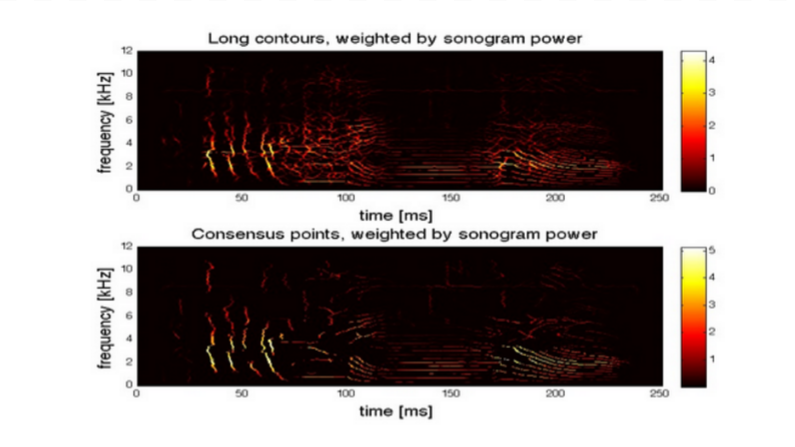
Time-frequency microstructure is unstable for regions of the time-frequency plane with spectrally dense content. For those regions, small changes in analysis parameters or added background noise in the signal can lead to changes in the details of a sonogram or contour shapes. Structurally unstable portions of the representation can be eliminated by showing only contour fragments that are in agreement across different angles and time-scales of analysis.The image below illustrates that process. On top, all long contours are shown, weighted by sonogram power.On bottom, only the structurally stable “consensus” elements are shown, also weighted by sonogram power.

Project Description

This project seeks to develop a high density, minimally invasive electrode array for long-term recording and control of brain activity. Multielectrode arrays are an essential tool in experimental and clinical neuroscience, yet current arrays are severely limited by a mismatch between large or stiff electrodes and the fragile environment ...

OnAir Post: High-Density Recording Microelectrodes

Skip to toolbar