Brandeis University has a highly interactive research culture, with many cross-lab interactions and collaborations. This interactive culture begins with the rotation program: all first-year PhD students perform rotations in 4 research labs.
Brandeis has significant expertise in behavioral/cognitive neuroscience, cellular and molecular neuroscience, computational neuroscience and systems neuroscience (including the Sloan-Swartz Center for Theoretical Neuroscience), and developmental neuroscience.
Web Information
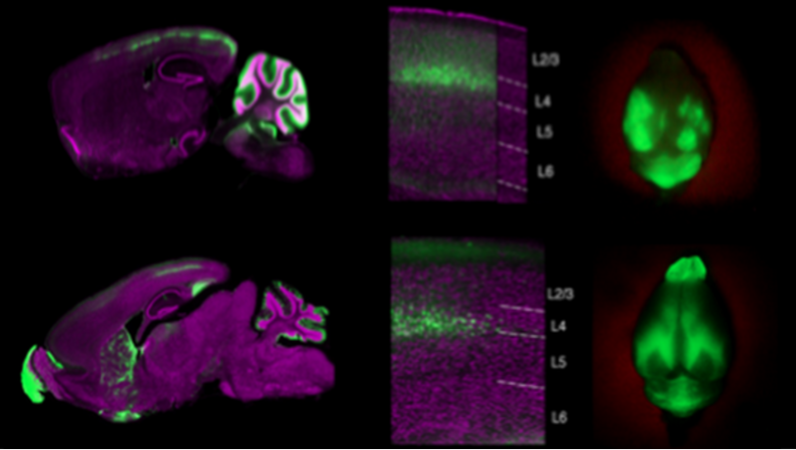
Website: http://www.bio.brandeis.edu/grad/neuro/index.html BRAIN Grant – “Combining genetics, genomics, and anatomy to classify cell types across mammals”
Contact Information
Email: scigradoffice @ brandeis.edu Phone: (781) 736-2000 Address:415 South Street, Waltham, MA
Graduate Program
The Graduate Program in Neuroscience brings together students from a variety of intellectual backgrounds — including biology, computer science, chemistry, engineering, genetics, physics, and psychology — who conduct interdisciplinary research to understand the fundamental principles of the nervous system.
Students entering the Neuroscience Program at Brandeis have opportunities to work in a range of fields, including cognitive neuroscience in humans, neurophysiology in behaving animals, the physiology and theory of synapses and networks, the structure and function of ion channels, and the neurogenetics of behavior. Brandeis has significant expertise inbehavioral/cognitive neuroscience, cellular and molecular neuroscience, computational neuroscience and systems neuroscience (including the Sloan-Swartz Center for Theoretical Neuroscience), and developmental neuroscience.
Brandeis University is an ...
OnAir Post: Brandeis University