Neural Systems Institute @Rockefeller


The Kavli Neural Systems Institute (Kavli NSI) at The Rockefeller University will promote interdisciplinary research and learn to tackle the biggest questions in neuroscience through high-risk, high-reward projects and the development of new research technologies.

“Kavli’s investment in neuroscience at Rockefeller will enable us to create and share new research approaches and laboratory technologies to capture the possibilities of neuroscience from the micro to the macro level,” said Rockefeller President Marc Tessier-Lavigne, PhD. “


Web Information

Kavli Foundation web page: http://www.kavlifoundation.org/rockefeller-university

About Kavlin NSI

Neuroscience is undergoing a convergence with fields such as bioengineering, nanoscience, and computer science that is expected to accelerate in the coming decades. The Kavli Neural Systems Institute (Kavli NSI) aims to be at the forefront of that shift, where multidisciplinary teams of scientists will work to develop new tools and novel approaches to meet the very biggest challenge’s in neuroscience.

The Kavli NSI fosters collaboration among Rockefeller’s dynamic community of scientists, including faculty, graduate students and postdoctoral fellows. Together, they seek to generate new knowledge about the brain at many levels, from molecules to cells, and from circuits to the whole brain. The ultimate goal is to integrate these different neural systems into a comprehensive view of the brain.

The Kavli ...

OnAir Post: Neural Systems Institute @Rockefeller

Rockefeller University

Centered around 76 cutting-edge laboratories working in a broad range of fields, The Rockefeller University fosters a collaborative research environment for its faculty and provides an innovative educational experience for its outstanding graduate students and postdoc researchers.

To help reduce artificial barriers and provide its investigators with the greatest degree of freedom, Rockefeller does not have academic departments. As a result, the university is not constrained to perform research in any particular field and can recruit the most accomplished and gifted investigators across a wide spectrum of disciplines in the sciences.

Web Information

Website: rockefeller.edu/ Wikipedia Entry: wiki/Rockefeller_University Brain Initiative Grant – “Remote regulation of neural activity”

Contact Information

Email: contacts Phone: 212-327-8000 Address: The Rockefeller University | 1230 York Avenue, New York, NY 10065

Fisher Center for Alzheimer’s Disease Research

The Fisher Center is a nexus for Alzheimer’s disease research at Rockefeller. The center’s scientists use state-of-the-art technologies to expand and accelerate Alzheimer’s research and lay the foundation for new treatment strategies.

The center’s investigations build on Alzheimer’s studies conducted in Rockefeller University labs, particularly research focused on how the cells of the brain process the amyloid precursor protein (APP). Faulty regulation of APP processing — in which APP is chopped into smaller pieces during normal brain cell ...

OnAir Post: Rockefeller University

Charles Gilbert, MD/PhD – Rockefeller


Arthur and Janet Ross Professor, Laboratory of Neurobiology

Dr. Gilbert studies the mechanisms underlying visual perception, including the specific role of the brain’s primary visual cortex in analyzing visual images and in perceptual learning. To this end, his laboratory investigates the circuitry of the brain and how the interactions between groups of neurons contribute to perception, learning and memory.

Web Information

Rockefeller webpage: rockefeller.edu/research/faculty/labheads/CharlesGilbert/

Lab webpagelab.rockefeller.edu/gilbert/

Rockefeller neuroscience: brain2015.onair.cc/rockefeller-university/

Contact Information

Email: Charles.Gilbert@rockefeller.edu

Phone: (212) 327-8000

Address: The Rockefeller University 1230 York Avenue New York, NY 10065

Biography

Dr. Gilbert received his M.D. and Ph.D. from Harvard Medical School in 1977, where he held an academic appointment until he joined Rockefeller in 1983 as assistant professor and head of laboratory. He became associate professor in 1985 and professor in 1991 and in 2004 was named Arthur and Janet Ross Professor.

A member of the National Academy of Sciences and the American Academy of Arts and Sciences, he has received numerous awards, including the W. Alden Spencer Award from the Columbia University College of Physicians and Surgeons.

Dr. Gilbert is a faculty member in the David Rockefeller Graduate Program and the Tri-Institutional M.D.-Ph.D. Program.

Research

Dr. Gilbert studies the mechanisms underlying visual perception, including the specific role of the brain’s primary visual cortex in analyzing visual images and ...

OnAir Post: Charles Gilbert, MD/PhD – Rockefeller

A circuit theory of cortical function

This project aims to develop and test a new conceptual framework for understanding brain function, and informing biologically based artificial intelligence systems. The underlying theory holds that the properties of any neuron and any cortical area are not fixed but undergo state changes with changing perceptual task, expectation and attention.

OnAir Post: A circuit theory of cortical function

The Dynamic Brain – Charles Gilbert

2015 Scolnick Prize Lecture: The Dynamic Brain

Dr. Charles Gilbert of The Rockefeller University delivers the annual Scolnick Prize Lecture on Friday, March 20, 2015. Charles Gilbert has been a pioneer in understanding the function of visual cortex. His work addresses fundamental questions about visual perception, and has also provided important insights into how the brain recovers from injury and degenerative disease.

Video Published  April 1, 2015 by McGovern Institute for Brain Research at MIT

https://www.youtube.com/watch?v=Bwrwa4Sx4-UVideo can’t be loaded because JavaScript is disabled: 2015 Scolnick Prize Lecture: The Dynamic Brain (https://www.youtube.com/watch?v=Bwrwa4Sx4-U)

OnAir Post: The Dynamic Brain – Charles Gilbert

Remote regulation of neural activity

The Stanley team will focus on the development of tools to instantly and precisely target cell activity deep in the brain using radio waves, nanoparticles and genetically modified viruses.

NIH Webpages

OnAir Post: Remote regulation of neural activity

Cori Bargmann, PhD – Rockefeller


Torsten N. Wiesel Professor at Rockefeller University and head of the Lulu and Anthony Wang Laboratory of Neural Circuits and Behavior Co-chair of the Advisory Committee to the NIH Director (ACD) and At large member of the Multi-Council Working Group (WCWG) for the BRAIN Initiative

Cori Bargmann was awarded the Kavli Prizein 2012  and the Breakthrough Prize in Life Sciences in 2013.  Cori is known for her work on the behavior in the C. elegans, particularly olfaction in the worm.

Web Information

Rockfeller website:  rockefeller.edu/research/faculty/labheads/CoriBargmann/

HHMI pages: .hhmi.org/scientists/cornelia-i-bargmann

Laboratory of Neural Circuits and Behaviorlab.rockefeller.edu/bargmann/

Wikipedia Entry: en.wikipedia.org/wiki/Cornelia_Bargmann

Contact Information

E-mail: Cori.Bargmann@rockefeller.edu Office Phone: (212) 327-7242 Lab Phone: (212) 327-7411 Address: The Rockefeller University 1230 York Avenue New York, NY 10065


Biography

From the Kavli prize page

Cornelia Isabella Bargmann was born in 1961 in Virginia and raised in Athens, Georgia, where she attended the University of Georgia. She then went north to study cancer-signalling genes and cloned the oncogene HER2, a key factor in breast cancer, in the laboratory of Robert Weinberg at the Whitehead Institute, Massachusetts Institute of Technology.

After receiving her Ph.D. in 1987, Professor Bargmann transferred to the laboratory of H. Robert Horvitz, at MIT, where she became acquainted with the tiny worm C. elegans. Professor Horvitz had already made major contributions to understanding neural ...

OnAir Post: Cori Bargmann, PhD – Rockefeller

Laboratory of Molecular Genetics – Rockefeller

Principal Investigator: Jeffrey M. Friedman Senior Research Associate: Sarah Stanley, Rockefeller University

The application of modern methods in genetics has led to the identification of a new hormone, leptin, that regulates body weight. Leptin is an adipose tissue hormone that interacts with receptors in the brain to regulate food intake, energy expenditure and other neuroendocrine systems. The molecular mechanisms of leptin in the brain are under investigation. These studies are being conducted in parallel with efforts to identify obesity genes in the human.

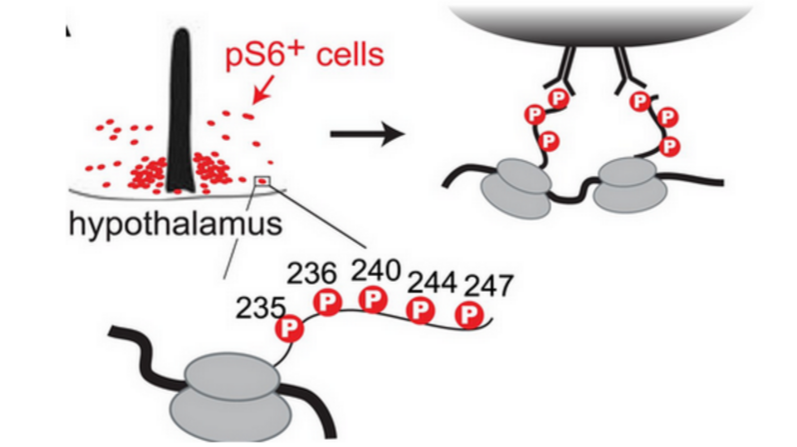
Diagram showing the phosphorylation sites on ribosomal protein S6 and strategy for immunoprecipitation of phosphorylated ribosomes. from A critical role for mTORC1 in erythropoiesis and anemia.

Web Information

Website:  lab.rockefeller.edu/friedman/ Brain Initiative Grant

Contact Information

Email: Jeffrey.Friedman@rockefeller.edu Phone: (212) 327-8000 Address: The Rockefeller University 1230 York Avenue New York, NY 10065 (212) 327-8000

Research

The application of modern methods in genetics has led to the identification of a new hormone, leptin, that regulates body weight. Leptin is an adipose tissue hormone that interacts with receptors in the brain to regulate food intake, energy expenditure and other neuroendocrine systems. The molecular mechanisms of leptin in the brain are under investigation. These studies are being conducted in parallel with efforts to identify obesity genes in the human.

Research Projects:

OnAir Post: Laboratory of Molecular Genetics – Rockefeller

Sarah Stanley, PhD – Rockefeller

Senior Research Associate , Rockefeller University and Laboratory of Molecular Genetics 

The technology Stanley is developing would enable researchers to manipulate the activity of neurons, as well as other cell types, in freely moving animals in order to better understand what these cells do. Staley’s new nanoparticle-based technique has a unique combination of features that may enable new types of experimentation.


Web Information

Webpage: rockefeller.edu/research/faculty/labmembers/JeffreyFriedman/ Brain Initiative Grant

Contact Information

Email: Sarah.Stanley@rockefeller.edu AddressAddress: The Rockefeller University 1230 York Avenue New York, NY 10065 (212) 327-8000

BRAIN Initiative Press Release

Rockefeller neurobiology lab is awarded first-round BRAIN initiative grant

Rockfeller Newswire 10/7/14

A proposal to develop a new way to remotely control brain cells from Sarah Stanley, a Research Associate in Rockefeller University’s Laboratory of Molecular Genetics, headed by Jeffrey M. Friedman, is among the first to receive funding from U.S. President Barack Obama’s BRAIN initiative. The project will make use of a technique called radiogenetics that combines the use of radio waves or magnetic fields with nanoparticles to turn neurons on or off.

The NIH is one of four federal agencies involved in the BRAIN (Brain Research through Advancing Innovative Neurotechnologies) initiative. Following in the ambitious footsteps of the Human Genome Project, the BRAIN initiative seeks to create a dynamic map of ...

OnAir Post: Sarah Stanley, PhD – Rockefeller

Skip to toolbar