Duke Institute for Brain Sciences


Summary

Duke Institute for Brain Sciences (DIBS) was created as a cross-school, campus-wide, interdisciplinary Institute with a commitment to building an interactive community of brain science research and scholarship.

DIBS encourages innovation and collaborations that transcend the boundaries of traditional disciplines, bringing together a diverse community of academics from the biomedical sciences, social sciences, physical sciences, humanities, law, business, public policy, mathematics, computer science and engineering.

Information

Website:   http://www.dibs.duke.edu/ Brain Initiative Grant – “Path Toward MRI with Direct Sensitivity to Neuro-Electro-Magnetic Oscillations”

Email:  contact form Phone: (919) 684-3422 Address: Duke University Box 91003 Levine Science Research Center, Room B107 450 Research Drive Durham, North Carolina 27708

Organization

Director: Michael Platt


About the Duke Institute for Brain Sciences

Duke Institute for Brain Sciences was created in 2007 as a cross-school, campus-wide, interdisciplinary Institute with a commitment to building an interactive community of brain science research and scholarship. DIBS encourages innovation and collaborations that transcend the boundaries of traditional disciplines, bringing together a diverse community of academics from the biomedical sciences, social sciences, physical sciences, humanities, law, business, public policy, mathematics, computer science and engineering.

Our Mission:

to advance interdisciplinary research and education that transforms our understanding of brain function and translates into innovative solutions for health and society

Our Vision:

an interactive community of scholars—faculty, students, postdoctoral fellows and staff—who ...

OnAir Post: Duke Institute for Brain Sciences

MRI Neuro-Electro-Magnetic Oscillations

Principal Investigator: Allen W Song Duke Institute for Brain Sciences Title: “Path Toward MRI with Direct Sensitivity to Neuro-Electro-Magnetic Oscillations” BRAIN Category: Next Generation Human Imaging (RFA MH-14-217)

Dr. Song’s group will develop a scanner technology sensitive enough to image brain activity in high resolution by directly tuning in the electromagnetic signals broadcast by neurons.

NIH Webpages

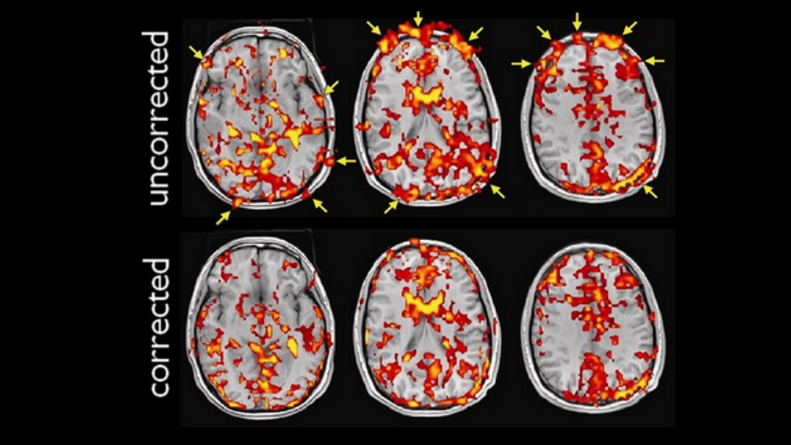
Spiral imaging is a fast MRI technique that is widely used in functional MRI. It is, however, vulnerable to spatial and temporal variations of the static magnetic field (B0) caused by susceptibility effects, subject motion, physiological noise, and system instabilities, resulting in blurring artifacts. To address these issues, we have developed a novel off-resonance correction method, based on k-space energy spectrum analysis (KESA), for inherent and dynamic B0 mapping and deblurring in spiral imaging. This method can generate a B0 map from the k-space data at each time point, without requiring any additional data acquisition or pulse sequence modification, and correct for the blurring caused by both spatial and temporal B0 variations, resulting in a high spatial and temporal fidelity.

Project Description

In response to the NIH RFA-MH-14-217 on “Planning for Next Generation Human Brain Imaging”, we propose a comprehensive plan to organize the ...

OnAir Post: MRI Neuro-Electro-Magnetic Oscillations

Emotional Brain: Mysteries of the Brain

https://www.youtube.com/watch?v=lKSuud5zMBIVideo can’t be loaded because JavaScript is disabled: Emotional Brain | Mysteries of the Brain (https://www.youtube.com/watch?v=lKSuud5zMBI)

“For years, researchers have struggled to understand how emotions are formed and processed by the brain. Now, neuroscientist Kevin LaBar and his graduate students at Duke University are using a virtual reality room to study how the brain reacts to both negative and positive emotions.

“Mysteries of the Brain” is produced by NBC Learn in partnership with the NSF.”

NSF BRAIN Initiative Published June 10, 2015

OnAir Post: Emotional Brain: Mysteries of the Brain

Allen Song, PhD – Duke


Professor of Radiology, Neurobiology, Psychiatry and Behavioral Science and Biomedical Engineering Director, Duke-UNC Brain Imaging and Analysis Center

Allen Song’s research interests focus on the acquisition methodology, processing strategies and contrast mechanism for functional MRI. Additional interests include the application of innovative fMRI acqusition and analysis methods to study functional neuroanatomy.

Web Information

Webpage:  biac.duke.edu/people/asong Duke Institute for Brain Sciences  Brain Initiative Grant

Contact Information

Emailallen.song@duke.edu Phone: (919) 684-1215 Address: Duke-UNC Brain Imaging and Analysis Center Duke University Hock Plaza, Suite 501 2424 Erwin Road Durham, NC 27705

Biography

Ph. D., 1995, Medical College of Wisconsin (Biophysics)

Post-Doctoral Fellowship, Lab of Brain and Cognition, NIH

Research

Research Interests

The acquisition methodology, processing strategies and contrast mechanism for functional MRI. Additional interests include the application of innovative fMRI acqusition and analysis methods to study functional neuroanatomy.

Research Statement

The research in this lab is concerned with the advancement of fMRI data acquisition methods that includes the development of real-time imaging using echo-planar and spiral data acquisition with high-order shimming control, development of robust and reliable single-shot image acquisition methods and optimization of the acquisition methods for improved functional sensitivity and specificity.

Our lab is also focused on understanding the contrast mechanism of the functional MRI, which includes the source localization of the functional signal using the blood ...

OnAir Post: Allen Song, PhD – Duke

Duke-UNC Brain Imaging & Analysis Center

The Brain Imaging and Analysis Center (BIAC) brings together scientists from throughout Duke University and the University of North Carolina at Chapel Hill to find interdisciplinary solutions to fundamental research questions about the human brain. Two key themes: to improve research techniques in neuroimaging and investigate the functional properties of the human brain.

OnAir Post: Duke-UNC Brain Imaging & Analysis Center

Skip to toolbar