Neuro@Tech

Neuroscience and Neuroengineering research and education are found across multiple Schools and Colleges at Georgia Tech and span a wide range of interests, many of which pivot on cutting-edge technology.

Neuro@Tech devleops and translates innovative solutions to the challenges of understanding the complexity of the nervour system, treating neurological diseases and injuries, and augmenting neural function. Neuro@Tech uses qualitative systems-level, and integrative approaches to study the brain, spinal cord, and peripheral nervous system.

Web Information

Website:  neuro.gatech.edu/ Brain Initiative Grant – “In-vivo circuit activity measurement at single cell, sub-threshold resolution”

Contact Information

Email: andrews@bme.gatech.edu

About

Welcome to Neuro@Tech!  Neuroscience and Neuroengineering research and education are found across multiple Schools and Colleges at Georgia Tech and span a wide range of interests, many of which pivot on cutting-edge technology. We develop and translate interdisciplinary and innovative solutions to the challenges of understanding the complexity of the nervous system, treating neurological diseases and injuries, and augmenting neural function.

What makes Neuro@Tech special? Neuro@Tech is a dynamic and exciting community that fosters our existing programs and catalyzes new collaborative directions within Georgia Tech and with the broader Neuroscience and Neuroengineering communities.  We use quantitative, systems-level, and integrative approaches to study the most complex human organ—the brain—and the equally elegant spinal cord and ...

OnAir Post: Neuro@Tech

Activity measurement at single cell

Principal Investigator: Craig Forest Georgia Institute of Technology Title: “In-vivo circuit activity measurement at single cell, sub-threshold resolution” BRAIN Category: Tools for Cells and Circuits (RFA MH-14-216)

Dr. Forest’s team will use a newly developed robot guided technique to measure precise changes in electrical activity from individual neurons that are connected over long distances across the brain, to understand how these connections change when our brains go into different states, such as sleeping and waking.

NIH Webpages


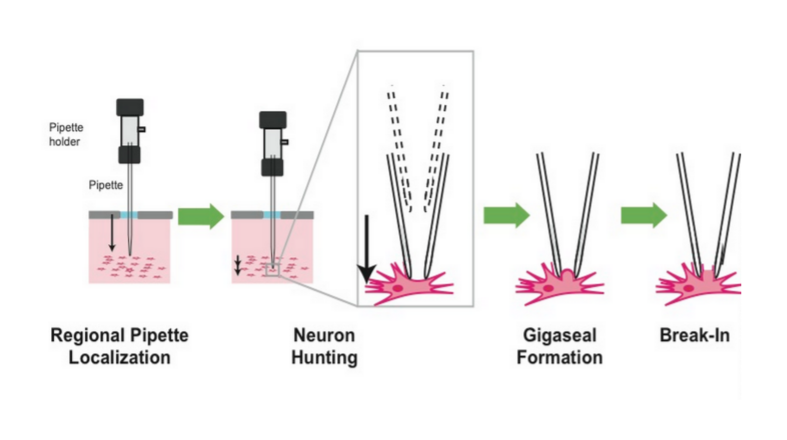
Whole-cell patch clamp electrophysiology of neurons, although a gold standard technique for high-fidelity analysis of the biophysical mechanisms of neural computation and pathology, requires great skill to perform. We have developed a simple robot that automatically performs patch clamping in vivo, algorithmically detecting cells by analyzing the temporal sequence of electrode impedance changes. We demonstrate good yield, throughput, and quality of recording in mouse cortex and hippocampus..

Project Description

Neurons communicate information through fluctuations in the electrical potentials across their cellular membranes. Whole-cell patch clamping, the gold standard technique for measuring these fluctuations, is something of an art form, requiring great skill to perform on only a few cells per day. Thus, it has been primarily limited to in vitro experiments, a few in ...

OnAir Post: Activity measurement at single cell

Craig Forest, PhD – Ga. Tech

Associate Professor of Bioengineering and BioMedical Engineering, Georgia Tech Principal Investigator, Precision Biosystems Laboratory Facilitator of the Invention Studio

Forest conducts research on miniaturized, high-throughput robotic instrumentation to advance neuroscience and genetic science, working at the intersection of bioMEMS, precision machine design, optics, and microfabrication. Prior to Georgia Tech, he was a research fellow in Genetics at Harvard Medical School.

Web Information

Webpage: me.gatech.edu/faculty/forest Neuro@Tech Brain Initiative Grant

Contact Information

Emailcraig.forest@me.gatech.edu Phone: 404-385-7645 Address: IBB Building, Room 1310

Biography

Education

Ph.D., Massachusetts Institute of Technology, 2007 M.S.M.E., Massachusetts Institute of Technology, 2003 B.S.M.E., Georgia Institute of Technology, 2001

Background

Dr. Craig Forest joined the Woodruff School of Mechanical Engineering as an Assistant Professor in August 2008.  Since then he has established a research program focused on the creation and application of miniaturized, high-throughput robotic instrumentation to advance biomolecular science, along with the fundamental engineering that makes such instrumentation possible. Dr. Forest’s laboratory works at the intersection of bioMEMS, machine design, signal processing, optics, and manufacturing at the frontiers of the emerging bio-nano field. The development of instruments that can load, manipulate, and measure many biological samples at the resolution of single cells simultaneously with better accuracy and reliability than current approaches opens the door to essential, comprehensive biological system studies.

“New directions in science are ...

OnAir Post: Craig Forest, PhD – Ga. Tech

Precision Biosystems Laboratory – Ga. Tech

The Precision Biosystems Laboratory is focused on fundamental engineering advancements, the development of miniaturized, high-throughput robotic instrumentation, and the application of the two to advance biomolecular science. Their research program is in the emerging bio-nano field—at the intersection of bioMEMS, machine design, neuroengineering, genetics, optics, and manufacturing.

OnAir Post: Precision Biosystems Laboratory – Ga. Tech

Skip to toolbar