Nanotechnology Grand Challenge


White House Office of Science and Technology Policy (OSTP) is announcing a grand challenge to develop transformational computing capabilities by combining innovations in multiple scientific disciplines.

The grand challenge, to  create a new type of computer that can proactively interpret and learn from data, solve unfamiliar problems using what it has learned, and operate with the energy efficiency of the human brain, addresses three administration priorities—the National Nanotechnology Initiative, the National Strategic Computing Initiative (NSCI), and the BRAIN initiative.

Web Information

National Nanotechnology Initiative website: http://www.nano.gov

Announcement

A Nanotechnology-Inspired Grand Challenge for Future Computing 

(October 20, 2015) The National Nanotechnology Coordination Office (NNCO) is pleased to highlight an important announcement issued today by the White House Office of Science and Technology Policy (OSTP), naming the first Nanotechnology-Inspired Grand Challenge in the field of Future Computing.

The grand challenge, to  create a new type of computer that can proactively interpret and learn from data, solve unfamiliar problems using what it has learned, and operate with the energy efficiency of the human brain, addresses three administration priorities—the National Nanotechnology Initiative, the National Strategic Computing Initiative (NSCI), and the BRAIN initiative. In order to continue the rapid pace of innovation beyond the next decade, major breakthroughs are ...

OnAir Post: Nanotechnology Grand Challenge
Best and Worst of Neuroscience and Neurology – August 2015

Brain Blogger’s best and worst of neuroscience and neurology for August 2015 by Viatcheslav Wlassoff, PhD.

The Best: Neuronal activity protects against neurodegeneration Modafinil is a first scientifically verified nootropics Existing drug might be helpful for slowing down Parkinson’s disease progression 10-minute test for dementia The brain’s ability to get rid of beta-amyloids reduces with age Physically active elderly people show greater mental flexibility

To read more: go to http://brainblogger.com/2015/09/16/best-and-worst-of-neuroscience-and-neurology-august-2015/


OnAir Post: Best and Worst of Neuroscience and Neurology – August 2015

BrainHack Americas Conference & Papers


The “Brainhack Thematic Series – Open Tools for Neuroscience” will highlight new tools and pipelines produced from past and future Brainhack events, in order to improve data sharing and reproducibility of results within neuroscience.

In addition to open review and open-access publication of your Research Articles, Technical Notes, and Data Notes, all supporting tools, materials, methods and results will also be openly available in the GigaScience repository, GigaDB.


Web Information

BrainHack Americas webpagebrainhack.org/americas/

BrainHack Americas

Brainhack is a unique conference that convenes researchers from across the globe and a myriad of disciplines to work together on innovative projects related to neuroscience. Year after year, global Brainhack events have brought together researchers to participate in open collaboration, and regional Brainhack events keep the momentum going throughout the year.

Brainhack Americas will unite several regional Brainhack events throughout North, Central, and South Americas during October 23, 24 & 25, 2015. Having several simultaneous events will help build a critical mass for the regional Brainhack movement and will provide opportunities for inter-Brainhack collaboration. Local events will be connected by videoconference to expand collaborative opportunities so that smaller sites can plug into the content and energy generated at larger sites.

Sites in Ann Arbor, MI, Atlanta, GA, Berkeley, CA, Miami, FL, ...

OnAir Post: BrainHack Americas Conference & Papers

Artifical neuron mimics human cells

Scientists at Sweden’s Karolinska Institutet have built what they claim is a fully functional neuron by using organic bioelectronics. This artificial neuron mimics the function of a human nerve cell and communicates in the same way as neurons do.

Such a device could eventually be miniaturized and implantable, says lead investigator Agneta Richter-Dahlfors, Karolinska Institutet professor of cellular microbiology. The research objective: improve treatments for neurological disorders, which are currently limited to traditional electrical stimulation.

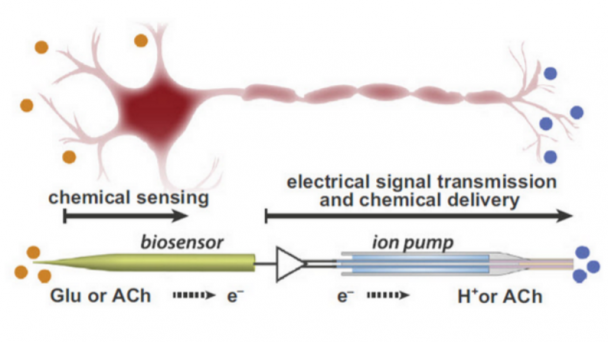
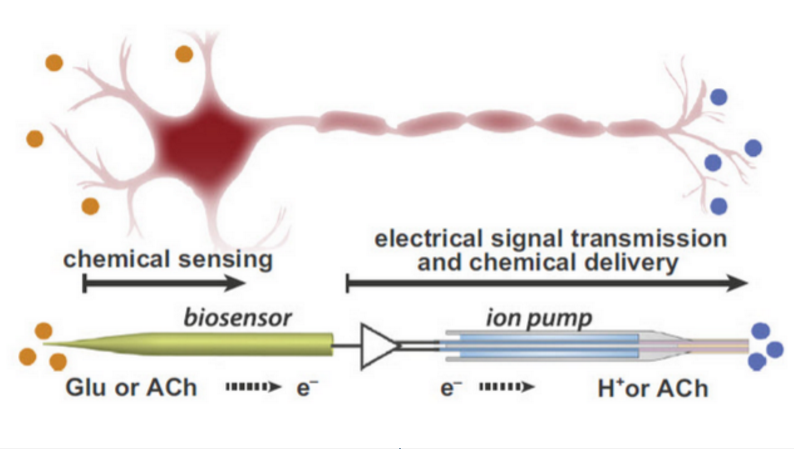
Chemical-to-electrical-to-chemical signal transmission. A conventional neuron (upper panel) senses chemical signals (orange circles), which trigger an electrical pulse of membrane depolarization (action potential) along the axon, causing chemical release at the axon terminals (blue circles). This process can be mimicked (lower panel) by a chemical biosensor (for glutamate or acetylcholine) connected to an axon-mimicking organic electronic ion pump that transmits electrons/ions and generates chemicals — forming an organic electronic biomimetic neuron. (credit: Daniel T. Simon et al./Biosensors and Bioelectronics

Press Release

Artifical neuron mimicks function of human cells

June 24, 2015

Scientists at Sweden’s Karolinska Institutet have managed to build a fully functional neuron by using organic bioelectronics. This artificial neuron contain no ‘living’ parts, but is capable of mimicking the ...

OnAir Post: Artifical neuron mimics human cells

Skip to toolbar