A new era of Exploration – Cori Bargmann

https://www.youtube.com/watch?v=Rt938F08d7c

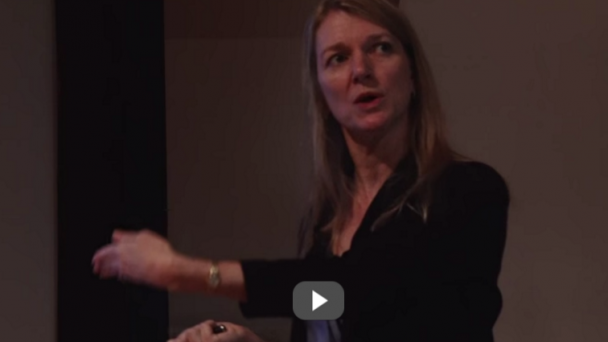
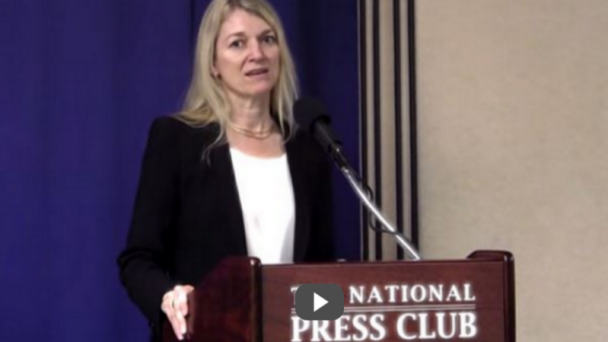
Rockefeller University neuroscientist Cori Bargmann, Ph.D., discussed the promise of the BRAIN Initiative at a press conference announcing the first wave of awards, September 30, 2014. Presentation of the BRAIN Initiative awards at the National Press Club.

Published on Oct. 20, 2014 by National Institute of Mental Health (NIMH)


OnAir Post: A new era of Exploration – Cori Bargmann

Cori Bargmann, PhD – Rockefeller


Torsten N. Wiesel Professor at Rockefeller University and head of the Lulu and Anthony Wang Laboratory of Neural Circuits and Behavior Co-chair of the Advisory Committee to the NIH Director (ACD) and At large member of the Multi-Council Working Group (WCWG) for the BRAIN Initiative

Cori Bargmann was awarded the Kavli Prizein 2012  and the Breakthrough Prize in Life Sciences in 2013.  Cori is known for her work on the behavior in the C. elegans, particularly olfaction in the worm.

Web Information

Rockfeller website:  rockefeller.edu/research/faculty/labheads/CoriBargmann/

HHMI pages: .hhmi.org/scientists/cornelia-i-bargmann

Laboratory of Neural Circuits and Behaviorlab.rockefeller.edu/bargmann/

Wikipedia Entry: en.wikipedia.org/wiki/Cornelia_Bargmann

Contact Information

E-mail: Cori.Bargmann@rockefeller.edu Office Phone: (212) 327-7242 Lab Phone: (212) 327-7411 Address: The Rockefeller University 1230 York Avenue New York, NY 10065


Biography

From the Kavli prize page

Cornelia Isabella Bargmann was born in 1961 in Virginia and raised in Athens, Georgia, where she attended the University of Georgia. She then went north to study cancer-signalling genes and cloned the oncogene HER2, a key factor in breast cancer, in the laboratory of Robert Weinberg at the Whitehead Institute, Massachusetts Institute of Technology.

After receiving her Ph.D. in 1987, Professor Bargmann transferred to the laboratory of H. Robert Horvitz, at MIT, where she became acquainted with the tiny worm C. elegans. Professor Horvitz had already made major contributions to understanding neural ...
OnAir Post: Cori Bargmann, PhD – Rockefeller

BRAIN Initiative on Charlie Rose Show

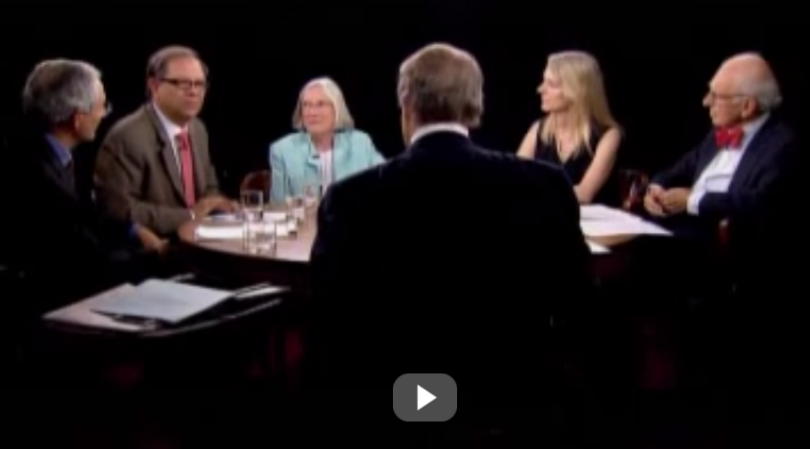
From left to right: Thomas Insel of the National Institute of Mental Health, William Newsome of Stanford University, Story Landis of the National Institute of Health, Cornelia Bargmann of Rockefeller University, William Newsome of Stanford University, and Eric Kandel of Columbia University. Charlie Rose back to camera.

Charlie Rose welcomed on July 14, 2013 a distinguished panel to discuss President Obama’s BRAIN initiative, including Eric Kandel, Thomas Insel, Story Landis, Cornelia Bargmann and William Newsome.

This 14 minute clip includes the opening setup and the conclusion during which the panelists each expresses what results they would like, or hope, to see. This 14th episode concludes the second season of the Charlie Rose Brain Series.

Full episode here: charlierose.com/watch/60241001 

https://www.youtube.com/watch?v=CtdFdWkBv8oVideo can’t be loaded because JavaScript is disabled: Charlie Rose Brain Series 2, Episode 14 (https://www.youtube.com/watch?v=CtdFdWkBv8o)


Curator comment

At the segment starting around minute 42 in the full episode on the Charlie Rose site, Rose says there needs to be a public information project…to facilitate “sharing of knowledge” …. on ...

OnAir Post: BRAIN Initiative on Charlie Rose Show

Cori Bargmann: 2012 Allen Symposium

https://www.youtube.com/watch?v=Blquxto1oIoVideo can’t be loaded because JavaScript is disabled: Cori Bargmann: 2012 Allen Institute for Brain Science Symposium (https://www.youtube.com/watch?v=Blquxto1oIo)

Published on November 12, 2012  by Allen Institute for Brain Science

Dr. Cori Bargmann, recent winner of the Kavli Prize in Neuroscience and a pioneer in methods of looking at C. elegans to uncover how neural circuits operate, presented the idea that particular classes of genes — neuropeptides to be specific — are good places to look for the genetic origin of behavior. Because much of the genome is conserved across species and throughout time, new behaviors may be created by redeploying old genes in different ways.

Uncovering the basic building blocks of behavior, she believes, is an unsolved question in neuroscience that is now becoming solvable.

“The question is not whether calbindin is expressed in the hippocampus, but whether it has something to do with the unique functions of human memory capabilities,” Bargmann said. “That is a hard question.” Certain kinds of molecules relate to innate behaviors that are shared across ...

OnAir Post: Cori Bargmann: 2012 Allen Symposium

Skip to toolbar