RAM Replay, a DARPA program

The RAM (Restoring Active Memory) Replay DARPA research program aims to investigate the role of neural “replay” in the formation and recall of memory. The goal is to help individuals better remember specific episodic events and learned skills. The military application is to improve rehabilitation and recovery for injured warfighters challenged by impaired memory.

The program is designed to develop “novel, rigorous computational methods to help investigators determine which brain components matter in memory formation and recall, and how much they matter.”

DARPA Article

DARPA Aims to Accelerate Memory Function for Skill Learning

Research may accelerate rehabilitation post trauma or memory impairment, enable warfighter training

OUTREACH@DARPA.MIL 4/27/2015

A new DARPA program aims to investigate the role of neural “replay” in the formation and recall of memory, with the goal of helping individuals better remember specific episodic events and learned skills. The 24-month fundamental research program, Restoring Active Memory Replay or RAM Replay, is designed to develop novel and rigorous computational methods to help investigators determine not only which brain components matter in memory formation and recall but also how much they matter. To ensure real-world relevance, those assessments will be validated through performance on DoD-relevant tasks instead of conventional computer-based behavioral paradigms commonly used ...

OnAir Post: RAM Replay, a DARPA program

HAPTIX, a DARPA program

Despite recent advances in technology for upper-limb prostheses, artificial arms and hands are still unable to provide users with sensory feedback. DARPA has awarded prime contracts for Phase 1 of its Hand Proprioception and Touch Interfaces (HAPTIX) program.

HAPTIX seeks to create a prosthetic hand system that moves and provides sensation like a natural hand. Sensory feedback, especially from the hand, is vitally important for many functions, and HAPTIX seeks to create a sensory experience so rich and vibrant that users would want to wear their prostheses full time.


Video

HAPTIX Virtual Limb Simulator Technologies

Published Feb. 9. 2015 by DARPAtv

DARPA’s Hand Proprioception and Touch Interfaces (HAPTIX) program seeks to develop advanced neural interfaces that would enable prosthetic hand systems to move and provide sensation like natural hands. To help the performers more quickly and cost-effectively conduct their research, DARPA is providing prosthetics simulation software for testing designs.

https://www.youtube.com/watch?v=VXCpVz-EAnEVideo can’t be loaded because JavaScript is disabled: HAPTIX Virtual Limb Simulator Technologies (https://www.youtube.com/watch?v=VXCpVz-EAnE)

DARPA Articles

HAPTIX Starts Work to Provide Prosthetic Hands ...

OnAir Post: HAPTIX, a DARPA program

RAM, DARPA program

Through the Restoring Active Memory (RAM) program, DARPA seeks to accelerate the development of technology able to address this public health challenge and help servicemembers and others overcome memory deficits by developing new neuroprosthetics to bridge gaps in the injured brain.

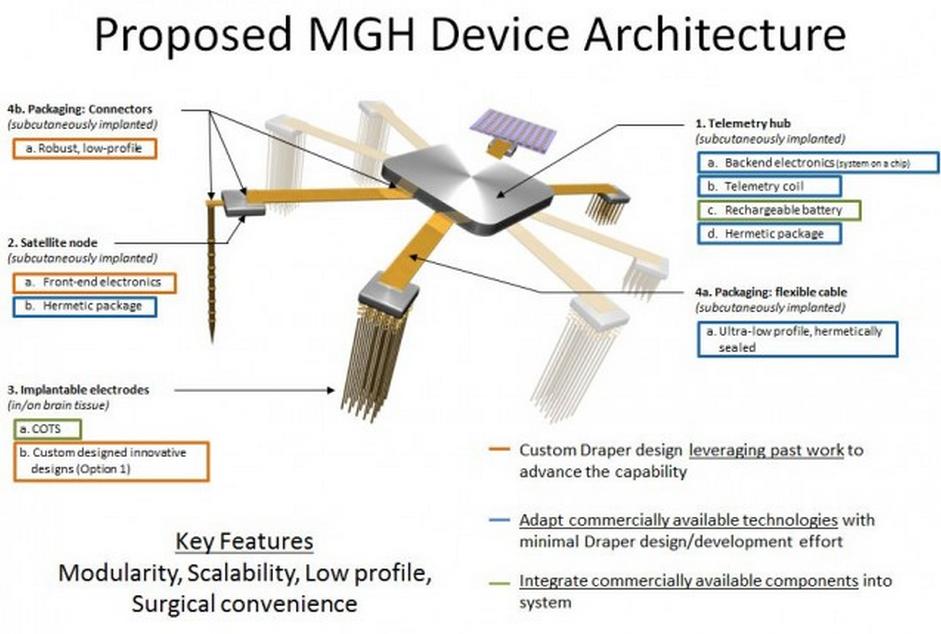
The end goal of RAM is to develop and test a wireless, fully implantable neural-interface medical device for human clinical use, but a number of significant advances will be targeted on the way to achieving that goal.”

Video

DARPA Developing Device to Restore Memory

Published July 15, 2014 by DoD News

DARPA’s Restoring Active Memory (RAM) program seeks to accelerate the pace of neuro-technology and restore lost memories.

https://www.youtube.com/watch?v=b7mMvzE-O3c

DOD/DARPA Articles

DARPA’s Memory Restoration Program

by JTozer July 15, 2014

We all forget things from time to time. 

The grocery list.  Our wallets.  Phone numbers.  That guy at the party who clearly remembers you but you can’t for the life of you remember his name. Forgetting things seems like it’s almost part of the human experience.  For the most part, these are easily corrected mistakes.  You go get the list, find your wallet, charge your phone, smile politely, and move on.

But for people with traumatic brain injuries ...

OnAir Post: RAM, DARPA program

SUBNETS, a DARPA Program

The Systems-Based Neurotechnology for Emerging Therapies (SUBNETS) was created in response to a pressing need. Despite the continued best efforts of the Departments of Defense and Veterans Affairs to protect the health of U.S. servicemembers and veterans, the effects of neuropsychological illness brought on by war, traumatic injuries, and other experiences remain challenging to treat.

The SUBNETS vision is distinct from current therapeutic approaches in that it seeks to create an implanted, closed-loop diagnostic and therapeutic system for treating, and possibly even curing, neuropsychological illness.

DARPA Articles

Systems-Based Neurotechnology for Emerging Therapies (SUBNETS)

by Dr. Justin Sanchez (BRAIN 2015 profile)

The Systems-Based Neurotechnology for Emerging Therapies (SUBNETS) program was created in response to a pressing need. Despite the continued best efforts of the Departments of Defense and Veterans Affairs to protect the health of U.S. servicemembers and veterans, the effects of neuropsychological illness brought on by war, traumatic injuries, and other experiences remain challenging to treat. Current approaches—surgery, medications, and psychotherapy—can often help to alleviate the worst effects of illnesses such as major depression and post-traumatic stress, but they are imprecise and not universally effective. Through SUBNETS, ...

OnAir Post: SUBNETS, a DARPA Program

Skip to toolbar