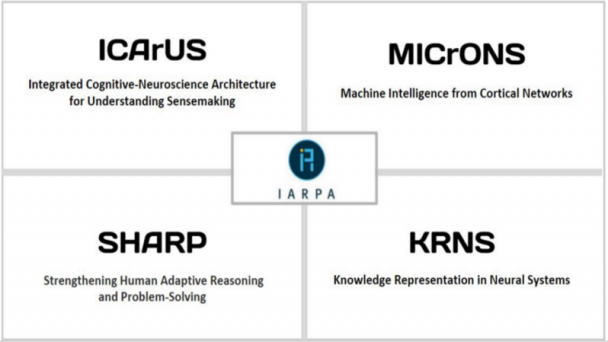
IARPA & the BRAIN Initiative


The acronyms for the four BRAIN Initiative related IARPA programs are ICArUS. MICrONS, KRNS, and SHARP.

The Intelligence Advanced Research Projects Activity (IARPA) invests in high-risk, high-payoff research programs to tackle some of the most difficult challenges of the agencies and disciplines in the Intelligence Community (IC). IARPA does not have an operational mission and does not deploy technologies directly to the field. Instead, IARPA facilitates the transition of research results to our IC customers for operational application.

Web Information

Website: www.iarpa.gov/ Neuroscience webpage: iarpa.gov/research-programs/neuroscience-programs-at-iarpa Wikipedia Entry: wiki/Intelligence_Advanced_Research_Projects_Activity


Contact Information

Email: dni-iarpa-info@iarpa.gov Phone: (301) 851-7500 Address: Office of the Director of National Intelligence Intelligence Advanced Research Projects Activity Washington, DC 20511


About IARPA

IARPA collaborates across the IC

to ensure that our research addresses relevant future needs. This cross-community focus ensures our ability to:

address cross-agency challenges leverage both operational and R&D expertise from across the IC coordinate transition strategies with our agency partners

IARPA does not have an operational mission and does not deploy technologies directly to the field. Instead, IARPA facilitates the transition of research results to our IC customers for operational application.

Our Leadership

IARPA is led by a distinguished group of accomplished scientists and researchers.

Our Organization

There are four research thrusts within IARPA embodied in four offices:

Office for Anticipating Surprise

The Office for Anticipating Surprise (OAS) focuses ...

OnAir Post: IARPA & the BRAIN Initiative

ICArUS, an IARPA program


The focus of the Integrated Cognitive- Neuroscience Architectures for Understanding Sensemaking (ICArUS)  Program is to understand and model how humans engage in the sensemaking process, both during optimal and suboptimal (biased) performance. Of particular interest are cognitive biases related to attention, memory, and decision making.

Sensemaking refers to the remarkable human ability to detect patterns in data, and to infer the underlying causes of those patterns – even when the data are sparse, noisy, and uncertain.

Web Information

IARPA Neuroscience programs pageiarpa.gov/neuroscience-programs-at-iarpa

ICArUS pagehttp://www.iarpa.gov/index.php/research-programs/icarus

Program Office pagehttp://www.iarpa.gov/index.php/about-iarpa/incisive-analysis

Contact Information

Program Manager email: rita.bush@iarpa.gov

Phone: (301) 851-7431

Address: Office of the Director of National Intelligence Intelligence Advanced Research Projects Activity Washington, District of Columbia 20511

Program Office

Office of Incisive Analysis

The Office of Incisive Analysis (IA) focuses on maximizing insights from the massive, disparate, unreliable and dynamic data that are—or could be—available to analysts, in a timely manner. We are pursuing new sources of information from existing and novel data, and we are investigating innovative techniques that can be utilized in the processes of analysis. Our programs are in diverse technical disciplines but have common features:

Involve potential transition partners at all stages, beginning with the definition of success; Create technologies that can earn the trust of the analyst user by providing the reasoning for ...

OnAir Post: ICArUS, an IARPA program

Skip to toolbar