Next generation imaging in vivo

Principal Investigator: Elly  Nedivi Massachusetts Institute of Technology Title: “Next generation high-throughput random access imaging, in vivo” BRAIN category: Large-Scale Recording-Modulation – Optimization (RFA NS-14-008)

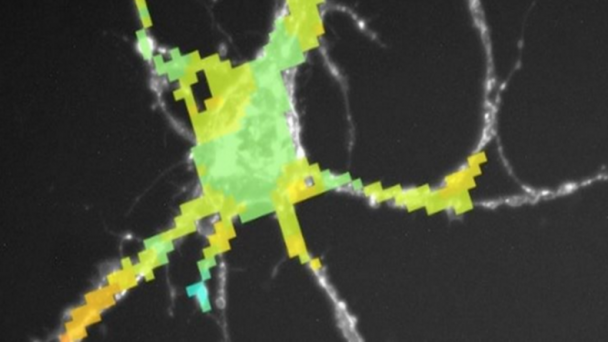
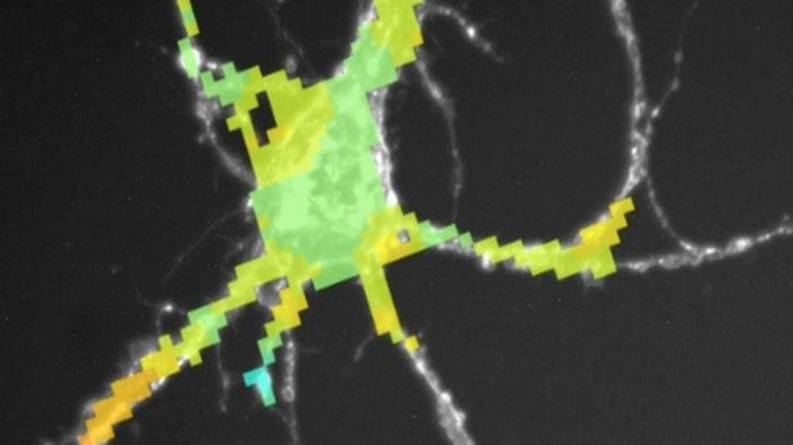
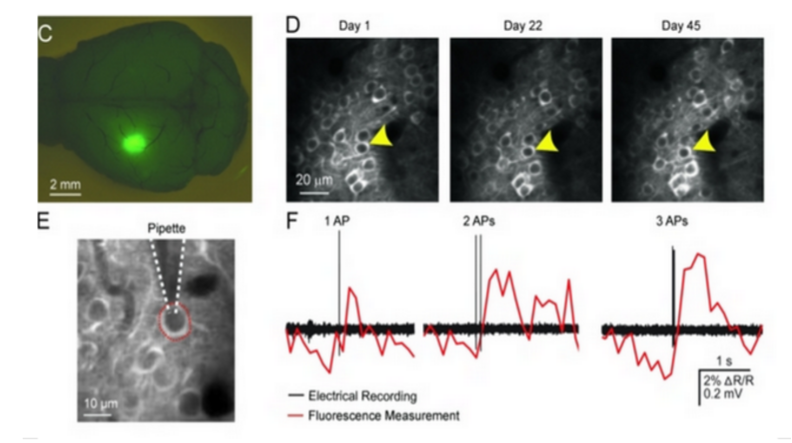
Dr. Nedivi’s team proposes a new imaging technology to simultaneously record activity at each of the thousands of synapses, or communication points, on a single neuron.

NIH Webpages

https://www.youtube.com/watch?v=lHLSFhp5HawVideo can’t be loaded because JavaScript is disabled: Neurotech 1: Multi-Photon Microscopy (https://www.youtube.com/watch?v=lHLSFhp5Haw)

Project Description

The goal of this proposal is to develop new methods for high speed monitoring of sensory-driven synaptic activity across all inputs to single living neurons in the context of the intact cerebral cortex. Although our focus is on understanding how synaptic inputs are integrated across a single neuron embedded in an intact circuit, the next generation random access imaging technology we propose is more broadly applicable for monitoring multi-cellular activity representing large intra-and inter areal neuronal networks. The approach improves on the speed and sensitivity of current random-access technology by nearly 2 orders of magnitude, enabling high- throughput interrogation of up to 104 independent locations within a fraction of a millisecond and compatible with imaging using next generation voltage sensitive indicators. ...

OnAir Post: Next generation imaging in vivo
Optimization of 3-photon microscopy

Principal Investigator: Chris Xu Cornell University Title: “Optimization of 3-photon microscopy for Large Scale Recording in Mouse Brain” BRAIN Category: Large-Scale Recording-Modulation – Optimization (RFA NS-14-008)

Dr. Xu and his collaborators will build new lasers and lenses to use three-photon microscopy to watch neuronal activity far deeper inside the brain than currently possible.

NIH Webpages

Project Description

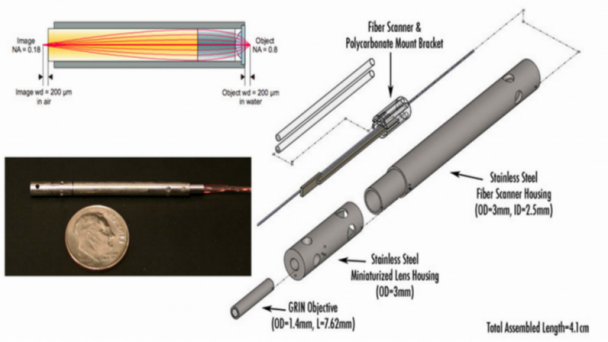
The goal of this research program is to optimize three-photon fluorescence microscopy (3PM) for large scale, noninvasive, volumetric imaging of neuronal activity. To leverage the superb performance of green-fluorescent protein based genetically engineered Ca-probes (e.g., GCaMPs), 3PM at the 1300-nm spectral window will be developed, which not only preserves the tissue penetration capability of 3PM at the longer excitation wavelength but also enables a wide variety of blue and green fluorophores, including a number of fluorescent proteins and Ca-indicators, to be excitable via three-photon excitation. To improve the signal-to-noise ratio (SNR) so that a practical frame rate can be achieved for imaging dynamic brain activity even at a penetration depth of 1.1 mm or beyond, new objective lenses will be designed and fabricated that will collect the signal efficiently at depth. In additin, the lens design will also support convenient integration with adaptive optics (AO), with the goal of making ...

OnAir Post: Optimization of 3-photon microscopy

Protein-based Voltage Probes

Principal Investigator: Vincent Allen Pieribone Yale Neuroscience Title: “Development of Protein-based Voltage Probes” BRAIN Category: Large-Scale Recording-Modulation – Optimization (RFA NS-14-008)

Dr. Pieribone and his team will optimize fluorescent voltage probe technology, to allow scientists to measure the activity of thousands of neurons using only a camera and a microscope.

NIH Webpages

Fluorogenetic Voltage Sensors. From website.

Project Description

The use of genetically encoded fluorescent activity probes represent the most advanced method to monitor the electrical activity of networks of neurons without using electrodes. While genetically encoded calcium indicators have been evolved to produce robust signals in a variety of different neuronal preparations, fluorescent probes of membrane potential have not been well evolved. Current voltage probes, while finally in expanded use, will need considerable improvement if the goal of recording the activity of a large number of neurons simultaneously in vivo is to be achieved. The goal of this project is to discover protein-based fluorescent voltage probes with signal to noise characteristics that allow routine optical recording of action potentials from single cortical neurons in vivo. We are seeking probes with significantly improved signal to noise characteristics, red-shifted fluorescence spectra, faster on and off rates and better plasma membrane expression. This ...

OnAir Post: Protein-based Voltage Probes

3D Holography for Optogenetic Manipulation

Principal Investigator: Serge Picaud Pierre and Marie Curie University Title: “Three Dimensional Holography for Parallel Multi-target Optogenetic Circuit Manipulation” BRAIN Category: Large-Scale Recording-Modulation – Optimization (RFA NS-14-008)

Dr. Picaud’s team will continue its development of holographic imaging to use lasers to induce the natural electrical activity of neurons and test theories of how circuits produce behaviors in a range of animal models.

NIH Webpages

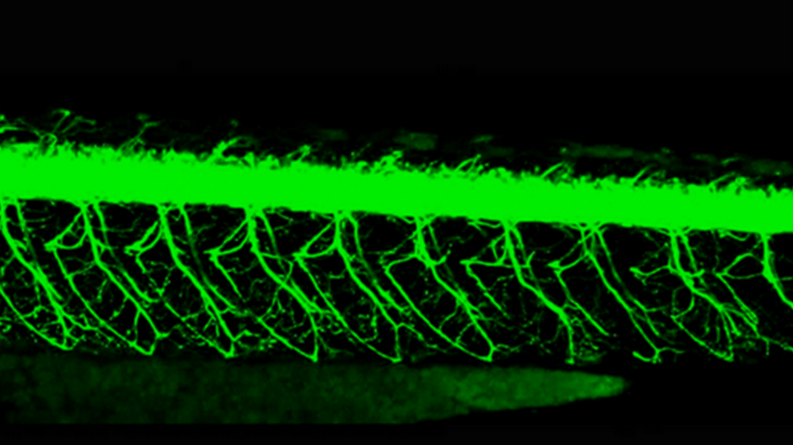
Zebrafish motoneurons visible thanks to a green fluorescent molecule, the GFP (Green Fluorescent Protein)© Inserm/Leclerc, Philippe

Project Description

Understanding communication between neurons, who is talking to whom, and what language they are speaking, is essential for discovering how brain circuits underlie brain function and dysfunction. Over the past decades, Neuroscience has made exponential progress toward recording and imaging communication between neurons. In addition, geneticists have recently developed the capability to manipulate neurons with light through the expression of light-activated microbial proteins called “opsins.” Now, neuroscientists can drive neural circuits in order to determine how they give rise to sensation, perception, and cognitive function. In order to take full advantage of “optogenetic” tools, we are developing holographic methods to deliver patterned light into brain tissue, to enable simultaneous activation of multiple neurons, independently controlling the strength and ...

OnAir Post: 3D Holography for Optogenetic Manipulation

Protein voltage sensor imaging in vivo

Principal Investigator: Mark J Schnitzer Stanford Neuroscience Title: “Protein voltage sensors: kilohertz imaging of neural dynamics in behaving animals” BRAIN Category: Large-Scale Recording-Modulation – Optimization (RFA NS-14-008)

Dr. Schnitzer and his team have created a new system for developing optical voltage sensors, which will allow scientists to simultaneously record firing of large groups of neurons or electrical activity in precise locations inside of neurons, such as synapses.

NIH Webpages

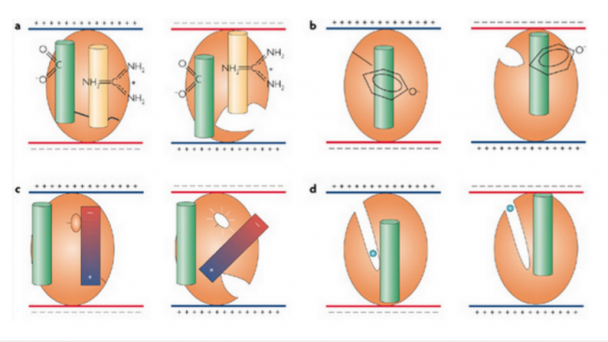
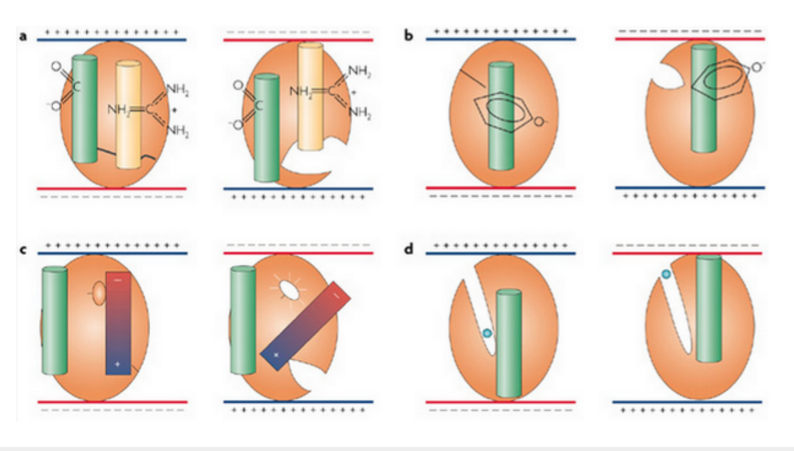
The diagrams show a hypothetical protein (orange oval) and the formation of an active site, which is due to a voltage-induced conformational change that is mediated by the defined regions of the protein (green and yellow cylinders). a | Charged amino acids may move within membranes in response to changes in voltage. The side groups of Asp and Arg are shown. b | Reorientation of an intrinsic residue dipole, such as Tyr, through changes in the field. c | An alpha-helix that is the length of the membrane (red to blue gradient) has a dipole moment that is equivalent to the length of the helix that separates plusminus0.5 electronic charges (e0); therefore, it can also reorientate when the field is changed. The oval that is attached to the alpha-helix ...

OnAir Post: Protein voltage sensor imaging in vivo

Optical control of synaptic transmission

Principal Investigator: Richard  Kramer UC Berkeley Helen Wills Neuroscience Institute Title: ” Optical control of synaptic transmission for in vivo analysis of brain circuits and behavior” BRAIN Category: Large-Scale Recording-Modulation – Optimization (RFA NS-14-008)

Dr. Kramer’s team will develop light-triggered chemical compounds that selectively activate or inhibit neurotransmitter receptors on neurons, to precisely control the signals sent between brain cells in behaving animals.

NIH Webpages

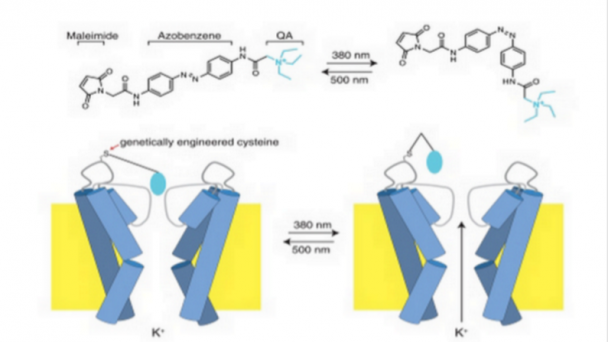
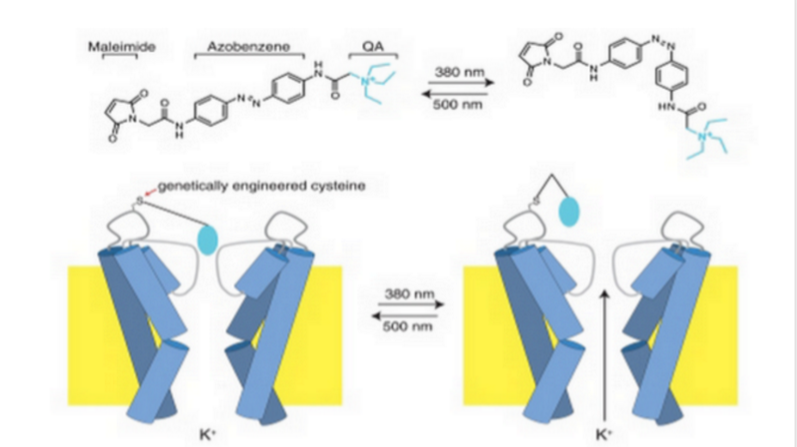
Targeting Specific Channels and Receptors for Photocontrol – We have developed a strategy for photocontrol of particular ion channels and receptors with “photoswitchable tethered ligands” (PTLs).

Project Description

Optogenetics has revolutionized neuroscience by making it possible to use heterologously expressed light-gated ion channels and pumps to stimulate or inhibit action potential firing of genetically selected neurons in order to define ther roles in brain circuits and behavior. Since the flow of information through neural circuits depends on synaptic transmission between cells, an important next technological step is to bring optogenetic control to the neurotransmitter receptors of the synapse. The Optogenetic Pharmacology that we propose makes this possible. In this approach genetically-engineered neurotransmitter receptor channels and G protein coupled receptors (GCPRs) from synapse are derivatized with synthetic Photoswitched Tethered Ligands (PTLs) and thereby made controllable by light. ...

OnAir Post: Optical control of synaptic transmission

Multi-area two-photon microscopy

Principal Investigator: Fritjof Helmchen Zurich Brain Research Institute Title: “Multi-area two-photon microscopy for revealing long-distance communication between multiple local brain circuits” BRAIN Category: Large-Scale Recording-Modulation – Optimization (RFA NS-14-008)

Dr. Helmchen and his colleagues propose a system to simultaneously record neuronal activity in four different areas of the neocortex and discover how brain cells in different regions interact during specific behaviors.

NIH Webpages

Two-photon laser-scanning microscopy has become the method of choice for imaging nerual dynamics on the cellular level in the intact brain. The particular advantage of 2-photon microscopy is its reduced sensitivity to light scattering so that individual cells with their dendrites can be resolved several hundreds of micrometers deep in neural tissue in living animals.

Project Description

Two-photon microscopy is a widely used, key method for functional imaging of cellular activity in living animals. Most recently, in vivo calciu imaging experiments have started to reveal the spatiotemporal activity patterns that occur in various areas of the neocortex during head-fixed mouse behavior. Typically, however, the field-of- view for imaging cellular activity is fairly small, on the order of a few hundred micrometers. This restriction limits the size of neuronal networks that can be studied and thus leaves open ...

OnAir Post: Multi-area two-photon microscopy

Electrophysiological Recording and Control

Principal Investigator: Baldwin Goodell Graymatter Research Title: “Large-Scale Electrophysiological Recording and Optogenetic Control System” BRAIN Category: Large-Scale Recording-Modulation – Optimization (RFA NS-14-008)

Dr. Goodell and his colleagues aim to develop optrodes, which are implantable columns of lights and wires for simultaneous electrical recording of neurons and delivery of light flashes to multiple brain areas.

NIH Webpages

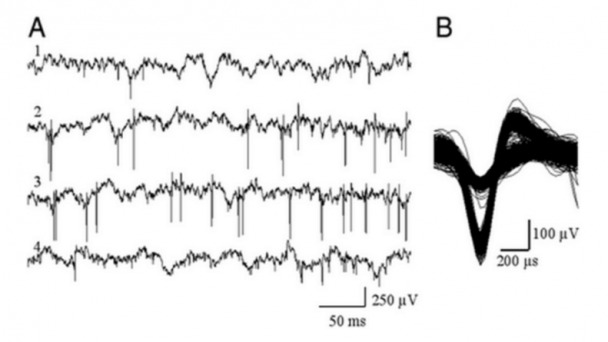
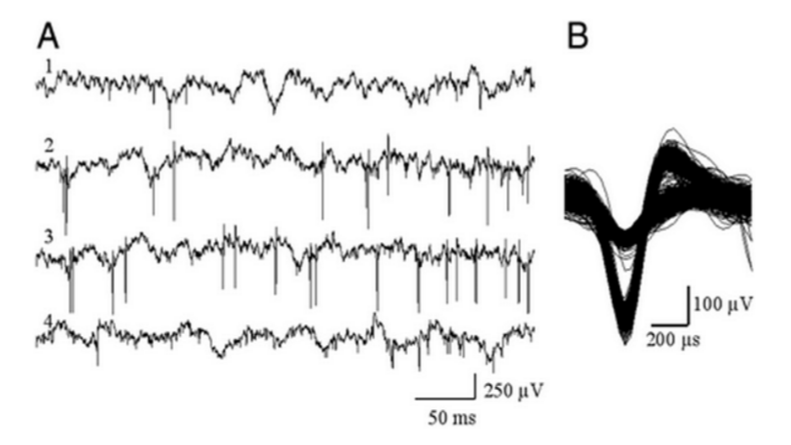
Example data collected from 4 electrodes during a single recording session. A: short epoch of raw data sampled from 4 electrodes in area 7a of the posterior parietal cortex of an alert monkey. The signals are broadband (1 Hz to 10 kHz). Extracellular action potentials are visible as negative going spikes in the signals. B: plot of 1,000 superimposed waveforms extracted from the high-pass filtered signal on channel 3. The high-amplitude waveforms reveal a single unit that is well separated from the lower amplitude multiunit activity.

Project Description

In order to gain a greater understanding of the neural mechanisms that mediate human cognitive function new approaches and technologies are needed to dramatically expand the ability to record and manipulate the activity of large numbers of neurons throughout widespread areas of the primate brain. Over the past 5-10 years, our groups have made two major ...

OnAir Post: Electrophysiological Recording and Control

Skip to toolbar