Holographic optogenetics and olfactory coding

Principal Investigator: Dmitry Rinberg NYU Neuroscience Institute Title: “Behavioral readout of spatiotemporal codes dissected by holographic optogenetics” BRAIN Category: Understanding Neural Circuits (RFA NS-14-009)

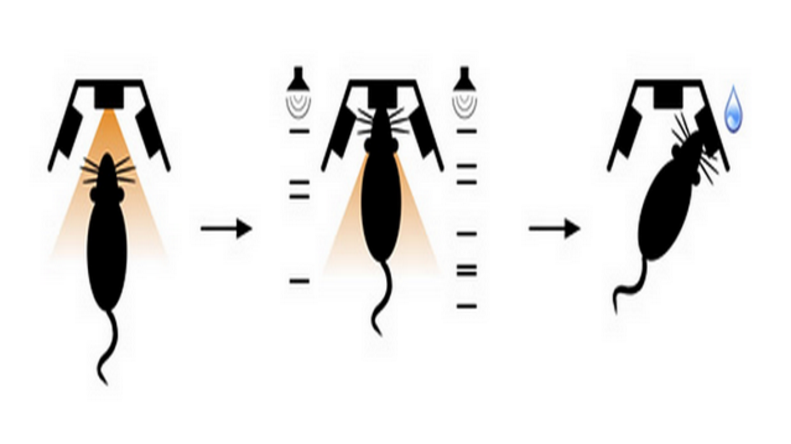
Dr. Rinberg’s team aims to understand how the brain turns odors into nerve signals by activating and recording neurons in the olfactory bulbs of mice as they detect a variety of odors.

NIH Webpages

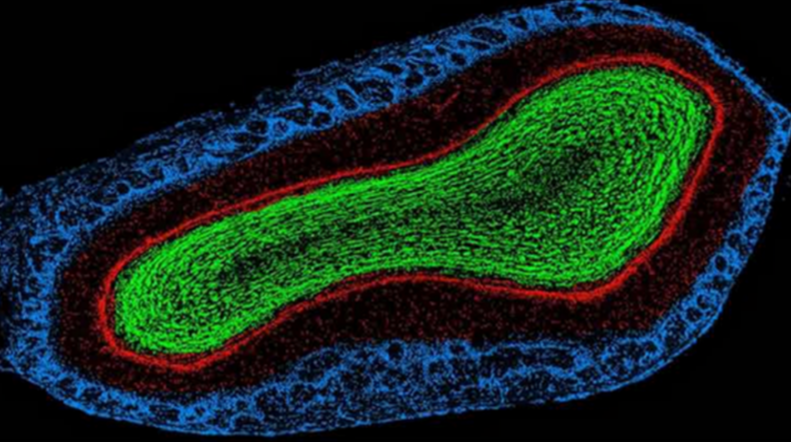
Scientists are now able to determine which receptors respond to certain odors in awake, freely behaving animals. This image is for illustrative purposes only and shows a coronal section through the main olfactory bulb of an adult male mouse. Credit Matt Valley.

Project Description

Two of the most fundamental questions of sensory neuroscience are: 1) how is stimulus information represented by the activity of neurons at different levels of information processing? And 2) what features of this activity are read by the higher brain areas to guide behavior? The first question has been the subject of a large body of work across different sensory modalities. To answer the second question, one needs to establish a causal link between neuronal activity and behavior. In many systems, fine spatiotemporal patterns of activity underlie the neural representation of information. In these systems, deciphering the salient ...

OnAir Post: Holographic optogenetics and olfactory coding
Mapping Sensory-Motor Pathways

Principal Investigator: Michael Dickinson Caltech Neuroscience Title: “Integrative Functional Mapping of Sensory-Motor Pathways” BRAIN Category: Understanding Neural Circuits (RFA NS-14-009)

Dr. Dickinson will lead an interdisciplinary team to study how the brain uses sensory information to guide movements, by recording the activity of individual neurons from across the brain in fruit flies, as they walk on a treadmill and see and smell a variety of sights and odors.

NIH Webpages

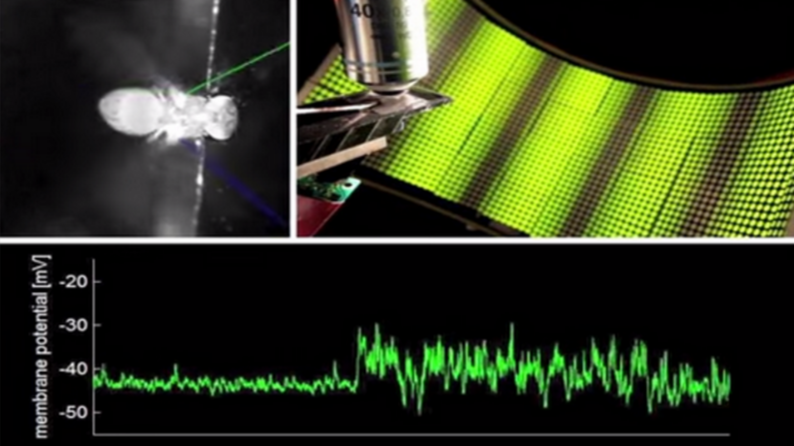
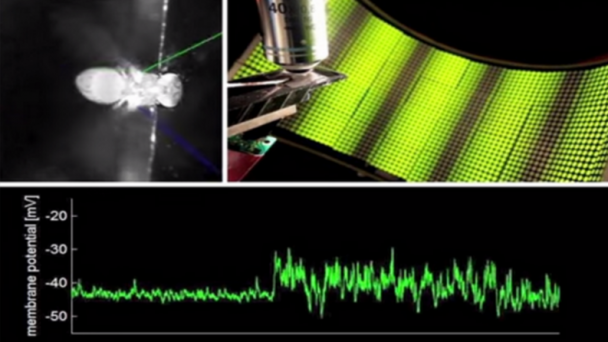
Flying Patch Clamp. Meausuring interneurons while flying.

Project Description

The goal of the project team is to develop a robust, multi-lab research framework, enabled by large scale imaging, which will lead to principled integrative models of ethologically-relevant behaviors that incorporate a detailed knowledge of individual cell classes. The specific neurobiological question that the team will address is how the brain integrates sensory information in order to guide locomotion in a particular direction. Our strategy is to systematically map and functionally characterize the neural circuits that underlie goal-directed locomotion, using the fruit fly, Drosophila, in order to exploit the convergence of powerful genetic, optical, behavioral, and analytical tools that are available in this species. The proposal focuses primarily on refining functional imaging approaches to map the activity of small ...

OnAir Post: Mapping Sensory-Motor Pathways

Integrated approach to visual neuroscience

PI: Sebastian Seung, Princeton University Title: “Vertically integrated approach to visual neuroscience: microcircuits to behavior” BRAIN category: Understanding Neural Circuits (RFA NS-14-009)

Dr. Seung and colleagues Thomas Euler (U Tübingen), Andrew Huberman (UC San Diego), Markus Meister (Caltech), and Rachel Wong (UW Seattle) will use state-of-the-art genetic, electrophysiological, and imaging tools to map the connectivity of the retina, the light-sensing tissue in the eye. The goal is to delineate all the retina’s neural circuits and define their specific roles in visual perception and behavior.

NIH Webpages

Project Description

Visual neuroscience is finally beginning to achieve a “vertically integrated” understanding of the retina, bridging all levels from molecules to microcircuits to behavior. Success could be achieved for all retinal microcircuits in just a decade, if progress were sped up drastically. Such acceleration will be attained by generating the following foundational data and disseminating it to the community. (1) We will use genetic control of ganglion cell types to pinpoint their specific roles in a suite of ethologically relevan, visually guided behaviors. Our functional explorations will be guided by the tracing of downstream pathways into subcortical and cortical regions using genetic techniques. (2) We will apply two-photon calcium imaging and serial electron microscopy to a single patch of ...

OnAir Post: Integrated approach to visual neuroscience

Neural circuits in zebrafish

Principal Investigator: Florian Engert Program in Neuroscience @Harvard Title: “Neural circuits in zebrafish: form, function and plasticity” BRAIN Category: Understanding Neural Circuits (RFA NS-14-009)

Dr. Engert’s team will combine a wide array of cutting-edge neuroscience techniques to watch the entire brain activity of a see-through fish while it swims, and to make detailed maps of its brain circuitry.

NIH Webpages

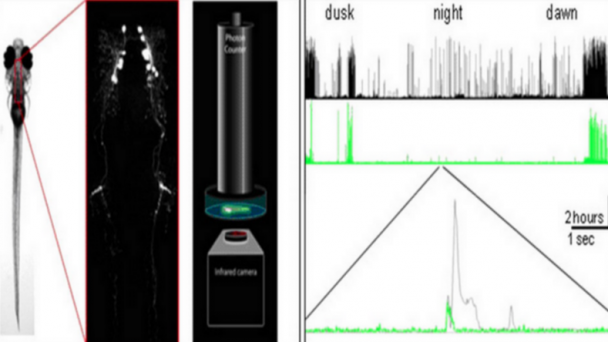
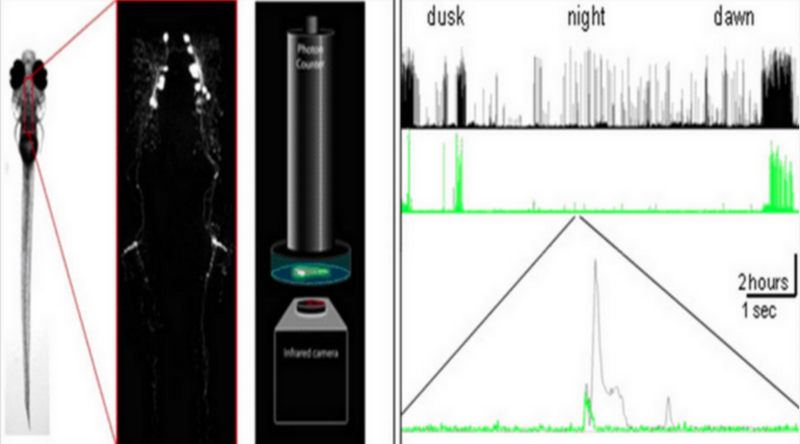
n order to examine response properties of specific neuronal subpopulation in freely swimming larvae we have developed an imaging technique based on the bioluminescence of Aquorin-GFP that does not require excitation light and can therefore operate on a zero background signal 17. This optical signal can be collected with large angle optics and detected as a one-dimensional temporal signal by a photon multiplier tube. Figure 3 shows data from a first series of experiments in which Aquorin is expressed in the hypocretin system, a small nucleus consisting of less than 20 neurons that are known to regulate the sleep-wake cycle.The left side shows an in-vivo two-photon image of the transgenic fish and a diagram of the set-up. On the right side bioluminescence photon counts from the same fish are shown in green below traces describing the simultaneously monitored ...

OnAir Post: Neural circuits in zebrafish

Neural circuit dynamics in working memory

Principal Investigator: Carlos D  Brody Princeton Neuroscience Institute Title: “Mechanisms of neural circuit dynamics in working memory” BRAIN Category: Understanding Neural Circuits (RFA NS-14-009)

Dr. Brody and his colleagues will study the underlying neuronal circuitry that contributes to short-term “working” memory, using tools to record circuit activity across many brain areas simultaneously while rodents run on a track-ball through virtual mazes projected onto a screen.

NIH Webpages

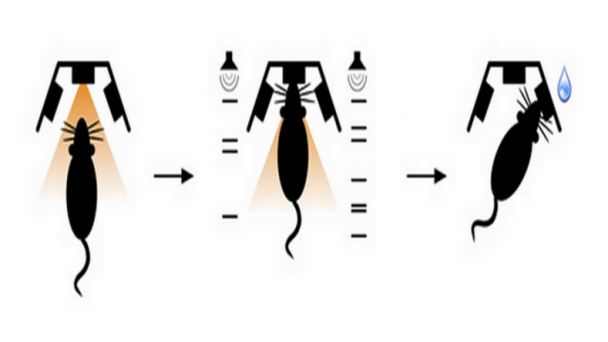
Figure: A decision-making task requiring accumulation of evidence over time. The capacity to gradually and steadily accumulate evidence favoring one choice or another is thought to be a core component of many different types of decision-making. In order to establish a rodent model of this cognitive process, we developed a task in which subjects hear simultaneously presented trains of randomly timed clicks, one train coming from a speaker to their left, the other from a speaker to their right. At the end of the trains, the subjects have to decide which side played the greater total number of clicks. We were able to train rats to perform this task, and to show that well-trained animals use a strategy of accumulating clicks over time. Having established a behavior that depends on gradual ...

OnAir Post: Neural circuit dynamics in working memory

Circuitry Underlying Memory replay

Principal Investigator: Ivan Soltesz UC Irvine Neuroscience Title: “Towards a Complete Description of the Circuitry Underlying Memory replay” BRAIN Category: Understanding Neural Circuits (RFA NS-14-009)

Dr. Soltesz’s team will combine computer brain modeling and large-scale recordings of hundreds of neurons to understand how the brain generates sharp-wave-ripples, a neuronal activity pattern essential for learning and memory.

NIH Webpages

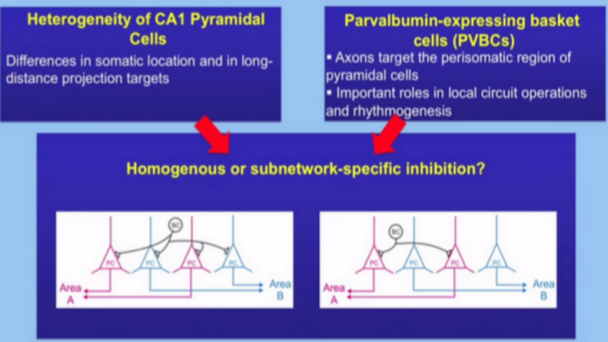
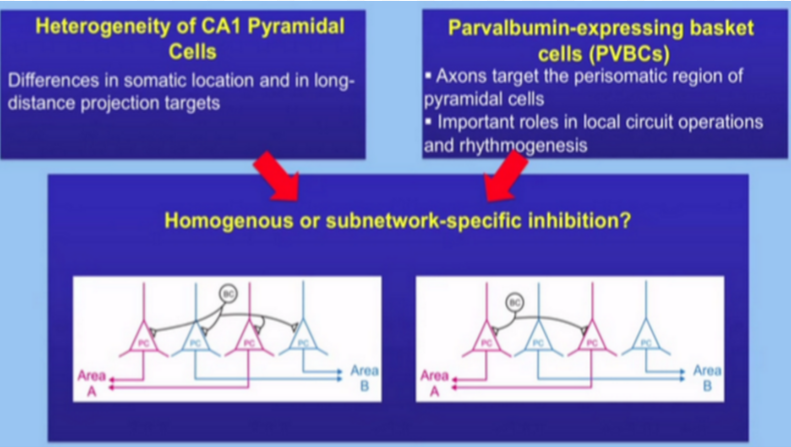
How GABAergic interneurons in the hippocampus choose their postsynaptic partners

Project Description

The function of a brain region is an emergent property of many cell types. The criteria needed to understand a network have been established in studies of invertebrate “simple” networks, but there has not yet been an attempt to provide such a full, mechanistic understanding of any network in the vertebrate brain. We believe that the time is now ripe for such an effort. Specifically, we propose to understand how the CA3 network in the hippocampus generates sharp-wave-ripples (SWR). These events are of great interest because of their cognitive function: they represent replay of episodic memory sequences and are required for subsequent memory recall, as demonstrated at the behavioral level. Our efforts to understand the SWR will build on previous work establishing the cell types of the hippocampus. However, to meet ...

OnAir Post: Circuitry Underlying Memory replay

Connectivity of brain stem circuits

Principal Investigator: David Kleinfeld UCSD Neuroscience Title: “Revealing the connectivity and functionality of brain stem circuits” BRAIN Category: Understanding Neural Circuits (RFA NS-14-009)

Dr. Kleinfeld and his colleagues will use a variety of tools and techniques to create detailed maps of circuits in the brainstem, the region that regulates many life-sustaining functions such as breathing and swallowing, and match the circuits to actions they control.

NIH Webpages


Project Description

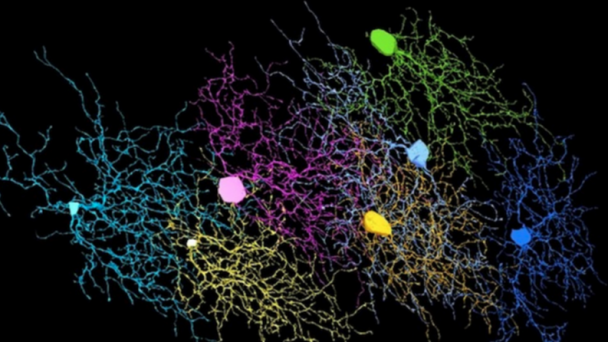
Neuronal circuits in the brainstem control life-sustaining functions, in addition to driving and gating active sensation through taste, smell, and touch. We propose to exploit the advent of molecular and genetic tools to undertake cell lineage marking, cell phenotyping, molecular connectomics, and methods from machine learning and image processing to construct an integrated anatomical and functional atlas of the brainstem. This will enable us to generate anatomical wiring diagrams for the brainstem circuits that control or facial actions. There are three phases to this work. (1) Reveal the identity and organization of brainstem nuclei. Motivated by striking similarities between the developmental plan for the spinal cord and brainstem, we will embrace and extend these efforts to interrogate the molecular composition of neurons that define individual nuclei with sensorimotor circuits in the murine brainstem. (2) Reveal brainstem neuronal circuits and ...

OnAir Post: Connectivity of brain stem circuits

Patterned activity and codes for behavior

Principal Investigator: John Maunsell Neuroscience at University of Chicago Title: “The role of patterned activity in neuronal codes for behavior” BRAIN Category: Understanding Neural Circuits (RFA NS-14-009)

Dr. Maunsell’s team will explore how large populations of neurons process visual information, using a newly developed light stimulation technique to induce brain cell activity in the visual cortex of mice.

NIH Webpages

Project Description

A key aspect of brain function is how the activity of neuronal populations encodes information that is used to guide behavior. A longstanding model system to understand population coding is the visual cerebral cortex, because its structure and anatomy are well understood, and because visual stimuli can be presented to subjects with high levels of temporal and spatial control. Thousands or more neurons fire action potentials in response to a single visual stimulus, and an important open question is how this population response carries information – how the detailed timing and pattern of these spikes across neurons is decoded to guide behavior. Because it is known that genetics controls the identity and morphology of neurons, and influences which other neurons they form synaptic partners with, it appears likely that the precise details of which neurons in a population fire spikes is vitally important for behavior. But ...

OnAir Post: Patterned activity and codes for behavior

Crowd coding in the brain

Principal Investigator: Patrick Kanold UMD Neuroscience and Cognitive Science Title: “Crowd coding in the brain: 3D imaging and control of collective neuronal dynamics” BRAIN Category: Understanding Neural Circuits (RFA NS-14-009)

Dr. Kanold and his team propose cutting edge methods to stimulate neurons at different depths in the auditory cortex, and will use new computational methods to understand complex interactions between neurons in mice while testing their ability to hear different sounds.

NIH Webpages

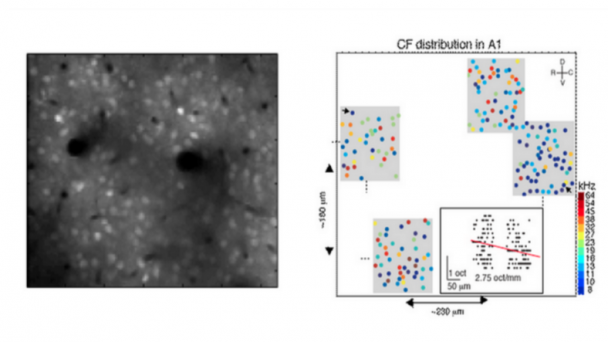
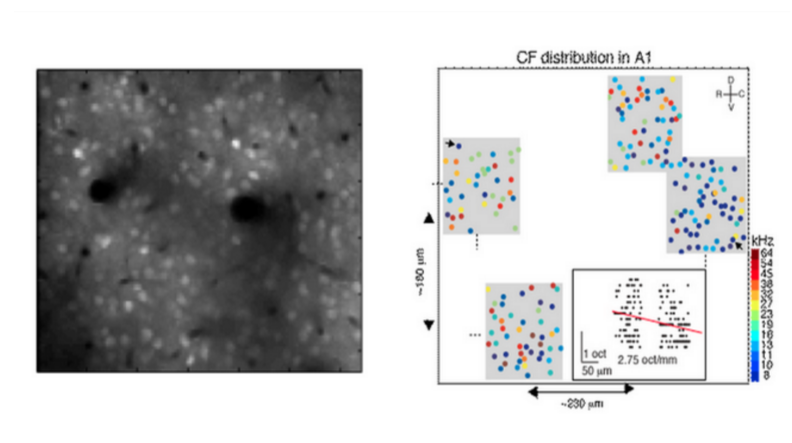
To overcome this we extensively use in vivo 2-photon imaging which can detects the activity of many single neurons in the brain of a living animal. the image below on the left shows many neurons in the brain loaded with a Ca-indicator dye which reports neuronal activity.

Project Description

The cortex is a laminated structure that is thought to underlie sequential information processing. Sensory input enters layer 4 (L4) from which activity quickly spreads to superficial layers 2/3 (L2/3) and deep layers 5/6 (L5/6) and other cortical areas eventually leading to appropriate motor responses. Sensory responses themselves depend on ongoing, i.e. spontaneous cortical activity, usually in the form of reverberating activit from within or distant cortical regions, as well as the state and behavioral context of the animal. Receptive ...

OnAir Post: Crowd coding in the brain

Cortical circuits and information flow

Principal Investigator: Mriganka Sur MIT Neuroscience Title: “Cortical circuits and information flow during memory-guided perceptual decisions” BRAIN Category:

Dr. Sur and his team will combine a number of cutting-edge, large-scale imaging and computational techniques to determine the exact brain circuits involved in generating short term memories that influence decisions.

NIH Webpages

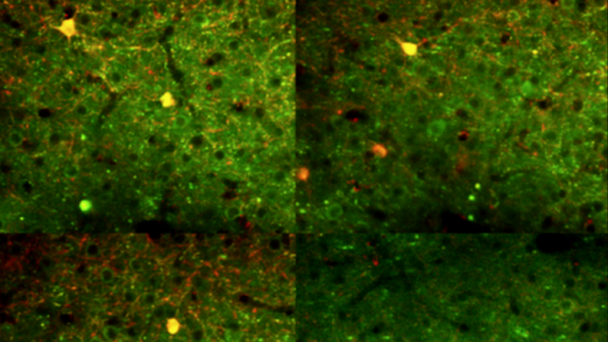
Neurons in the primary visual cortex of an awake mouse. Image: Sami Elboustani

Project Description

Perceptual decision-making involves multiple cognitive components and diverse brain regions. To perform a perceptual decision, an individual must process an incoming sensory percept, retain this information in short- term memory, and choose an appropriate motor action. Research using delayed-response tasks in nonhuman primates has revealed that sensory and choice information is distributed across a hierarchy of cortical areas, with task-relevant information flowing from sensory to association to motor regions. However, a mechanistic understanding of how circuits in these regions transform and maintain information during such tasks is lacking, due to limited ability to identify and manipulat specific circuits in the primate brain. By developing a memory- guided task for head-fixed mice, we intend to leverage the genetic tractability of the mouse to address these questions. We have developed a perceptual decision task for ...

OnAir Post: Cortical circuits and information flow

Skip to toolbar