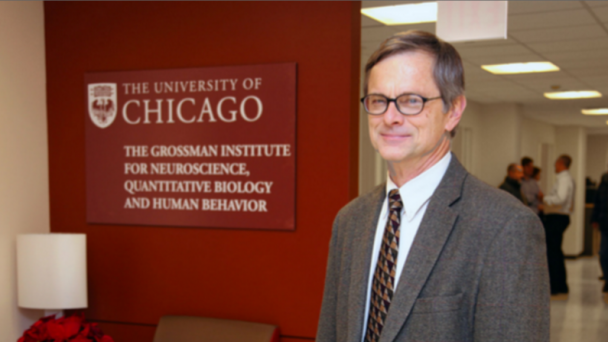
John Maunsell, PhD – Chicago


Professor, Department of Neurobiology Director, Grossman Institute for Neuroscience, Quantitative Biology and Human Behavior

Maunsell’s research is aimed at understanding how neuronal signals in visual cerebral cortex generate perceptions and guide behavior. Our approach is to record from individual neurons in trained, behaving monkeys and mice while they perform visual tasks. Another line of research has been exploring the more general question of how the activity of given neurons contributes to specific visual behaviors.

Web Information

Webpage: neurobiology.uchicago.edu/page/john-maunsell Neuroscience at University of Chicago  BRAIN Initiative Grant – “The role of patterned activity in neuronal codes for behavior”

Contact Information

Emailmaunsell@uchicago.edu Phone: (773) 702-3203 Address: The University of Chicago 5812 S Ellis Street, MC0912 Chicago, IL 60637


Biography

Since 2007, Maunsell has served as editor-in-chief of The Journal of Neuroscience, one of the top peer-reviewed journals in its field and primary publication of the Society for Neuroscience, the largest neuroscientist organization in the world. Maunsell brings to the University of Chicago an intimate knowledge of the people, projects and landscape of the international neuroscience research community.

Maunsell’s honors include election to the American Association for the Advancement of Science, American Academy of Arts and Sciences and appointment as a Howard Hughes Medical Institute investigator. Previous to Harvard, he served on the faculty of the ...

OnAir Post: John Maunsell, PhD – Chicago

David Kleinfeld, PhD – UCSD


Professor of Biophysics Director, David Kleinfeld Laboratory

David Kleinfeld and his colleagues take biophysical and computational approaches to bridge phenomena at different levels in the brain, ranging from intracellular electrophysiology to multi-cellular recording to animal behavior. This provides an opportunity to discover algorithms and principles that underlie computations within nervous systems. In additional, they develop instrumentation and analysis procedures that facilitate the study of physiology.

Web Information

Neurograd Program webpage: healthsciences.ucsd.edu/education/neurograd/faculty/david-kleinfeld Lab webpage: https://physics.ucsd.edu/neurophysics/kleinfeldcv.php UCSD Neuroscience BRAIN Initiative Grant – “Revealing the connectivity and functionality of brain stem circuits”

Contact Information

Email: dk@physics.ucsd.edu Phone: 858-822-0342 Address: Physics Department UC San Diego


Biography

1984 The Neurobiology Summer School, Marine Biological Laboratory, Woods Hole. 1984 Doctor of Philosophy in Physics, University of California at San Diego. Dissertation: On the Dynamics of Electron Transfer in Photosynthetic Reaction Centers (with Prof. George Feher). 1977 Master of Science, Physics, University of Illinois at Urbana-Champaign. 1976 Bachelor of Science in Electrical Engineering (High Honors), University of Illinois at Urbana-Champaign. Senior Thesis: Growth of Ionization Tracts in Pulsed Microwave Field

Research

David Kleinfeld and his colleagues take biophysical and computational approaches to bridge phenomena at different levels in the brain, ranging from intracellular electrophysiology to multi-cellular recording to animal behavior. This provides an opportunity to discover algorithms and principles that underlie computations within nervous systems. In additional, they ...

OnAir Post: David Kleinfeld, PhD – UCSD

Patrick Kanold, PhD – UMD


Associate Professor of Biology Director, Kanold Lab

Dr. Kanold studies the development and plasticity of the brain, in particular how periods of learning and plasticity are initiated and controlled. His work focuses on the development of the central auditory and visual system in particular on the role of early cortical circuits in brain wiring. He uses advanced neurophysiological, in vivo imaging, optogenetic, molecular and computational techniques.


Web Information

Webpage:  biology.umd.edu/patrick-kanold.html UMD Neuroscience and Cognitive Science  BRAIN Initiative Grant – “Crowd coding in the brain: 3D imaging and control of collective neuronal dynamics”

Contact Information

Emailpkanold@umd.edu Phone: 301.405.5741 Address: 1116 Bioscience Research Building College Park, MD 2074


Biography

Awards

2007 Ralph E Powe Award 2010 Alfred P. Sloan Foundation 2013 NOHR/ARo Burt Evans Award

Education

Dipl. Ing (M.Sc.), Technische Universität Berlin, Germany, 1994 Ph.D., Johns Hopkins University, 2000 PostDoc, Harvard Medical School 2000-2005 Instructor, Harvard Medical School 2005-2006


Research

Dr. Kanold studies the development and plasticity of the brain, in particular how periods of learning and plasticity are initiated and controlled. His work focuses on the development of the central auditory and visual system in particular on the role of early cortical circuits in brain wiring. He uses advanced neurophysiological, in vivo imaging, optogenetic, molecular and computational techniques. His work furthers our understanding of how prenatal and postnatal brain injury ...

OnAir Post: Patrick Kanold, PhD – UMD

Ivan Soltesz, PhD – UC Irvine

Professor & Chair: Anatomy & Neurobiology, Physiology & Biophysics, and Neurobiology & Behavior Director, Soltesz Lab

Research Focus: Working to understand: traumatic brain injury, post-traumatic epilepsy, fever-induced (Febrile) seizures in childhood, learning and memory deficits. 

Scientific Focus: functions, development and plasticity of hippocampal interneuronal networks. Physiological basis of hyperexcitability. Mechanisms of selective neuronal vulnerability.

Web Information

Webpage: anatomy.uci.edu/soltesz.html UC Irvine Neuroscience Brain Initiative Grant – “Towards a Complete Description of the Circuitry Underlying Memory replay”

Contact Information

Email: isoltesz@uci.edu Phone: 949-824-3957 and 3967 Address: Dep’t Anatomy & Neurobiology 117 Irvine Hall School of Medicine University of California Irvine, California 92697-1280


Biography

1983-1988

Diploma in Biology L. Eotvos University, Budapest, Hungary

1988-1989

Ph.D., Comparative Physiology L. Eotvos University, Budapest, Hungary

1989-1990

Postdoctoral Research Fellow, MRC Anatomical Neuropharmacology Unit Oxford University, England

1990-1991

Postdoctoral Researcher, Dept of Visual Science, Institute of Opthalmology University of London, U.K.

1991-1992

Post-graduate Postdoctoral Researcher, Centre de Recherche en Neurobiologie Université Laval, Quebec

1992-1993

Postdoctoral Researcher, Dept of Neurology and Neurological Sciences Stanford University, Palo Alto, California

1993-1995

Postdoctoral Researcher, Dept of Anesthesiology and Pain Management UT Southwestern, Dallas, Texas

1995-1999

Assistant Professor, Dept.’s of Anatomy & Neurobiology and Physiology & Biophysics University of California, Irvine, California

1999-2003

Associate Professor, Dept.’s of Anatomy & Neurobiology and Physiology & Biophysics University of California, Irvine, California

2002-2003

Associate Professor, Dept. of Neurobiology & Behavior University of California, Irvine, California

2001-present

Fellow, Center for the Neurobiology of Learning & Memory University of California, Irvine, California

2003-present

Professor, ...

OnAir Post: Ivan Soltesz, PhD – UC Irvine

Dmitry Rinsberg, PhD – NYU


Associate Professor, Department of Neuroscience & Physiology,NYU Neuroscience Institute Principal Investigator: Rinberg Lab

Rinsberg’s research uses electrophysiology, optogenetics, and psychophysics to understand the principles of the sensory information processing. Specifically we are focused on two questions: 1) how is odor information coded in the brain of the awake, behaving mouse? And 2) how is information relevant to animal behavior extracted by the brain? In short, we want to know what the mouse’s nose tells its brain.


Web Information

Webpage: neuro-physio.med.nyu.edu/faculty/Dmitry-rinberg Brain Initiative Grant

Contact Information

Email: Dmitry.Rinberg@nyumc.org Phone: 646-501-4535 Address: 450 East 29th St Room 935 East River Science Park New York, NY 10016


Biography

Research

Our lab is using electrophysiology, optogenetics, and psychophysics to understand the principles of the sensory information processing. Specifically we are focused on two questions: 1) how is odor information coded in the brain of the awake, behaving mouse? And 2) how is information relevant to animal behavior extracted by the brain? In short, we want to know what the mouse’s nose tells its brain.

Recently, our laboratory has been focused on temporal aspects of olfactory coding. We discovered that a) olfactory neuronal code at the level of olfactory bulb is temporally very precise (~10 ms) [Shusterman-2011], and b) the mammalian olfactory system can read and interpret temporal patterns at ...

OnAir Post: Dmitry Rinsberg, PhD – NYU

Florian Engert, PhD – Harvard


Professor of Molecular and Cellular Biology, Harvard University Director, Engert Lab

The general goal of my research is the development of the larval zebrafish as a model system for the comprehensive identification and examination of neural circuits controlling visually induced behaviors. My lab plans to establish and quantify a series of visually induced behaviours and analyze the individual resulting motor components. Using these assays we will monitor neuronal activity throughout the fish brain in an awake and intact preparation.


Web Information

Webpage: mcb.harvard.edu/mcb/faculty/profile/florian-engert/ Program in Neuroscience @Harvard  Brain Initiative Grant

Contact Information

Emaillorian@mcb.harvard.edu Phone: 617-495-4382 Address: Harvard University BioLabs 16 Divinity Avenue Cambridge, MA 2138


Research

Neuroscientists have long been working to understand how biological structures can produce the complex behaviors that are generated by the nervous system. However, even the basic operational principles governing a brain’s interconnected network of cells have remained painfully elusive. My laboratory is working on a scientific strategy focused on building a complete, multi-level picture of simple neural circuits that will advance our basic understanding of brain function and offers a complete view into the neuronal activity underlying a series of relatively complex behaviors. We are taking a first step towards this rather lofty goal via the comprehensive identification and examination of neural circuits controlling behavior in the ...

OnAir Post: Florian Engert, PhD – Harvard

Michael Dickinson, PhD – Caltech


Zarem Professor of Bioengineering, Caltech Neuroscience Director, Dickinson Lab

The aim of Dickinson’s research is to elucidate the means by which flies accomplish their aerodynamic feats. A rigorous mechanistic description of flight requires an integration of biology, engineering, fluid mechanics, and control theory. The long term goal, however, is not simply to understand the material basis of insect flight, but to develop its study into a model that can provide insight to the behavior and robustness of complex systems in general.

Web Information

Webpage:   eas.caltech.edu/people Lab:  http://depts.washington.edu/flyarama/ TEDx video:  ted.com/talks/michael_dickinson_how_a_fly_flies Wikipedia Entry: wiki/Michael_Dickinson BRAIN Initiative grant

Contact Information

Email: flymancaltech.edu Phone: 626-395-5775 Address: The California Institute of Technology Mail Code 216-76 Pasadena, CA 91125


Biography

from Wikipedia page

Michael H. Dickinson (born 1963) is an American fly bioengineer and neuroscientist, and Zarem Professor of Biology and Bioengineering at the California Institute of Technology. He studies Drosophila flight control systems and sensory processing.

He graduated from Brown University with a B.S. in 1984, and from University of Washington with a Ph.D. in 1989. He was previously part of the faculty at the University of Chicago,  the University of California, Berkeley, and the University of Washington.

He is a Monitoring Editor at the Journal of Experimental Biology.He was a course director of the Neural Systems and ...

OnAir Post: Michael Dickinson, PhD – Caltech

Sebastian Seung, PhD – Princeton


Professor, Computer Science Department and Princeton Neuroscience Institute Principal Investigator, Seung Lab

Seung is a multi-disciplinary expert whose research efforts have spanned the fields of neuroscience, artificial intelligence. physics and bioinformatics. His TED talk “I am my connectome” has been viewed more than 750,000 times. His book Connectome: How the Brain’s Wiring Makes Us Who We Are is considered by some as “the best lay book on brain science I’ve ever read.” Seung is also the organizer of the Citizens Science project/game called EyeWire.


Web Information

Lab website:  eunglab.org/

Wikipedia entry :  wikipedia.org/wiki/Sebastian_Seung

Twitter: twitter.com/sebastianseung 

Contact Information

E-mail:  sseung@princeton.edu

Address: 153 Princeton Neuroscience Institute Washington Road Princeton, NJ 08544


Biography

From Wikipedia entry

Hyunjune Sebastian Seung (Hangul: 승현준; hanja: 承現峻; is a Korean American multi-disciplinary expert whose research efforts have spanned the fields of neuroscience, physics and bioinformatics. He was a professor of Computational Neuroscience in the Department of Brain and Cognitive Sciences and a professor of Physics at the Massachusetts Institute of Technology and is now a professor at Princeton University. He also was an Investigator of the Howard Hughes Medical Institute. He is the son of the philosopher, T. K. Seung.

Seung studied theoretical physics at Harvard University where he obtained his Ph.D. degree ...

OnAir Post: Sebastian Seung, PhD – Princeton

Mriganka Sur, PhD – MIT


Professor of Neuroscience, MIT Department of Brain and Cognitive Sciences Director, Simons Center for the Social Brain Principal Investigator, Laboratory of Mriganka Sur

Dr. Sur studies the organization, development and plasticity of the cerebral cortex of the brain using experimental and theoretical approaches. He has discovered fundamental principles by which networks of the cerebral cortex are wired during development and change dynamically during learning.


Web Information

Webpage: web.mit.edu/msur/www/profile.html Simons Center for the Social Brain website: web.mit.edu/scsb/ MIT Neuroscience Brain Initiative Grant

Contact Information

Email: msur@mit.edu Phone: 617.253.8785 Address: 43 Vassar St. 46-6227 Cambridge, MA, 02139


Biography

Dr. Mriganka Sur is the Paul E. and Lilah Newton Professor of Neuroscience and Director of the Simons Center for the Social Brain at MIT, which he founded after 15 years as head of the MIT Department of Brain and Cognitive Sciences. Dr. Sur studies the organization, development and plasticity of the cerebral cortex of the brain using experimental and theoretical approaches. He has discovered fundamental principles by which networks of the cerebral cortex are wired during development and change dynamically during learning. His laboratory has identified gene networks underlying cortical plasticity, and pioneered high resolution imaging methods to study cells, synapses and circuits of the intact brain. Recently, his group has demonstrated novel mechanisms underlying disorders of brain ...

OnAir Post: Mriganka Sur, PhD – MIT

Carlos D Brody, PhD – Princeton


Professor of neuroscience and molecular biology, Princeton  Neuroscience Institute Howard Hughes Medical Institute Investigator Principal Investigator, Brodylab

Brody’s focus is on novel quantitative behaviors that allow exploring high-level cognitive questions. Brody’s group now uses rats to investigate the neural bases of decision making, working memory and executive control using a combination of high-throughput semiautomated behavior as well as computational, electrophysiological, pharmacological and optogenetic methods.

Web Information

Webpage: molbio.princeton.edu/faculty/molbio-faculty/142-brody HHMI page:  hhmi.org/scientists/carlos-d-brody Simons Foundation page: simonsfoundation.org/life-sciences/collaboration-on-the-global-brain/ Brain Initiative Grant

Contact Information

Email: brody@princeton.edu Phone: (609) 258-7645 Address: Princeton University 119 Lewis Thomas Laboratory Washington Road Princeton, NJ 08544-1014


Biography

Carlos Brody completed his Ph.D. in 1997, in computation and neural systems with John Hopfield at California Technical Institute. Starting in 2001, he led a computational neuroscience group as an assistant professor at Cold Spring Harbor Laboratory. Inspired by the efforts that Zachary Mainen’s and Anthony Zador’s experimental groups at Cold Spring Harbor Laboratory were making in developing highly controlled behaviors for rats, Brody added experimental approaches to his research portfolio. His focus is on novel quantitative behaviors that allow exploring high-level cognitive questions using powerful emerging tools for studying neural mechanisms in rats. Brody’s group now uses rats to investigate the neural bases of decision making, working memory and executive control using a ...

OnAir Post: Carlos D Brody, PhD – Princeton

Skip to toolbar