IARPA & the BRAIN Initiative


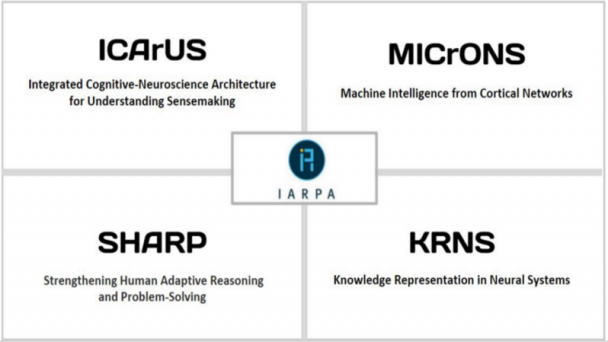
The acronyms for the four BRAIN Initiative related IARPA programs are ICArUS. MICrONS, KRNS, and SHARP.

The Intelligence Advanced Research Projects Activity (IARPA) invests in high-risk, high-payoff research programs to tackle some of the most difficult challenges of the agencies and disciplines in the Intelligence Community (IC). IARPA does not have an operational mission and does not deploy technologies directly to the field. Instead, IARPA facilitates the transition of research results to our IC customers for operational application.

Web Information

Website: www.iarpa.gov/ Neuroscience webpage: iarpa.gov/research-programs/neuroscience-programs-at-iarpa Wikipedia Entry: wiki/Intelligence_Advanced_Research_Projects_Activity


Contact Information

Email: dni-iarpa-info@iarpa.gov Phone: (301) 851-7500 Address: Office of the Director of National Intelligence Intelligence Advanced Research Projects Activity Washington, DC 20511


About IARPA

IARPA collaborates across the IC

to ensure that our research addresses relevant future needs. This cross-community focus ensures our ability to:

address cross-agency challenges leverage both operational and R&D expertise from across the IC coordinate transition strategies with our agency partners

IARPA does not have an operational mission and does not deploy technologies directly to the field. Instead, IARPA facilitates the transition of research results to our IC customers for operational application.

Our Leadership

IARPA is led by a distinguished group of accomplished scientists and researchers.

Our Organization

There are four research thrusts within IARPA embodied in four offices:

Office for Anticipating Surprise

The Office for Anticipating Surprise (OAS) focuses ...

OnAir Post: IARPA & the BRAIN Initiative

NIH Institutes and BRAIN Initiative

NEI -- National Eye Institute
NIA -- National Institute on Aging
NIAAA -- National Institute on Alcohol Abuse and Alcoholism
NIBIB -- National Institute of Biomedical Imaging and Bioengineering
NICHD -- National Institute of Child Health and Human Development
NIDCD -- National Institute on Deafness and Other Communication Disorders
NIDA -- National Institute on Drug Abuse
NIMH -- National Institute of Mental Health
NINDS -- National Institute of Neurological Disorders and Stroke
NCCIH -- National Center for Complementary and Integrative Health

OnAir Post: NIH Institutes and BRAIN Initiative

OSTP and The BRAIN Initiative

The US Congress established the Office of Science and Technology Policy (OSTP) in 1976 with a broad mandate to advise the President and others within the Executive Office of the President on the effects of science and technology on domestic and international affairs.

OSTP with NIH is leading interagency efforts to develop and implement the BRAIN Initiative policies and budgets, and is working with the private sector, state and local governments, the science and higher education communities, and other nations toward this end.

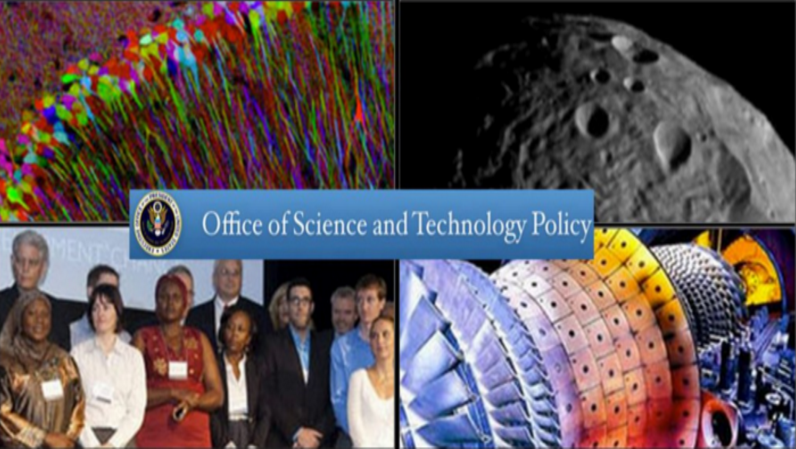
Images from the OSTP Grand ChallengesUpper Left: NIH, DARPA, and NSF’s BRAIN Initiative;Upper Right: NASA’s Asteroid Grand Challenge;Lower Right: DOE’s SunShot Grand Challenge;Lower left: USAID’s Grand Challenges for Development, including Saving Lives at Birth.


Web Information

Website:   whitehouse.gov/administration/eop/ostp YouTube Channel:  youtube.com/user/whitehouse Twitter:  @whitehouseostp  Wikipedia Entry: wiki/Office_of_Science_and_Technology_Policy

Contact Information

Email:  contact form Phone: 202-456-4444 Address: Eisenhower Executive Office Building 1650 Pennsylvania Avenue Washington, DC 20504

Organization

Director:  John P. Holdren Assistant Director, Neuroscience, Mental Health, and Broadening Participation:  Monica Basco Staff Directory


The BRAIN Initiative

OSTP works to advance a wide range of initiatives, programs, projects, and activities that unleash the power of science, technology, and innovation for the benefit of Americans and ...

OnAir Post: OSTP and The BRAIN Initiative

NSF


Summary

National Science Foundation (NSF is the only federal agency whose mission includes support for all fields of fundamental science and engineering, except for medical sciences.

NSF keeps the United States at the leading edge of discovery in areas from astronomy to geology to zoology. In addition to funding research in the traditional academic areas, the agency also supports “high-risk, high pay-off” ideas, novel collaborations and numerous projects that may seem like science fiction today, but which the public will take for granted tomorrow.

Information

Website:  nsf.gov/ YouTube Channel:  youtube.com/user/VideosatNSF  Twitter:  twitter.com/NSF Facebook: facebook.com/US.NSF Wikipedia Entry:  wiki/National_Science_Foundation

Emailinfo@nsf.gov Phone: (703) 292-5111 Address: National Science Foundation 4201 Wilson Blvd Arlington, VA 2223


Organization

Director: France A. Córdova Advisory Committees: Staff Directory

The National Science Foundation’s street address is 4201 Wilson Boulevard, Arlington, VA 22230

About NSF

NSF AT A GLANCE The National Science Foundation (NSF) is an independent federal agency created by Congress in 1950 “to promote the progress of science; to advance the national health, prosperity, and welfare; to secure the national defense…” With an annual budget of $7.3 billion (FY 2015), we are the funding source for approximately 24 percent of all federally supported basic research ...

OnAir Post: NSF

DARPA and the BRAIN Initiative

The Defense Advanced Research Projects Agency (DARPA) mission is to create breakthrough technologies for US national security and to protect the health of U.S. service members and veterans.

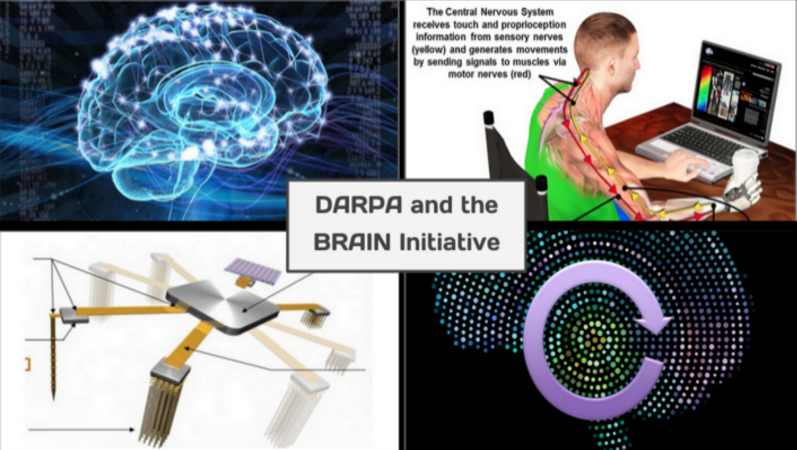
To better address the health needs of service members and veterans, DARPA has launched four programs that support the goals of the BRAIN Initiative: RAM (Restoring Active Memory), RAM Replay, HAPTIX (Hand Proprioception and Touch Interfaces), and SUBNETS (Systems-Based Neurotechnology for Emerging Therapies).

Clockwise from top left: RAM, HAPTIX, RAM Replay, and SUBNETS. Images from DARPA articles.

DARPA and the BRAIN Initiative

DARPA is supporting four current programs and is planning new investments in support of the BRAIN Initiative, with the ultimate goal of relieving and rehabilitating warfighters and civilians suffering from traumatic injury and neuro-psychiatric illness: The Defense Advanced Research Projects Agency (DARPA) has launched a number of major efforts to develop breakthrough neurotechnologies that are deepening scientists’ understanding of brain function and are supporting the development of novel therapeutic strategies. As part of this effort, DARPA is developing and assessing revolutionary electronic interfaces to the brain, as well as to the peripheral nervous system, that have the potential to provide high-resolution insights into neural circuits, lower the need for ...

OnAir Post: DARPA and the BRAIN Initiative

Skip to toolbar