IARPA & the BRAIN Initiative


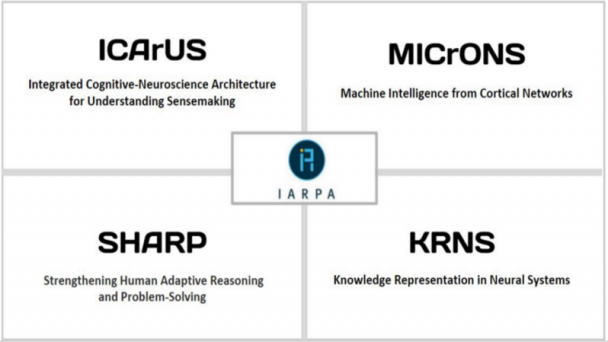
The acronyms for the four BRAIN Initiative related IARPA programs are ICArUS. MICrONS, KRNS, and SHARP.

The Intelligence Advanced Research Projects Activity (IARPA) invests in high-risk, high-payoff research programs to tackle some of the most difficult challenges of the agencies and disciplines in the Intelligence Community (IC). IARPA does not have an operational mission and does not deploy technologies directly to the field. Instead, IARPA facilitates the transition of research results to our IC customers for operational application.

Web Information

Website: www.iarpa.gov/ Neuroscience webpage: iarpa.gov/research-programs/neuroscience-programs-at-iarpa Wikipedia Entry: wiki/Intelligence_Advanced_Research_Projects_Activity


Contact Information

Email: dni-iarpa-info@iarpa.gov Phone: (301) 851-7500 Address: Office of the Director of National Intelligence Intelligence Advanced Research Projects Activity Washington, DC 20511


About IARPA

IARPA collaborates across the IC

to ensure that our research addresses relevant future needs. This cross-community focus ensures our ability to:

address cross-agency challenges leverage both operational and R&D expertise from across the IC coordinate transition strategies with our agency partners

IARPA does not have an operational mission and does not deploy technologies directly to the field. Instead, IARPA facilitates the transition of research results to our IC customers for operational application.

Our Leadership

IARPA is led by a distinguished group of accomplished scientists and researchers.

Our Organization

There are four research thrusts within IARPA embodied in four offices:

Office for Anticipating Surprise

The Office for Anticipating Surprise (OAS) focuses ...

OnAir Post: IARPA & the BRAIN Initiative

ICArUS, an IARPA program


The focus of the Integrated Cognitive- Neuroscience Architectures for Understanding Sensemaking (ICArUS)  Program is to understand and model how humans engage in the sensemaking process, both during optimal and suboptimal (biased) performance. Of particular interest are cognitive biases related to attention, memory, and decision making.

Sensemaking refers to the remarkable human ability to detect patterns in data, and to infer the underlying causes of those patterns – even when the data are sparse, noisy, and uncertain.

Web Information

IARPA Neuroscience programs pageiarpa.gov/neuroscience-programs-at-iarpa

ICArUS pagehttp://www.iarpa.gov/index.php/research-programs/icarus

Program Office pagehttp://www.iarpa.gov/index.php/about-iarpa/incisive-analysis

Contact Information

Program Manager email: rita.bush@iarpa.gov

Phone: (301) 851-7431

Address: Office of the Director of National Intelligence Intelligence Advanced Research Projects Activity Washington, District of Columbia 20511

Program Office

Office of Incisive Analysis

The Office of Incisive Analysis (IA) focuses on maximizing insights from the massive, disparate, unreliable and dynamic data that are—or could be—available to analysts, in a timely manner. We are pursuing new sources of information from existing and novel data, and we are investigating innovative techniques that can be utilized in the processes of analysis. Our programs are in diverse technical disciplines but have common features:

Involve potential transition partners at all stages, beginning with the definition of success; Create technologies that can earn the trust of the analyst user by providing the reasoning for ...

OnAir Post: ICArUS, an IARPA program

KRNS, an IARPA program


The goal of the Knowledge Representation in Neural Systems (KRNS) Program is to develop and rigorously evaluate theories that explain how the human brain represents conceptual knowledge.

In part the evaluation will rest on how well concepts can be interpreted from neural activity patterns using algorithms derived from the theories. In addition to new theories and algorithms, KRNS seeks the development of innovative protocols for evoking and measuring concept-related neural activity using neural imaging methods such as (but not limited to) fMRI, and MEG.

Web Information

IARPA Neuroscience programs pageiarpa.gov/neuroscience-programs-at-iarpa

KRNS pagehttp://www.iarpa.gov/index.php/research-programs/krns

Program Office pagehttp://www.iarpa.gov/index.php/about-iarpa/incisive-analysis

Contact Information

Program Manager email: jacob.vogelstein@iarpa.gov

Phone: 301-851-7497

Address: Office of the Director of National Intelligence Intelligence Advanced Research Projects Activity Washington, District of Columbia 20511

Program Office

Incisive Analysis

The Office of Incisive Analysis (IA) focuses on maximizing insights from the massive, disparate, unreliable and dynamic data that are—or could be—available to analysts, in a timely manner. We are pursuing new sources of information from existing and novel data, and we are investigating innovative techniques that can be utilized in the processes of analysis. Our programs are in diverse technical disciplines but have common features:

Involve potential transition partners at all stages, beginning with the definition of success; Create technologies that can earn the trust of the analyst user by ...

OnAir Post: KRNS, an IARPA program

MICrONS, an IARPA program


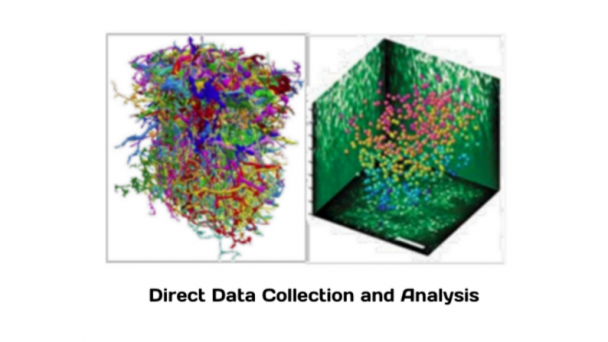
MICrONS, Machine Intelligence from Cortical Networks,seeks to revolutionize machine learning by reverse-engineering the algorithms of the brain. The program is expressly designed as a dialogue between data science and neuroscience.

Participants in the program will have the unique opportunity to pose biological questions with the greatest potential to advance theories of neural computation and obtain answers through carefully planned experimentation and data analysis.

Web Information

IARPA Neuroscience programs pageiarpa.gov/neuroscience-programs-at-iarpa

MICrONS pagehttp://www.iarpa.gov/index.php/research-programs/microns

Program Office pagehttp://www.iarpa.gov/index.php/about-iarpa/safe-and-secure-operations

Contact Information

Program Manager email: jacob.vogelstein@iarpa.gov

Phone: 301-851-7497

Address: Office of the Director of National Intelligence Intelligence Advanced Research Projects Activity Washington, District of Columbia 20511

Program Office

Office of Safe & Secure Operations

The Office of Safe and Secure Operations (SSO) focuses on the IC’s ability to operate freely and effectively in an often hostile and increasingly interdependent and resource-constrained environment. Key research focus areas for SSO include information assurance, advanced computing technologies and architectures, quantum information science and technology, and threat detection and mitigation.

Office Director

Dr. William Vanderlinde (301) 851-7508 william.vanderlinde@iarpa.gov

Program Information

Solicitation Status: Open

IARPA-BAA-14-06 Proposers’ Day Date: July 17, 2014 BAA Release Date: January 8, 2015 BAA Question Period: January 8, 2015–February 9, 2015 Proposal Due Date: March 13, 2015

Despite significant progress in machine learning over the past few years, today’s state of the art algorithms are brittle ...

OnAir Post: MICrONS, an IARPA program

SHARP, an IARPA program


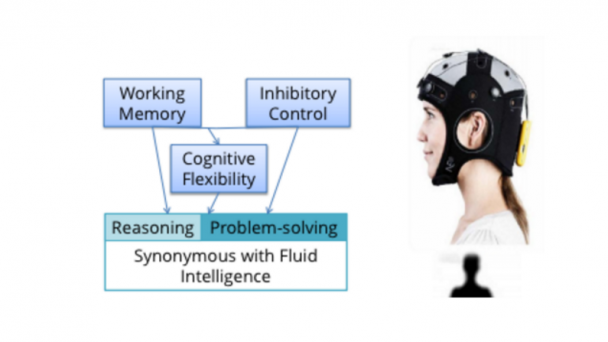
The Strengthening Human Adaptive Reasoning and Problem-Solving (SHARP) Program is seeking to fund rigorous, high-quality research to address these limitations and advance the science on optimizing human adaptive reasoning and problem-solving.

The goal of the program is to test and validate interventions that have the potential to significantly improve these capabilities, leading to improvements in performance for high-performing adults in information-rich environments.


Web Information

IARPA Neuroscience programs pageiarpa.gov/neuroscience-programs-at-iarpa

SHARP pageiarpa.gov/index.php/research-programs/sharp

Program Office pagehttp://www.iarpa.gov/index.php/about-iarpa/smart-collection


Contact Information

Program Manager email: alexis.jeannotte@iarpa.gov

Phone: 301-851-7517

Address: Office of the Director of National Intelligence Intelligence Advanced Research Projects Activity Washington, District of Columbia 20511


Program Office

Smart Collection

The Office of Smart Collection (SC) focuses on improving the value of collected data from all sources. The Office seeks to achieve this goal by, among other activities, developing new sensor and transmission technologies, new collection techniques that more precisely target desired information, and means for collecting information from previously inaccessible sources. In addition, the Office pursues new mechanisms for combining information gathered from multiple sources to enhance the quality, reliability, and utility of collected information.

Areas of interest include:

Innovative methods or tools for identifying and/or creating novel sources of new information Sensor technologies that dramatically improve the reach, sensitivity, size, weight, and power for collection of broad signal or ...

OnAir Post: SHARP, an IARPA program

Skip to toolbar