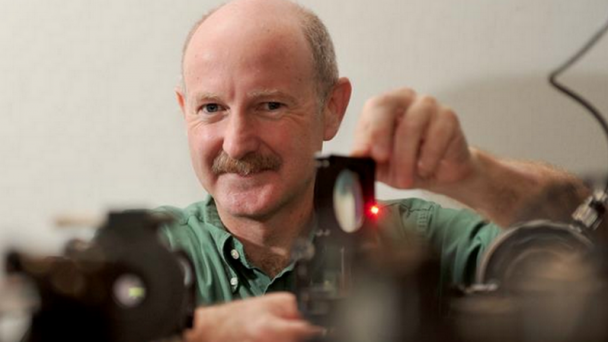
Giorgio Ascoli

Founding Editor-in-Chief, Neuroinformatics

The main effort of Dr. Ascoli's lab is to connect the cellular organization of brain networks to cognitive functions such as learning and memory. His laboratory hosts and curates a central inventory of digitally reconstructed neurons in NeuroMorpho.Org and Hippocampome knowledge  base and has developed L-Neuron, a neuron modeling  tool. His  long-term scientific and philosophical goal consists in establishing a working model for the highest cognitive functions such as human consciousness.

OnAir Post: Giorgio Ascoli

Rubén Armañanzas

Dr. Armañanzas research topics include machine learning, computational neuroscience, and neuroinformatics. In particular, applications within these topics are: knowledge discovery in digital neuronal reconstructions, automatic classification of neuronal types, complex neuromorphic networks, and unveiling key aspects of neuronal morphogenesis in the developing brain.

OnAir Post: Rubén Armañanzas

Sridevi Polavaram

Dr. Polavaram received her Ph.D. in Neuroscience from George Mason University, she has been working for over a decade in the field of Computational Neuroanatomy and Neuroinformatics providing services in software engineering, data management, analytics,  visualization, and applied ontologies. Her current area of research investigates biologically meaningful morphological patterns derived from digitally reconstructed neuronal arbors representing the cellular diversity of the nervous system.

OnAir Post: Sridevi Polavaram

Ruchi Parekh


Summary

Manager, EM Connectome Annotation Team, Janelia Farm Campus, Howard Hughes Medical Institute

Dr. Parekh’s professional background is in neuroscience, epilepsy research, and neuroinformatics with a strong publication record.

Her professional aspirations are to facilitate open science collaborative efforts towards the common goal of understanding the brain.


Information

Janelia Farm page   LinkekIn page

Email: parekhr@janelia.hhmi.org Address: 19700 Helix Drive Ashburn, Va. 201247


Biosketch

From LinkedIn page

I have a professional background in neuroscience, epilepsy research, and neuroinformatics with a strong publication record. I am a result-oriented leader and strategic thinker with a multifaceted skill set. My strength lies in interdisciplinary collaboration, communication, and management.

My professional aspirations are to facilitate open science collaborative efforts towards the common goal of understanding the brain.

Honors & Awards

OSCAR Mentoring Excellence Award Nominee George Mason University February 2014 The purpose of this award is to recognize and reward outstanding Mason community members who have mentored undergraduate students on research and creative activities and who foster a culture of student scholarship in support of Mason’s Students as Scholars initiative. Co-Principal Investigator National Academies Keck Futures Initiatives May 2013

Crowdsourcing Extraction of Knowledge From Data: Pilot Designs in Neuroscience — $100,000 The ongoing/forthcoming deluge of digital scientific data poses the “interpretation challenge” of digesting raw data into information accessible to people and machines alike. ...

OnAir Post: Ruchi Parekh

Michele Ferrante

Postdoctoral Scientist, Boston University PhD in Neuroscience from George Mason University

Michele’s research focus is on Whole-cell Electrophysiology, Biotechnology, Optogenetics, Neuropharmacology, and Computational Models.  Michele employs Electrophysiology in brain slices – patch clamp and neuropharmacology. implements biophysically realistic models of neurons.


Web Information

Research Gate webpageresearchgate.net/profile/Michele_Ferrante

LinkedIn webpage:   inkedin.com/pub/michele-ferrante/6/333/634

Twitter@mferr133

Contact Information

Email:

Phone:

Address:

Biography

Research


Publications

OnAir Post: Michele Ferrante

Rafael Yuste, MD, PhD – Columbia


Summary

Professor, Biological Sciences and Neuroscience and Co-Director, Kavli Institute for Brain Science at Columbia University Member, Multi-Council Working Group (BRAIN Initiative) Member, Advisory Committee to the Director (NIH)

Dr. Yuste has pioneered the application of imaging techniques, such as calcium imaging of neuronal circuits, two-photon imaging, photostimulation using caged compounds and holographic spatial light modulation microscopy.


Information

Columbia/Kavli Webpage: kavli.columbia.edu/leadership/yuste Lab Webpage: columbia.edu/cu/biology/faculty/yuste/ Allen Institute Webpage: alleninstitute.org/our-institute/advisors/profiles/rafael-yuste/ Twitter:  @yusterafa

Email: rafaelyuste@columbia.edu Phone: 212-854-5023 Address: 901 NWC Building 550 West 120th Street New York, NY 10027

Research

The goal of Dr. Yuste’s research is to understand the function of the cortical microcircuit. The cortex constitutes the larger part of the brain in mammals. In humans it is the primary site of mental functions like perception, memory, control of voluntary movements, imagination, language and music. No accepted unitary theory of cortical function exists yet; nevertheless, the basic cortical microcircuitry develops in stereotyped fashion, is similar in different cortical areas and in different species, and has apparently not changed much in evolution since its appearance. At the same time, the cortex participates in apparently widely different computational tasks, resembling a “Turing machine”. Because of this, it is conceivable that a “canonical” cortical microcircuit may exist and implement a relatively simple, and flexible, computation.

We pursue the reverse-engineering of the ...

OnAir Post: Rafael Yuste, MD, PhD – Columbia

Skip to toolbar