Google Hangout with Christof Koch

Hangout On Air Summary

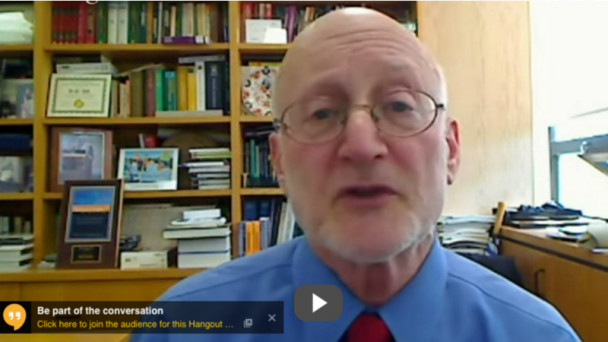
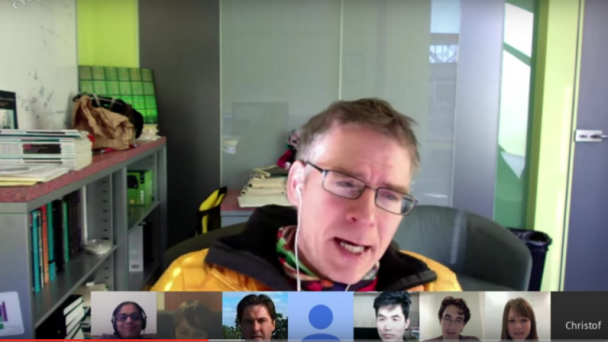
This Hangout was live streamed on Tuesday Jan. 13, 2015. Christof Koch, Chief Scientist at the Allen Institute, was the presenter. It was part of an MIT edX course on the the neuroscience of vision.

Hangout participants included Sebastian Seung, the course lead who is now at Princeton; Claire O’Connell of MIT who was the class organizer, and a number of the best students from the class around the world.


Hangout On Air

https://www.youtube.com/watch?v=qTlvf4J2tJE#t=2812Video can’t be loaded because JavaScript is disabled: 9.01.1x Discussion with Christof Koch (https://www.youtube.com/watch?v=qTlvf4J2tJE#t=2812)

Kristof (starts around minute 15) about special neurons that can identify faces and other objects Nerve cells that focus just on faces. Voxels in fMRI are at 100,000 neurons and only observe power consumption. We know very little about individual neurons in humans. Focusing on dead brains or fMRI does

At minute 50 Kristof starts talking about consciousness and the brain – look for certain behaviors associated with consciousness – look for footprint NCC (Neuronal Correlates of Consciousness)- parts of brain (not in cerebellum, or visual cortex).


Chrisof Koch

Dr.Koch is Chief Scientific Officer at the Allen Institute for ...

OnAir Post: Google Hangout with Christof Koch
The Brain or the Universe – Where Does Math Come From?

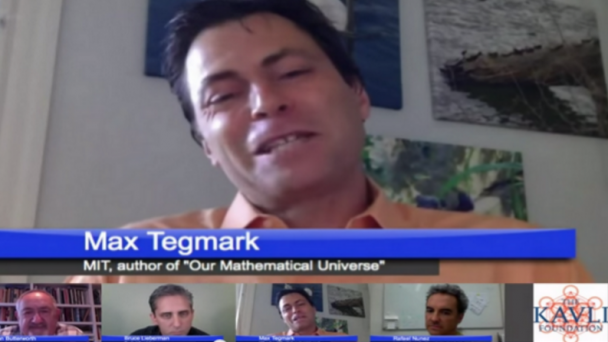
On Aug. 7th, science writer Bruce Lieberman asked your questions of three leading scientists — two neuroscientists and one astrophysicist — about math and the mind.

Join Brian Butterworth (Emeritus Professor of Cognitive Neuropsychology at the Institute of Cognitive Neuroscience at University College London), Rafael Núñez (Professor of Cognitive Science at the University of California, San Diego and member of UCSD’s Kavli Institute for Brain and Mind), and astrophysicist Max Tegmark (Professor of Physics at the Massachusetts Institute of Technology, and member of MIT’s Kavli Institute for Astrophysics and Space Research) as they discuss where math comes from.

Sections of Video

3:15 What are the primary reasons that we think the universe is inherently mathematical? 5:15 If the universe is inherently mathematical how does that effect neuroscience? 8:00 If the universe is not inherently mathematical how does that effect astrophysics? 14:05 If the universe is inherently mathematical, for something to exist does it need to belong to a set/group? 16:50 Are there aspects of the natural world that elude to their innate mathematical properties? 24:05 Does a mathematical universe suggest there was a first cause (god) of all the seen or unseen universe? 29:15 Does the universe have an innate mathematical proportionality?

OnAir Post: The Brain or the Universe – Where Does Math Come From?

NIMH Hangout on First-Episode Psychosis

https://www.youtube.com/watch?v=IJuy7E4RC6g

The National Institute of Mental Health (NIMH) hosted a Hangout during National Children’s Mental Health Awareness Week on first-episode psychosis with NIMH expert Amy Goldstein, Ph.D. and NIMH grantee and psychiatrist John Kane, M.D.

Each year, about 100,000 young people in the U.S. experience a first episode of psychosis.

NIMH grantee John Kane, M.D., Vice President for Behavioral Health Services of the North Shore – Long Island Jewish Health System and Chairman of Psychiatry at The Zucker Hillside Hospital.

Streamed live on May 5, 2015

OnAir Post: NIMH Hangout on First-Episode Psychosis

The Microbiome & the Brain – A New State of Mind


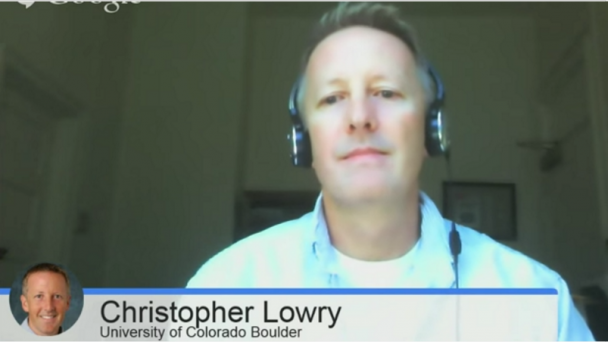
Neuroscientist Christopher Lowry discusses the emerging science, that’s connecting the microbiome – the community of microbes that inhabit the body – with brain health including whether we can treat common brain disorders through the gut.

Lindsay Borthwick is moderating the discussion.

Organized by the Kavli Foundation Jan. 15, 2015


Questions

2:40 Do we know which particular species/community are important for brain health? 5:25 Is it likely that other organisms besides bacteria are also important to the microbiome? 7:20 What prompted you to study bacteria and their interaction with our nervous system? 8:50 How did the behavior of mice change in your experiment? 10:40 How do these microbes communicate with the nervous system? 17:30 Have there been human trials to test microbiome treatments? 19:30 How far are we from treating brain disorders with probiotics? 20:45 Can the microbiome effect our brain development? 22:45 Could destruction to the microbiome cause neurological issues? 24:10 How have you changed your lifestyle throughout your research? 28:00 What kind of research is being done to study the average/optimal microbiome?

Hangout On Air

Streamed live on Jan. 15, 2015 by Kavli Foundation

Youtube page

OnAir Post: The Microbiome & the Brain – A New State of Mind

Skip to toolbar