Brain-to-brain interfaces (review)

Recent advances in brain-computer interfaces are turning the science fantasy of transmitting thoughts directly from one brain to another into reality.

Studies published in the last two years have reported direct transmission of brain activity between two animals, between two humans and even between a human and a rat.


Article in The Conversation (cc)

Brain-to-brain interfaces: the science of telepathy

The Conversation 3/8/15 by Kristyn Bates

Brain-to-brain interface is made possible because of the way brain cells communicate with each other. Cell-to-cell communication occurs via a process known as synaptic transmission, where chemical signals are passed between cells resulting in electrical spikes in the receiving cell.

Synaptic transmission forms the basis of all brain activity, including motor control, memory, perception and emotion. Because cells are connected in a network, brain activity produces a synchronised pulse of electrical activity, which is called a “brain wave”.

Brain waves change according to the cognitive processes that the brain is currently working through and are characterised by the time-frequency pattern of the up and down states (oscillations).

For example, there are brainwaves that are characteristic of the different phases of sleep, and patterns characteristic of various states of awareness and consciousness.

An example of brainwaves that appear during one of ...

OnAir Post: Brain-to-brain interfaces (review)
UW researchers improve Brain-to-brain interface

The first direct brain-to-brain interface in humans and present results from experiments involving six different subjects.

“The new study brings our brain-to-brain interfacing paradigm from an initial demonstration to something that is closer to a deliverable technology,” said co-author Andrea Stocco, a research assistant professor of psychology and a researcher at UW’s Institute for Learning & Brain Sciences. “Now we have replicated our methods and know that they can work reliably with walk-in participants.”


PLOS Article

 A Direct Brain-to-Brain Interface in Humans By Rao RPN, Stocco A, Bryan M, Sarma D, Youngquist TM, et al PLOS One Nov. 5, 2014

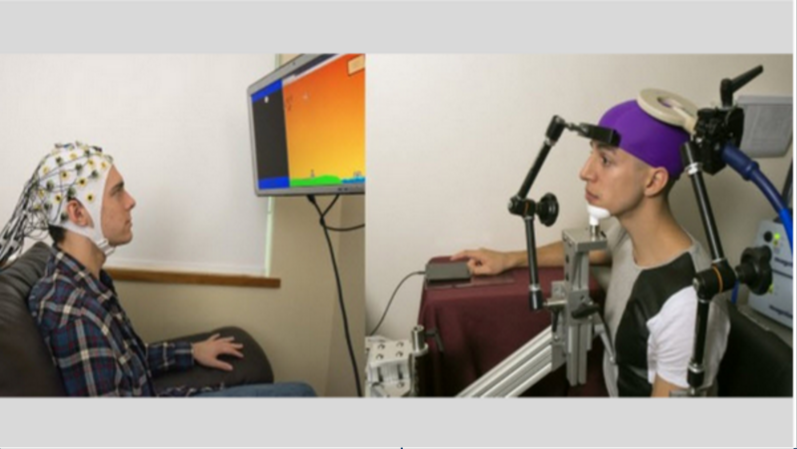
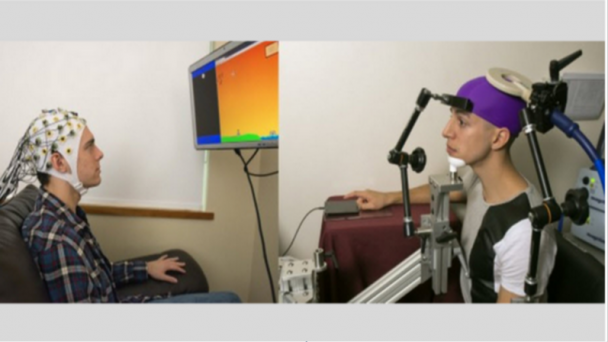
UW students are positioned in two different buildings on campus. The sender, left, thinks about firing a cannon at various points throughout a computer game. That signal is sent over the Web directly to the brain of the receiver, right, whose hand automatically hits a touchpad to fire the cannon. (Credit: Mary Levin, U of Wash.)

Abstract

We describe the first direct brain-to-brain interface in humans and present results from experiments involving six different subjects. Our non-invasive interface, demonstrated originally in August 2013, combines electroencephalography (EEG) for recording brain signals with transcranial magnetic stimulation (TMS) for delivering information to ...

OnAir Post: UW researchers improve Brain-to-brain interface

Skip to toolbar