Interdisciplinary Research

Numerous new disciplines have arisen over the past ten to twenty years based on neurosience research. One of the objectives of the Neuroscience Knowledge Network is to provide people and organizations exploring these new collaborations with Hubs that facilitate the evolution and promotion of these new fields of study and practice.

OnAir Post: Interdisciplinary Research

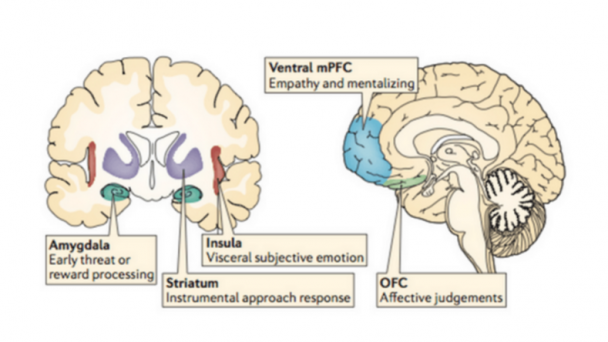
Humans are wired for prejudice but… not end of story

Neuroscience has begun to tease out the neural underpinnings of prejudice in the human brain.

We now know that prejudiced behavior is controlled through a complex neural pathway consisting of cortical and sub-cortical regions. The vast majority of brain research has focused on the amygdala and the cortical regions that influence it.


Author’s Bio

Caitlin Millett is a blogger and neuroscience graduate student at Penn State College of Medicine.

Caitlin’s thesis research delves into the role of zinc signaling in hippocampal atrophy- a hallmark of progressed depression and bipolar disorder.

Experience

PhD graduate student in Neural and Behavioral Science, Pennsylvania State University –present

Education

Simmons College, BS, 2012

More information on Millet’s The Conversation page

The Conversation 2/4/15

Humans are wired for prejudice but that doesn’t have to be the end of the story

All people have prejudices, but learning more about them could help keep them in check. Crowd image via www.shutterstock.com.

Humans are highly social creatures. Our brains have evolved to allow us to survive and thrive in complex social environments. Accordingly, the behaviors and emotions that help us navigate our social sphere are entrenched in networks ...

OnAir Post: Humans are wired for prejudice but… not end of story

Equity theory and fair inequality

Excerpt

People’s preferences for income distribution fundamentally affect their behavior and contribute to shaping important social and political institutions. The study of such preferences has become a major topic in behavioral research in social psychology and economics. There is no direct neuronal evidence of how the brain responds to income distributions when people have made different contributions in terms of work effort.

The present paper reports from, to our knowledge, the first neuroimaging study designed to examine how the brain responds to the distribution of income in such situations.

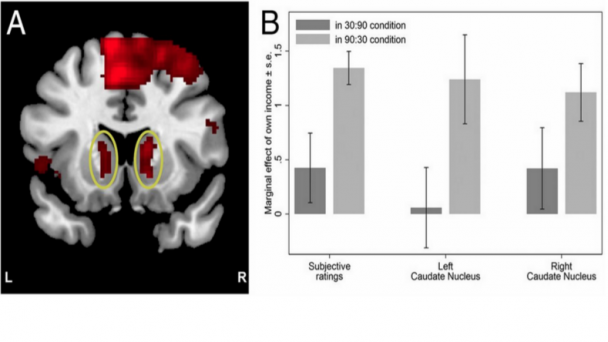
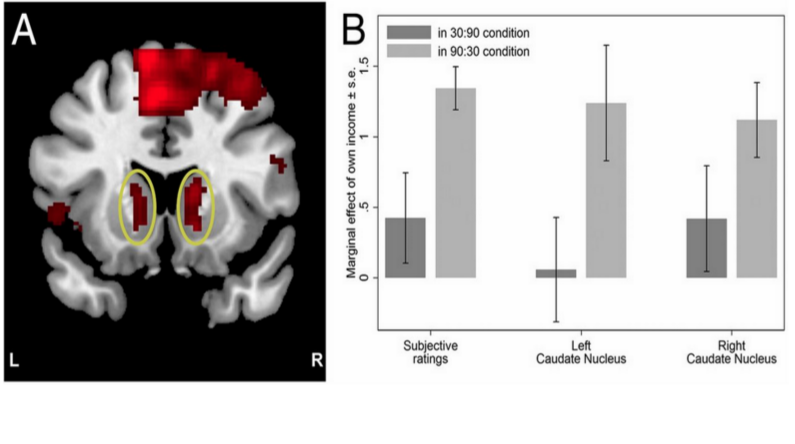
Regions of interest. A indicates the two regions in the striatum, the left and right caudate nucleus, in which experimental trials produced significantly different BOLD responses from control trials. Other displayed areas are regions that were located outside the striatum in which we also found difference between experimental and control trials that were significant at an FWE-corrected threshold of [Math Processing Error], and had at least 10 voxels per cluster. A complete list of these regions is reported and analyzed in SI Text. B reports the marginal effect of own income on the subjective rating and the BOLD response in the left and right caudate nucleus ...

OnAir Post: Equity theory and fair inequality

Stanford researchers bridge education and neuroscience

Excerpt

As methods of imaging the brain improve, neuroscientists and educators can now identify changes in children’s brains as they learn, and start to develop ways of personalizing instruction for kids who are falling behind.

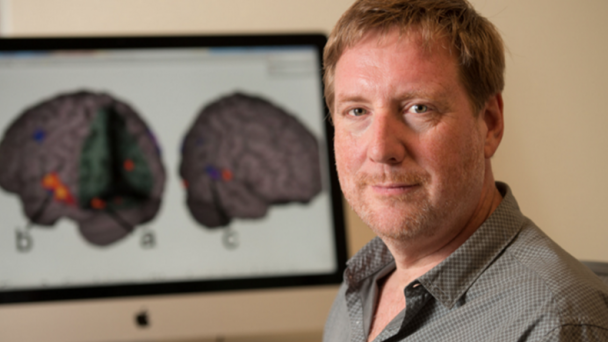
Bruce McCandliss, a professor of education leads an interdisciplinary team of Stanford scientists who are all involved in the growing field of educational neuroscience.

Education Professor Bruce McCandliss is part of an an interdisciplinary team of researchers involved in the growing field of educational neuroscience.


Press Release

Stanford researchers bridge education and neuroscience to strengthen the growing field of educational neuroscience

Education Professor Bruce McCandliss is part of an an interdisciplinary team of researchers involved in the growing field of educational neuroscience.

A child’s brain in early elementary school goes through a dramatic transformation, first developing the ability to identify letters or numbers, then learning how to interpret those symbols in written words or math. That transformation comes about due to new connections being made and strengthened in the brain.

“This reorganization is driven by activity that is happening in the classroom,” said Bruce McCandliss, a professor of education. ...

OnAir Post: Stanford researchers bridge education and neuroscience

Architects applying Neuroscience

Excerpt

Advances in brain science and brain-computer interfaces have already been adopted by architectural research; if not for scientific experimentations, then design ones.

And that research is happening thanks to the experimental frontiers only possible in academia. But aside from experimental novelty, neuroscience stands to help architects better understand not just their process, but subsequently, how the discipline is taught.

Salk Institute for Biologiical Studies Credit: Newswise.com


Events

3/6-3/7/2015-  Sculpting the Architectural Mind

DATE:  March 6 and 7, 2015  (Live Stream)

TOPIC:  Sculpting the Architectural Mind: Neuroscience and the Education of the Architect

ORGANIZERS: Dan Bucsescu,Ralph Steenblik,  Michael Arbib of ANFA

LOCATION: Higgins Hall Auditorium Pratt Institute 61 Saint James Pl, Brooklyn, NY 11238

Articles

“Sculpting the Architectural Mind” conference examines neuroscience’s effects on architecture education

A new conference hosted by the Pratt Institute’s School of Architecture, “Sculpting the Architectural Mind: Neuroscience and the Education of the Architect” moves into the question of how neuroscientific data might impact architectural pedagogy. Organized in collaboration with ANFA by architects Dan Bucsescu and Ralph Steenblik, along with Michael Arbib (a founding Board Member of ANFA), the conference has mirrored intentions: to better understand the mind of the architect through neuroscience, and to let these lessons guide pedagogical priorities. ...

OnAir Post: Architects applying Neuroscience

Positive Effects of Music on Brain & Behavior

Excerpt

Review article by Kathleen Howard, Professor of Music Therapy at Berklee College of Music. 

As a professor of music therapy, I’m preparing the next generation of music therapists to work in a variety of settings: early intervention programs, public schools, hospice and palliative care, cancer clinics, nursing homes and private practice. For many students, it’s an attractive opportunity – a chance to use their artistry to make the world a better place.

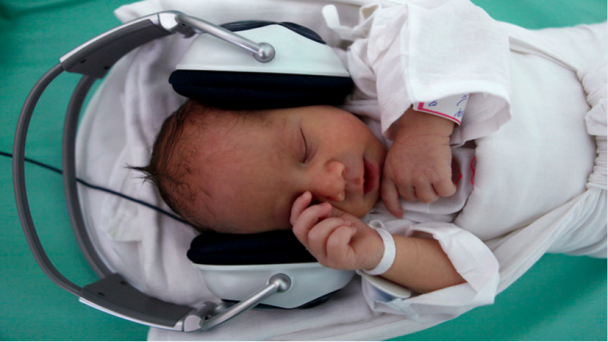
A newborn baby undergoes music therapy at a hospital in Slovakia. The hospital uses music therapy to treat infants who have been separated from their mothers. Petr Josek Snr/Reuters

Article in The Conversation (cc)

Healthy songs: the amazing power of music therapy

The Conversation 3/16/15 (cc)

When I was a child, on most Fridays, my dad, mom, brother and I would travel to Cape Cod to visit my grandparents. For my father, this drive would come after a long day of work, during which he had already commuted from our home, an hour outside of the city, to Boston, where he worked as an accountant, and back home again. He was an intense man, and during these drives to the Cape we ...

OnAir Post: Positive Effects of Music on Brain & Behavior

Skip to toolbar