Next Generation of Neuroprosthetics

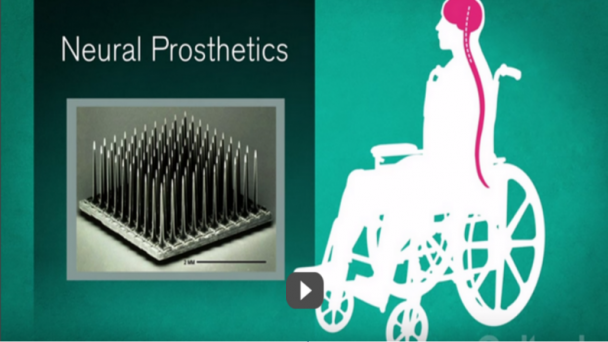
https://www.youtube.com/watch?v=F4wAvlA_Of0Video can’t be loaded because JavaScript is disabled: Next Generation of Neuroprosthetics: Science Explained – R. Andersen – May 2015 (https://www.youtube.com/watch?v=F4wAvlA_Of0)

Next Generation of Neuroprosthetics: Science Explained

Published on May 21, 2015 by caltech

Read the news story: http://www.caltech.edu/news/controlli…

Read the abstract of this research: http://resolver.caltech.edu/CaltechAU… “Decoding Motor Imagery from the Posterior Parietal Cortex of a Tetraplegic Human.” Science, 348 (6237). pp. 906-910. ISSN 0036-8075

OnAir Post: Next Generation of Neuroprosthetics

Integrating neural interfaces & machine intelligence for prosthetics

Principal Investigators: Charles Liu, PhD – USC; Kapil Katyal, PhD – JHU; Richard Andersen, PhD – Caltech Title: Integrating neural interfaces and machine intelligence for advanced neural prosthetics BRAIN Category: Neuroengineering and Brain-inspired concepts and design 

This collaborative project will decode high-level cognitive actions from neural signals recorded in the parietal cortex of a tetraplegic human, then carry out those intents using a smart robotic prosthesis. Experimental results will be used to construct BMI control algorithms optimized to decode these cognitive signals.

Abstract

Brain-machine interfaces (BMI) read signals directly from the brain to control external devices such as robotic limbs. While this technology has great potential to benefit people who are paralyzed, BMIs often have poor performance because they use noisy, low-level signals to simultaneously control many aspects of the robotic limb’s movements. In contrast, this project will address this shortcoming by reading high-level intents from the brain in order to control an intelligent robotic system. These changes reflect cutting-edge advances in neuroscience and machine intelligence and will require close cooperation between scientists, engineers, and physicians. The project aims to leverage expertise across these diverse fields in order to generate significant improvements in BMI technology to advance the national health, increase scientific understanding of the brain, and lead to dramatic ...

OnAir Post: Integrating neural interfaces & machine intelligence for prosthetics

A brain-computer interface for controlling an exoskeleton

https://www.youtube.com/watch?v=jeLghZ8GASAVideo can’t be loaded because JavaScript is disabled: A brain-computer interface for controlling an exoskeleton (https://www.youtube.com/watch?v=jeLghZ8GASA)

Scientists at Korea University and TU Berlin have developed a brain-computer interface (BCI) for a lower limb exoskeleton used for gait assistance by decoding specific signals from the user’s brain. Using an electroencephalogram (EEG) cap, the system allows users to move forward, turn left and right, sit, and stand, simply by staring at one of five flickering light emitting diodes (LEDs).

Video published on YouTube Aug. 17, 2015  by SciNews

For more information,  see this review by KurzweilAI.net

OnAir Post: A brain-computer interface for controlling an exoskeleton

Eliciting brain plasticity

https://www.youtube.com/watch?v=RQ9UJXE_a8s

“Eliciting brain plasticity to keep the body moving”

With support from the National Science Foundation’s (NSF) Emerging Frontiers of Research and Innovation (EFRI) program, bioengineer Gert Cauwenberghs, of the Jacobs School of Engineering and the Institute for Neural Computation at the University of California (UC), San Diego, and his colleagues are working to understand how brain circuitry controls how we move. The goal is to develop new technologies to help patients with Parkinson’s disease and other debilitating medical conditions navigate the world on their own.

NSF BRAIN Initiative Science Nation – March 28, 2014

Description

“Parkinson’s disease is not just about one location in the brain that’s impaired. It’s the whole body. We look at the problems in a very holistic way, combine science and clinical aspects with engineering approaches for technology,” explains Cauwenberghs. “We’re using advanced technology, but in a means that is more proactive in helping the brain to get around some of its problems–in this case, Parkinson’s disease–by working with the brain’s natural plasticity, in wiring connections between neurons in different ways.”

Outcomes of this research are contributing to the system-level understanding of human-machine interactions, and motor learning and control in real world environments for humans, and are ...
OnAir Post: Eliciting brain plasticity

Mind Reading Computer System

https://www.youtube.com/watch?v=FKu75kiqoSoVideo can’t be loaded because JavaScript is disabled: Mind Reading Computer System May Help People with Locked-in Syndrome – Science Nation (https://www.youtube.com/watch?v=FKu75kiqoSo)

“Mind Reading Computer System May Help People with Locked-in Syndrome”

Boston University neuroscientist Frank Guenther works with the National Science Foundation’s Center of Excellence for Learning in Education, Science and Technology (CELEST), which is made up of eight private and public institutions. Its purpose is to synthesize the experimental modeling and technological approaches to research in order to understand how the brain learns as a whole system.

NSF BRAIN Initiative Science Nation – October 13, 2011

Description

Imagine living a life in which you are aware of the world around you but you’re prevented from engaging in it because you are completely paralyzed. Even speaking is impossible. For an estimated 50,000 Americans this is a harsh reality. It’s called locked-in syndrome, a condition in which people with normal cognitive brain activity suffer severe paralysis, often from injuries ...

OnAir Post: Mind Reading Computer System

Mind-controlled quadcopter

https://www.youtube.com/watch?v=Vilmvv1cD_AVideo can’t be loaded because JavaScript is disabled: Mind-controlled quadcopter demonstrates new possibilities for disabled people – Science Nation (https://www.youtube.com/watch?v=Vilmvv1cD_A)

“Mind-controlled quadcopter demonstrates new possibilities for disabled people”

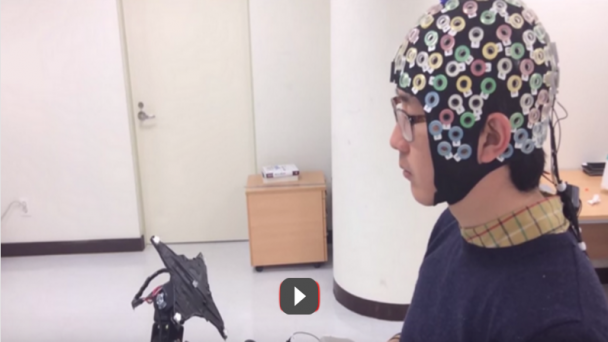
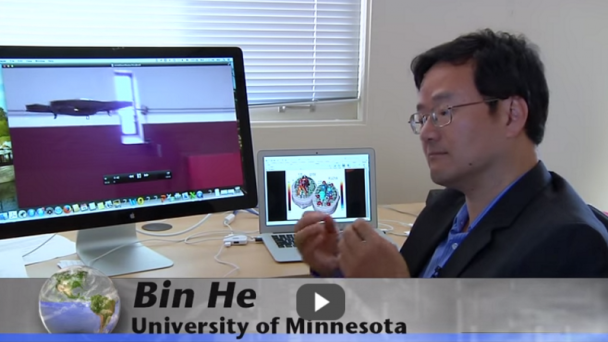
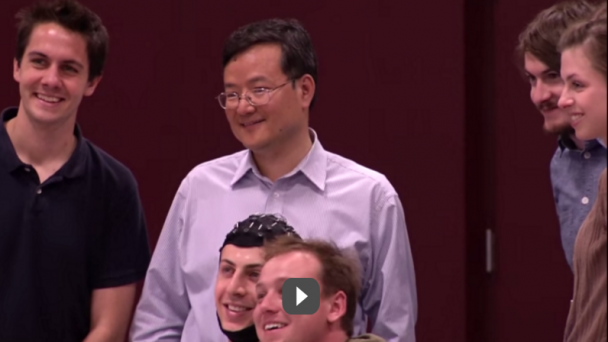
With support from the National Science Foundation (NSF), biomedical engineer Bin He and his team at the University of Minnesota have created a brain-computer interface with the goal of helping people with disabilities.  Participants wear an electro-encephalography, or EEG, cap with 64 electrodes. When the participant thinks about a specific movement, neurons in his or her brain’s motor cortex produce tiny electric signals, which are sent to a computer. The computer processes the signals and sends directions through a Wi-Fi system to direct the quadcopter.

NSF BRAIN Initiative Science Nation – April 2, 2014

Description

Meet the mind-controlled quadcopter. With support from the National Science Foundation (NSF), biomedical engineer Bin He and his team at the University of Minnesota have created a brain-computer interface with the goal of helping people with disabilities, such as paralysis, regain the ability ...

OnAir Post: Mind-controlled quadcopter

Advances in mind-controlled machines

https://www.youtube.com/watch?v=TjKi0hWFIpUVideo can’t be loaded because JavaScript is disabled: Advances in mind-controlled machines (https://www.youtube.com/watch?v=TjKi0hWFIpU)

Mind-controlled machines have the potential to help people with limited physical control. NSF grantee and biomedical engineer Bin He talks about advances in brain-machine interface technology and the big challenges in brain research.

For more information on Bin He, see his BRAIN 2015 profile.

OnAir Post: Advances in mind-controlled machines

Mind Over Mechanics

https://www.youtube.com/watch?v=6LWz4qa2XQA&feature=youtu.be

In a jaw-dropping feat of engineering, electronics turn a person’s thoughts into commands for a robot. Using a brain-computer interface technology pioneered by University of Minnesota biomedical engineering professor Bin He, several young people have learned to use their thoughts to steer a flying robot around a gym, making it turn, rise, dip, and even sail through a ring.

The technology may someday allow people robbed of speech and mobility by neurodegenerative diseases to regain function by controlling artificial limbs, wheelchairs, or other devices. And it’s completely noninvasive: Brain waves (EEG) are picked up by the electrodes of an EEG cap on the scalp, not a chip implanted in the brain.

A report on the technology has been published in the Journal of Neural Engineering.

For more information on Bin He, see his BRAIN 2015 profile.

Published on June 4, 2013 by University of Minnesota

OnAir Post: Mind Over Mechanics

Kendall Lee: Deep Brain Stimulation Research


https://www.youtube.com/watch?v=5HR_Szjhrg8Video can’t be loaded because JavaScript is disabled: Deep Brain Stimulation Research (DBS) – Mayo Clinic (https://www.youtube.com/watch?v=5HR_Szjhrg8)

Kendall Lee, M.D., Mayo Clinic neurosurgeon, describes research into deep brain stimulation being conducted at Mayo Clinic, including the WINCS device that enable precise measurements of the effects of brain stimulation.

Video published on Mar. 18, 2010 by Mayo Clinic


Profile

Professor of Neurosurgery and Physiology, Mayo Clinic

The research interests of Kendall H. Lee, M.D., Ph.D., are to develop deep brain stimulation (DBS) for the treatment of Parkinson’s disease, tremor, depression, obsessive-compulsive disorder and epilepsy. Dr. Lee is fascinated with the possibility of combining sophisticated electrophysiological recordings with miniaturized analytical elements (microprocessors) to augment or repair disrupted function of the brain.

OnAir Post: Kendall Lee: Deep Brain Stimulation Research

Brain Waves: Recording from 12 neurons at once

https://www.youtube.com/watch?v=ILgONEL1Jz0Video can’t be loaded because JavaScript is disabled: Brain Waves: Recording from 12 neurons at once (https://www.youtube.com/watch?v=ILgONEL1Jz0)

The art and science of measuring the electrical activity of many individual neurons at the same time

Published on March 24, 2015  by Allen Institute for Brain Science

OnAir Post: Brain Waves: Recording from 12 neurons at once

Lloyd Watts: 2013 Allen Symposium


https://www.youtube.com/watch?v=U5-YeSZwFREVideo can’t be loaded because JavaScript is disabled: Lloyd Watts: 2013 Annual Symposium (https://www.youtube.com/watch?v=U5-YeSZwFRE)

Commercializing auditory neuroscience

Dr. Donald “Lloyd” Watts has worked as an engineer at Microtel Pacific Research, Synaptics and Arithmos. In 1997, he joined Paul Allen’s Interval Research Corporation and continued his research in reverse-engineering the human auditory pathway. In 2000, he founded Audience, Inc., to commercialize his research, with investment from Paul Allen, Carver Mead and Allan Crawford. He served as Chairman and Chief Executive Officer from 2000-2005, leading the development of the company’s core technologies. In 2005, he transitioned to the role of Audience’s Chief Technology Officer. In 2011, he became Chief Scientist. In 2013, he retired from Audience.


Published on October 3, 2013 by Allen Institute for Brain Science

OnAir Post: Lloyd Watts: 2013 Allen Symposium

John Donoghue: 2012 Allen Symposium

“Neurotechnology: Fixing broken brains by decoding cortex”

Dr. Donoghue’s lab works in both basic and applied neuroscience, studying network computation on one end, and restoring lost motor cortical function on the other end. His work has culminated in BrainGate, a human brain-computer interface that senses neural activity in the motor cortex and decodes it to instruct a robotic arm or a cursor, reconnecting the cortex to lost action in the case of spinal cord injury or paralyzing disease such as amyotrophic lateral sclerosis. Donoghue showed video clips from his lab featuring long-paralyzed patients successfully navigating a robotic arm to drink their favorite beverage or guiding a computer cursor to communicate with loved ones. Among other noteworthy aspects of this work are the two notions that 1) the program actually decodes activity in the motor cortex rather than using a binary measure of activity (e.g., on or off) and 2) individual neurons in the motor cortex retain activity and function, even in quadriplegics who have not used this area of the brain in over a dozen years. While the functional utility of this work is self-evident, the value and applications to basic neuroscience are no less important. In going from a plan ...

OnAir Post: John Donoghue: 2012 Allen Symposium

Viviana Gradinaru


https://www.youtube.com/watch?v=NJJnmSlTjIgVideo can’t be loaded because JavaScript is disabled: Viviana Gradinaru: 2013 Annual Symposium (https://www.youtube.com/watch?v=NJJnmSlTjIg)

“Neuromodulation and neurodegeneration: Insights from optogenetics.”

Dr. Viviana Gradinaru is Assistant Professor at the Califiornia Institute of Technology (Caltech). She discovered her passion for neuroscience at Caltech, her alma mater, where she was accepted as a transfer student from University of Physics, Romania, with a full scholarship. Dr. Gradinaru did her Ph.D. work with Karl Deisseroth at Stanford University and she played an instrumental role in the early development and applications of optogenetics, a research area concerned with the perturbation of neuronal activity via light-controlled ion channels and pumps.

Published on October 3, 2013  by Allen Institute for Brain Science

OnAir Post: Viviana Gradinaru

A light switch for neurons

https://www.youtube.com/watch?v=hupHAPF1fHYVideo can’t be loaded because JavaScript is disabled: Ed Boyden: A light switch for neurons (https://www.youtube.com/watch?v=hupHAPF1fHY)

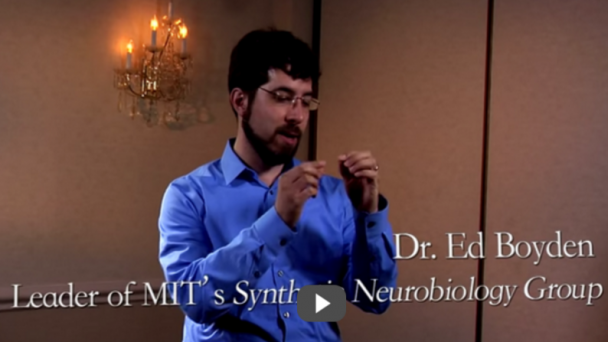
Ed Boyden shows how, by inserting genes for light-sensitive proteins into brain cells, he can selectively activate or de-activate specific neurons with fiber-optic implants. With this unprecedented level of control, he’s managed to cure mice of analogs of PTSD and certain forms of blindness. On the horizon: neural prosthetics.

Filmed March 2011 at TED 2011 Uploaded to YouTube on May 17, 2011 by TED  

OnAir Post: A light switch for neurons

A look inside the brain in real time

The applications for real-time fMRIs start with chronic pain control and range into the realm of science fiction, but this technology is very real.

Filmed February 2008 at TED 2008
Uploaded to YouTube on March 27, 2008 by TED

TED Talks webpage

OnAir Post: A look inside the brain in real time

Turning off Parkinson’s and depression

https://www.youtube.com/watch?v=9wiHfHOPbyEVideo can’t be loaded because JavaScript is disabled: Parkinson’s, depression and the switch that might turn them off – Andres Lozano (https://www.youtube.com/watch?v=9wiHfHOPbyE)

Deep brain stimulation is becoming very precise. This technique allows surgeons to place electrodes in almost any area of the brain, and turn them up or down — like a radio dial or thermostat — to correct dysfunction. Andres Lozano offers a dramatic look at emerging techniques, in which a woman with Parkinson’s instantly stops shaking and brain areas eroded by Alzheimer’s are brought back to life.

Filmed January 2013 at TEDs Caltech 2013 Uploaded to YouTube on June 12,, 2013 by TED 

OnAir Post: Turning off Parkinson’s and depression

A mouse. A laser beam. A manipulated memory.

https://www.youtube.com/watch?v=EXo3qA9V3eIVideo can’t be loaded because JavaScript is disabled: Steve Ramirez and Xu Liu: A mouse. A laser beam. A manipulated memory. (https://www.youtube.com/watch?v=EXo3qA9V3eI)

“Can we edit the content of our memories? It’s a sci-fi-tinged question that Steve Ramirez and Xu Liu are asking in their lab at MIT. Essentially, the pair shoot a laser beam into the brain of a living mouse to activate and manipulate its memory. In this unexpectedly amusing talk they share not only how, but — more importantly — why they do this.”

Filmed June 2013 at TEDx Boston 2013 Uploaded to YouTube on August 15,, 2013 by TED 

OnAir Post: A mouse. A laser beam. A manipulated memory.

A neural portrait of the human mind

https://www.youtube.com/watch?v=5Yj3nGv0kn8Video can’t be loaded because JavaScript is disabled: Nancy Kanwisher: A neural portrait of the human mind (https://www.youtube.com/watch?v=5Yj3nGv0kn8)

“Brain imaging pioneer Nancy Kanwisher, who uses fMRI scans to see activity in brain regions (often her own), shares what she and her colleagues have learned: The brain is made up of both highly specialized components and general-purpose “machinery.” Another surprise: There’s so much left to learn.”

Filmed March 2014 at TED 2014 Uploaded to YouTube on October 2, 2014 by TED 

OnAir Post: A neural portrait of the human mind

The paralyzed rat that walked

https://www.youtube.com/watch?v=X9FFzWUInyAVideo can’t be loaded because JavaScript is disabled: Grégoire Courtine: The paralyzed rat that walked (https://www.youtube.com/watch?v=X9FFzWUInyA)

“A spinal cord injury can sever the communication between your brain and your body, leading to paralysis. Fresh from his lab, Grégoire Courtine shows a new method — combining drugs, electrical stimulation and a robot — that could re-awaken the neural pathways and help the body learn again to move on its own. See how it works, as a paralyzed rat becomes able to run and navigate stairs.”

Filmed June 2013 at TED Global 2013 Uploaded to YouTube on November 6, 2013 by TED 

OnAir Post: The paralyzed rat that walked

How to control someone else’s arm with your brain

https://www.youtube.com/watch?v=rSQNi5sAwucVideo can’t be loaded because JavaScript is disabled: How to control someone else’s arm with your brain | Greg Gage (https://www.youtube.com/watch?v=rSQNi5sAwuc)

“Greg Gage is on a mission to make brain science accessible to all. In this fun, kind of creepy demo, the neuroscientist and TED Senior Fellow uses a simple, inexpensive DIY kit to take away the free will of an audience member. It’s not a parlor trick; it actually works. You have to see it to believe it.”

Filmed March 2015 at TED 2015 Uploaded to YouTube on April 28, 2015 by TED 

OnAir Post: How to control someone else’s arm with your brain

Can the damaged brain repair itself?

‘After a traumatic brain injury, it sometimes happens that the brain can repair itself, building new brain cells to replace damaged ones. But the repair doesn’t happen quickly enough to allow recovery from degenerative conditions like motor neuron disease (also known as Lou Gehrig’s disease or ALS). Siddharthan Chandran walks through some new techniques using special stem cells that could allow the damaged brain to rebuild faster.”

Filmed March 2014 at TED 2014 Uploaded to YouTube on February 24, 2014 by TED 

OnAir Post: Can the damaged brain repair itself?

Your brain is more than a bag of chemicals


https://www.youtube.com/watch?v=D9xJl4S6NsMVideo can’t be loaded because JavaScript is disabled: David Anderson: Your brain is more than a bag of chemicals (https://www.youtube.com/watch?v=D9xJl4S6NsM)

“Modern psychiatric drugs treat the chemistry of the whole brain, but neurobiologist David Anderson believes in a more nuanced view of how the brain functions. He illuminates new research that could lead to targeted psychiatric medications — that work better and avoid side effects. How’s he doing it? For a start, by making a bunch of fruit flies angry”.

Filmed January 2013 at TEDx Caltech 2013 Uploaded to YouTube on March 12, 2013 by TED

TED Talks webpage

OnAir Post: Your brain is more than a bag of chemicals

Could future devices read images from our brains?

“As an expert on cutting-edge digital displays, Mary Lou Jepsen studies how to show our most creative ideas on screens. And as a brain surgery patient herself, she is driven to know more about the neural activity that underlies invention, creativity, thought. She meshes these two passions in a rather mind-blowing talk on two cutting-edge brain studies that might point to a new frontier in understanding how (and what) we think.”

Filmed March 2013 at TED 2013 Uploaded to YouTube on March 3, 2013 by TED 

TED Talks webpage

https://www.youtube.com/watch?v=vNDhu2uqfdoVideo can’t be loaded because JavaScript is disabled: Mary Lou Jepsen: Could future devices read images from our brains? (https://www.youtube.com/watch?v=vNDhu2uqfdo)

OnAir Post: Could future devices read images from our brains?

Monkey controls a robot with its thoughts

https://www.youtube.com/watch?v=CR_LBcZg_84Video can’t be loaded because JavaScript is disabled: Miguel Nicolelis: A monkey that controls a robot with its thoughts. No, really. (https://www.youtube.com/watch?v=CR_LBcZg_84)

“Can we use our brains to directly control machines — without requiring a body as the middleman? Miguel Nicolelis talks through an astonishing experiment, in which a clever monkey in the US learns to control a monkey avatar, and then a robot arm in Japan, purely with its thoughts. The research has big implications for quadraplegic people — and maybe for all of us.”

Filmed April 2012 at TEDMED 2012 Uploaded to YouTube on February 18, 2013 by TED  

TED Talks webpage

OnAir Post: Monkey controls a robot with its thoughts

Optogenetics research changes brain research

https://www.youtube.com/watch?v=_bZHG-wo6_IVideo can’t be loaded because JavaScript is disabled: Optogenetics research changes brain research (https://www.youtube.com/watch?v=_bZHG-wo6_I)

How two unlikely microbes (that don’t even have brains) led to the development of one of today’s most promising brain research techniques–which is being used to study many diseases including schizophrenia and Parkinson’s.

For more information about the BRAIN Initiative visit: nsf.gov/brain

NSF BRAIN Initiative Published APRIL 18, 2014

OnAir Post: Optogenetics research changes brain research

Optogenetics pioneer observes neuron behavior with light

https://www.youtube.com/watch?v=dr_sSYSHxVsVideo can’t be loaded because JavaScript is disabled: Optogenetics pioneer Ed Boyden observes neuron behavior with light (https://www.youtube.com/watch?v=dr_sSYSHxVs)

Optogenetics is a revolutionary field that allows scientists to selectively turn targeted neurons in animal brains on and off. Ed Boyden, of MIT, is one of the pioneering optogenetics research that may help us understand and treat brain disorders.

For more information about the BRAIN Initiative visit: nsf.gov/brain

NSF BRAIN Initiative Published APRIL 2, 2014

OnAir Post: Optogenetics pioneer observes neuron behavior with light

Brain-Computer Interface: Mysteries of the Brain

https://www.youtube.com/watch?v=7t84lGE5TXAVideo can’t be loaded because JavaScript is disabled: Brain-Computer Interface | Mysteries of the Brain (https://www.youtube.com/watch?v=7t84lGE5TXA)

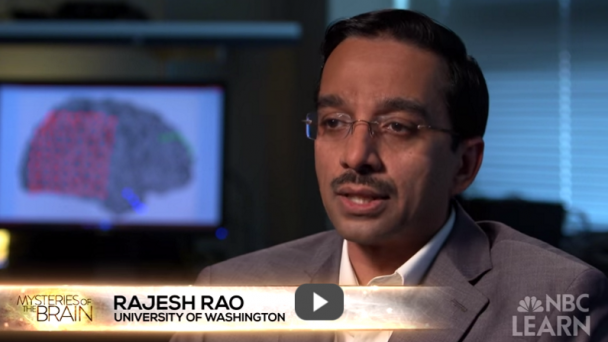
“Neuroengineer Rajesh Rao of the University of Washington is developing brain-computer interfaces, devices that can monitor and extract brain activity to enable a machine or computer to accomplish tasks, from playing video games to controlling a prosthetic arm.

“Mysteries of the Brain” is produced by NBC Learn in partnership with the NSF.”

NSF BRAIN Initiative Published June 17, 2015


OnAir Post: Brain-Computer Interface: Mysteries of the Brain

NIH Neuroscience Seminar- June 15, 2015

TITLE: Photo-control of endogenous ion channels and neurotransmitter receptors in the CNS

AUTHOR: Richard Kramer, Ph.D., University of California, Berkeley

TIME: 12:00:00 PM  DATE: Monday, June 15, 2015

PLACE: Porter Neuroscience Research Center

 Live NIH Videocast (archived after seminar)


Abstract

Remote control of neural activity with “light-activated” ion channels To overcome the loss of retinal photoreceptors in diseases such as retinitis pigmentosa and macular degeneration, scientists are attempting to develop electrical prosthetic devices, in which an implantable array of electrodes is used to stimulate remaining healthy neurons downstream in the visual pathway. We are taking a different approach, which involves direct optical regulation of the electrical activity of neurons without using invasive implantable devices. We have engineered the first ion channel that is directly activated with light. This channels consists of a genetically engineered ion channel protein that is covalently attached to a specially designed light-sensitive molecule, which includes a blocker of the channel’s pore. Photoisomerization of the light-sensitive molecule extends or retracts the blocker, opening or closing the flow of ions through the pore. Different wavelengths of light switch the molecule back and forth between blocking and unblocking states, so both channel opening and closing are controllable with light. Expression of these channels ...

OnAir Post: NIH Neuroscience Seminar- June 15, 2015

NIH Neuroscience Seminar- June 1, 2015

TITLE: Rethinking Depression and its Treatment: Perspectives from Studies of Deep Brain Stimulation

AUTHOR: Helen Mayberg, M.D., Emory University

TIME: 12:00:00 PM  DATE: Monday, June 1, 2015

PLACE: Porter Neuroscience Research Center

 Live NIH Videocast (archived after seminar)


Profile

Professor, Psychiatry, Neurology, and Radiology Dorothy C. Fuqua Chair Psychiatric Neuroimaging and Therapeutics Emory University School of Medicine

Dr. Mayberg leads a multidisciplinary research program studying brain mechanisms mediating depression pathogenesis and antidepressant treatment response using neuroimaging and pioneered the development of deep brain stimulation for treatment resistant depression.

Web Information

Webpage:  psychiatry.emory.edu/faculty/mayberg_helen Game Changers page: med.emory.edu/gamechangers/researchers/mayberg/bio

Contact Information

Email: hmayber@emory.edu Phone: 404-727-6740 Address:

Related Research

Current projects emphasize development of novel imaging biomarkers predictive of treatment response and optimal treatment selection for individual depressed patients at all stages of illness. Predictive biomarker studies are complemented by clinical testing, surgical refinement and multimodal mechanism studies of deep brain stimulation for treatment resistant patients.

Videos

https://www.youtube.com/watch?v=x1XI4LfSt7Q

https://www.youtube.com/watch?v=1MkVk0HnG5AVideo can’t be loaded because JavaScript is disabled: Deep Brain Stimulation & Depression: A Decade of Progress with Helen S. Mayberg, ...

OnAir Post: NIH Neuroscience Seminar- June 1, 2015

Skip to toolbar