Equity theory and fair inequality

ix
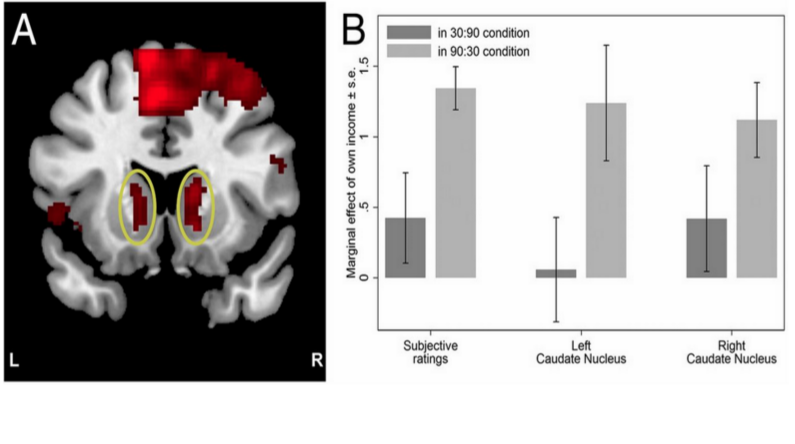
Regions of interest. A indicates the two regions in the striatum, the left and right caudate nucleus, in which experimental trials produced significantly different BOLD responses from control trials. Other displayed areas are regions that were located outside the striatum in which we also found difference between experimental and control trials that were significant at an FWE-corrected threshold of [Math Processing Error], and had at least 10 voxels per cluster. A complete list of these regions is reported and analyzed in SI Text. B reports the marginal effect of own income on the subjective rating and the BOLD response in the left and right caudate nucleus for participants in the 30:90 condition and the 90:30 condition in the interval between 250 and 750 NOK

Summary

People’s preferences for income distribution fundamentally affect their behavior and contribute to shaping important social and political institutions. The study of such preferences has become a major topic in behavioral research in social psychology and economics. There is no direct neuronal evidence of how the brain responds to income distributions when people have made different contributions in terms of work effort.

The present paper reports from, to our knowledge, the first neuroimaging study designed to examine how the brain responds to the distribution of income in such situations.

OnAir Post: Equity theory and fair inequality

Discuss

OnAir membership is required. The lead Moderator for the discussions is Scott Joy. We encourage civil, honest, and safe discourse. For more information on commenting and giving feedback, see our Comment Guidelines.

    Skip to toolbar