Systems neuroscience: From the human brain to the global brain?

ix
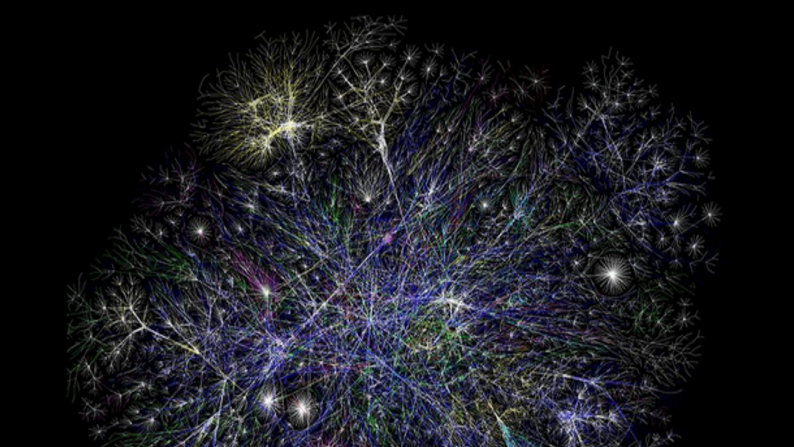
Computer-generated image of internet connections world-wide (Global Brain). The conceptual similarities with the human brain are remarkable. Both networks exhibit a scale-free, fractal distribution, with some weakly-connected units, and some strongly-connected ones which are arranged in hubs of increasing functional complexity. This helps protect the constituents of the network against stresses. Both networks are ‘small worlds’ which means that information can reach any given unit within the network by passing through only a small number of other units. This assists in the global propagation of information within the network, and gives each and every unit the functional potential to be directly connected to all others. Source: The Opte Project / Barrett Lyon. CC-BY

Summary

Kyriazis suggests ways to enhance our strength of presence within this global intelligent network, and discuss how this may be relevant in changing our evolution as humans.

Building and expanding on existing neuroscience research on brain-to-brain communication, Marios Kyriazis argues that the realization of the Global Brain (GB), the worldwide distributed and self-organized intelligence both depends on, and influences, its individual components, i.e. the individual human brains.


OnAir Post: Systems neuroscience: From the human brain to the global brain?

Discuss

OnAir membership is required. The lead Moderator for the discussions is Scott Joy. We encourage civil, honest, and safe discourse. For more information on commenting and giving feedback, see our Comment Guidelines.

    Skip to toolbar